
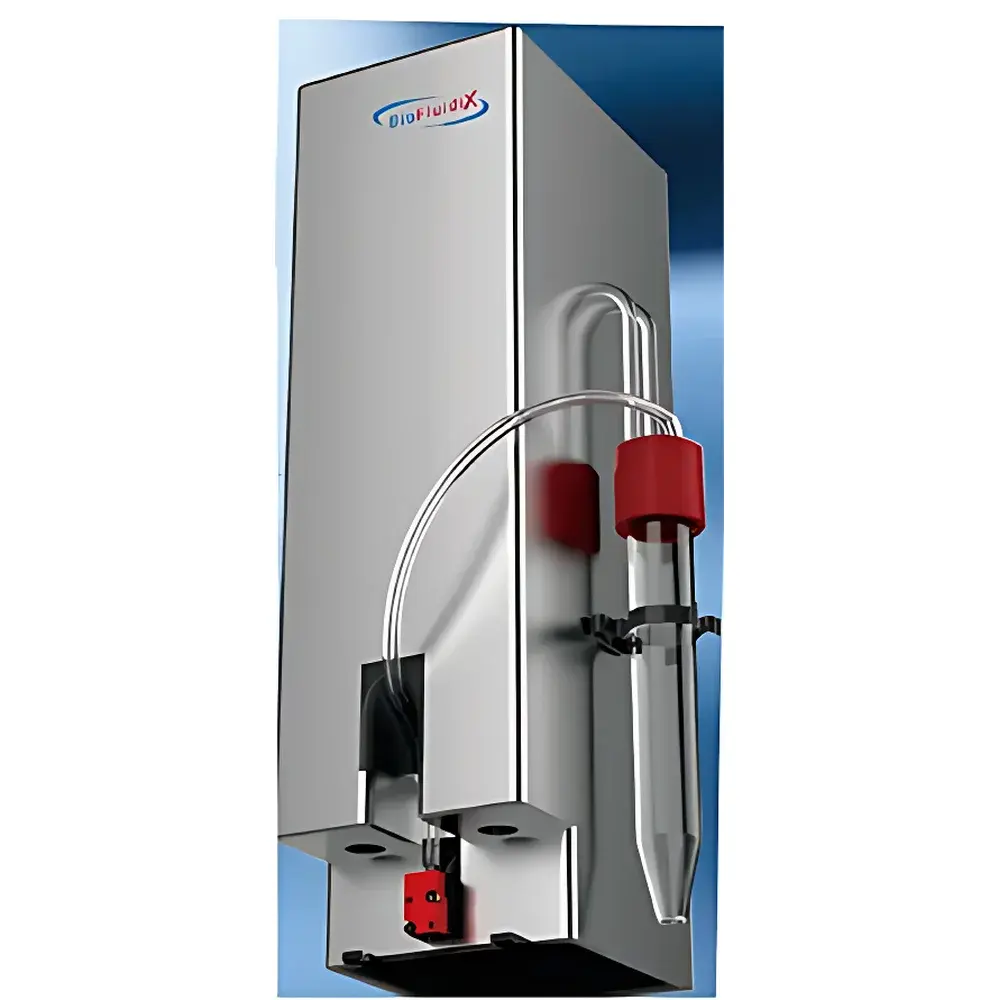
BioFluidix AllDrop nl-Level Non-Contact Dispensing Workstation
| Brand | BioFluidix |
|---|---|
| Origin | Germany |
| Model | AllDrop |
| Instrument Type | Microarray Chip System |
| Sample Types | Nucleic Acids, Proteins, Carbohydrates |
| Dispensing Range | 1–70 nL |
| Liquid Reservoir Capacity | 15 mL |
| Precision (CV) | <1–3% |
| Compliance | Designed for GMP-Compliant Environments |
Overview
The BioFluidix AllDrop nl-Level Non-Contact Dispensing Workstation is an engineered solution for high-fidelity, contact-free liquid handling in microarray fabrication, assay development, and miniaturized biological screening. Based on piezoelectric-driven droplet-on-demand (DOD) technology, the system generates discrete nanoliter-scale droplets without physical tip contact—eliminating cross-contamination, carryover, and surface wetting artifacts. Its core architecture integrates real-time optical monitoring with closed-loop feedback control to ensure reproducible volumetric delivery across diverse fluid classes, including viscous biomolecules, volatile solvents, and particulate-laden suspensions. Designed specifically for integration into automated lab environments or standalone operation, the AllDrop meets the stringent spatial and volumetric requirements of next-generation biochip manufacturing, where spot uniformity, positional accuracy (<±25 µm), and inter-spot coefficient of variation (CV) <3% are critical for downstream hybridization, enzymatic reaction, or imaging readout.
Key Features
- Piezoelectric non-contact dispensing with programmable pulse shaping for optimal droplet formation across fluid viscosities (0.8–25 cP) and surface tensions (20–40 mN/m)
- True nl-range precision: stable delivery from 1 nL to 70 nL per dispense, with volume resolution adjustable in 0.1 nL increments
- Integrated 15 mL sterile-compatible reservoir module with pressure-regulated fluid supply and bubble detection circuitry
- SmartDrop calibration suite: high-speed CMOS camera (1000 fps) captures droplet trajectory, size, and velocity; auto-calculates effective volume using calibrated pixel-to-micron mapping and dynamic meniscus modeling
- Manual volume override mode with iterative optimization algorithm—users input target volume and system refines waveform parameters over successive test dispenses
- Full ejection audit trail: timestamped image log, pressure waveform data, and environmental metadata (temperature, humidity) stored per dispense event
- GMP-aligned firmware architecture supporting user access levels, electronic signatures, and 21 CFR Part 11-compliant audit logging
Sample Compatibility & Compliance
The AllDrop accommodates a broad spectrum of life science and materials science reagents without nozzle clogging or performance degradation. Validated compatibility includes aqueous nucleic acid solutions (DNA/RNA ≤ 100 ng/µL), protein formulations (IgG, enzymes, lysates), glycoprotein mixtures, DMSO-based compound libraries (up to 100% DMSO), ethanol/methanol solvents, UV-curable acrylate inks, photoresists (SU-8, AZ series), low-viscosity adhesives, mineral oils, and monodisperse bead suspensions (1–10 µm diameter). Living cell suspensions (e.g., mammalian, yeast, bacteria) have been successfully dispensed with >95% post-dispense viability under optimized waveform and substrate humidity conditions. The system conforms to ISO 13485 design controls and supports GLP/GMP documentation workflows—including instrument qualification (IQ/OQ/PQ), calibration certificate traceability to NIST standards, and raw data export in HDF5 format for regulatory submission.
Software & Data Management
Controlled via AllDrop Control Suite v4.x (Windows 10/11), the software provides intuitive graphical programming for pattern-based dispensing (grids, circles, freehand paths), multi-channel synchronization, and conditional logic (e.g., “if pressure drift >5% → pause & recalibrate”). All acquisition and calibration data are stored in ACID-compliant SQLite databases with SHA-256 hash integrity verification. Export options include CSV (for statistical process control), TIFF stacks (for droplet morphology analysis), and XML-based protocol files compatible with third-party LIMS and ELN systems (e.g., LabVantage, Benchling). Audit logs retain full provenance: operator ID, session start/end time, firmware version, calibration history, and all parameter modifications—with immutable timestamps signed by onboard hardware security module (HSM).
Applications
- High-density DNA/protein microarray printing for diagnostics and biomarker discovery
- On-chip reagent pre-spotting in digital ELISA and single-cell proteomics platforms
- Deposition of photopolymerizable resins in microfluidic device prototyping
- Patterned delivery of CRISPR RNP complexes for spatially resolved genome editing assays
- Serial dilution series generation directly onto 384-/1536-well plates for HTS assay miniaturization
- Functionalization of biosensor surfaces with controlled ligand density gradients
- Micro-dosing of live cells into microwell arrays for organoid initiation and co-culture studies
FAQ
What fluid properties require adjustment before dispensing?
Viscosity, surface tension, and volatility must be entered into the fluid profile database; the system then selects appropriate waveform amplitude, duration, and hold time. Temperature-controlled stage (optional) is recommended for fluids with strong thermal expansion coefficients.
Can the AllDrop interface with third-party robotic arms or plate handlers?
Yes—via standard TCP/IP API and RS-232 serial commands; SDK includes Python and C# wrappers with full command reference and error-code mapping.
Is routine maintenance required beyond nozzle cleaning?
No consumables are used during normal operation; periodic validation (weekly) using certified dye standards and droplet imaging is recommended to maintain GMP traceability.
How is calibration traceability documented?
Each SmartDrop calibration generates a PDF certificate listing camera calibration matrix, reference droplet measurements, uncertainty budget (k=2), and NIST-traceable gravimetric validation report (available upon request).




