
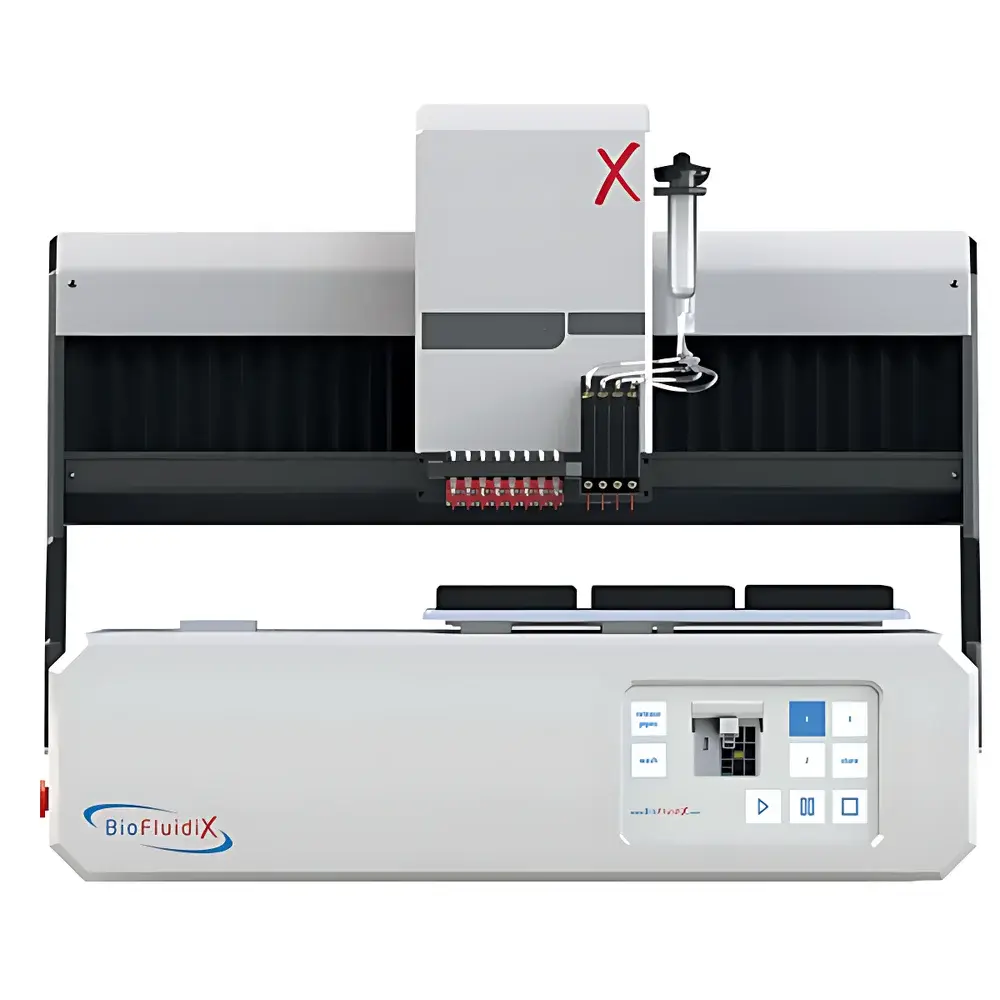
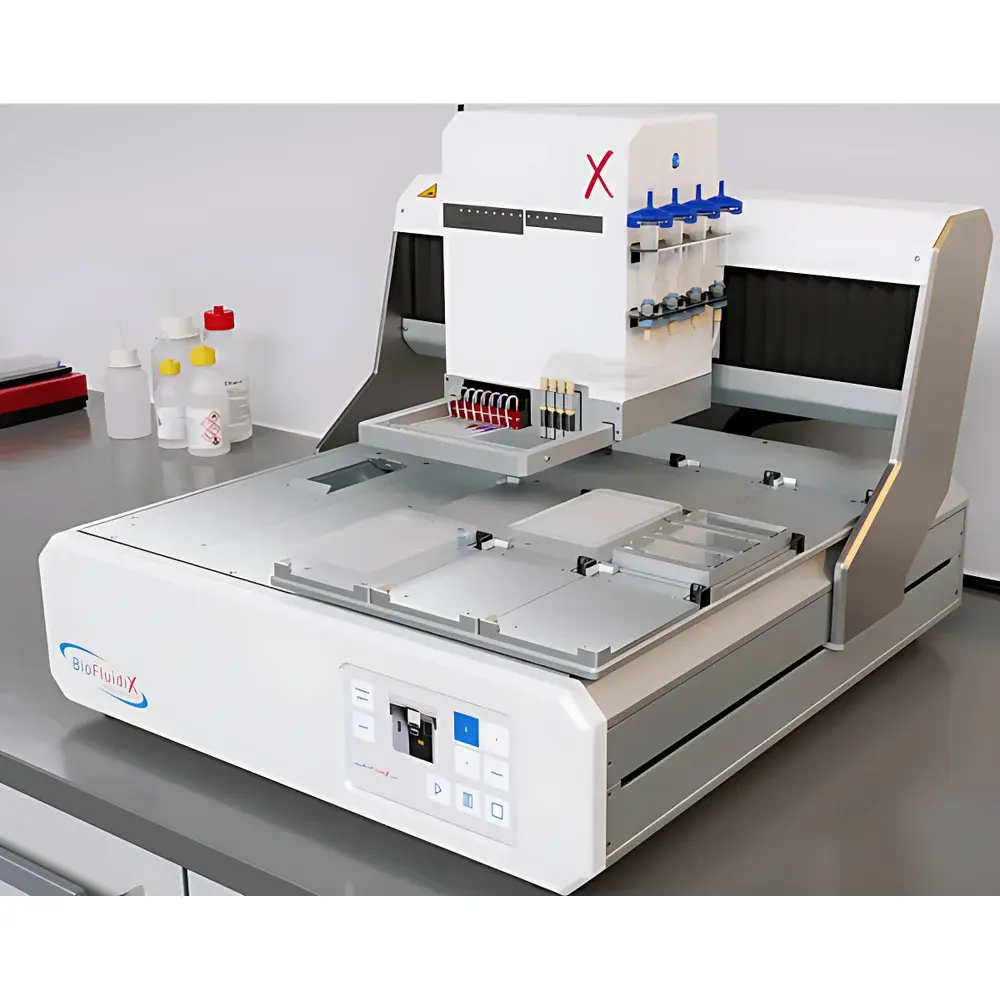
BioFluidix BioSpot Custom Non-Contact Micro/Nano-Volume Liquid Dispensing Workstation
| Brand | BioFluidix |
|---|---|
| Origin | Germany |
| Manufacturer Type | Authorized Distributor |
| Product Category | Imported Instrument |
| Model | BioSpot Custom |
| Instrument Type | Microarray Chip System |
| Sample Types | Nucleic Acids, Proteins, Carbohydrates, Small Molecules, Viscous Biological Fluids |
| Dispensing Modules | SiJet (pL), PipeJet (nL), ValveJet (µL) |
| Maximum Channels | 12 |
| Integrated Quality Control | TopView Camera + SmartDrop Auto-Calibration System |
| Dispensing Precision | CV < 1–3% |
| Operational Modes | Static Spotting, Flying Mode (High-Throughput Linear Motion) |
| Compliance | Designed for GLP/GMP-aligned workflows |
Overview
The BioFluidix BioSpot Custom is a non-contact, piezo-driven micro- and nano-volume liquid dispensing workstation engineered for high-fidelity spatial deposition of biological and chemical reagents onto solid substrates—primarily microarrays, biochips, microfluidic devices, and MALDI targets. Unlike contact-based pin tools or pressure-driven systems, the BioSpot Custom employs acoustic droplet ejection (ADE) and precision piezoelectric actuation to generate and eject discrete droplets without physical nozzle contact, eliminating carryover, cross-contamination, and surface damage. Its modular architecture enables seamless integration of three distinct dispensing technologies—SiJet (sub-picoliter resolution), PipeJet (nanoliter range), and ValveJet (microliter-scale)—within a single platform. This allows users to execute multi-scale assay development protocols on one instrument: from ultra-low-volume probe spotting (e.g., 0.5–50 pL oligonucleotide arrays) to nanoliter-scale protein immobilization or µL-level PCR master mix distribution. The system operates under ambient conditions and is compatible with aqueous buffers, glycerol-containing solutions, DMSO-based compound libraries, and low-surface-tension solvents—provided viscosity remains within defined operational limits (≤20 mPa·s for SiJet, ≤50 mPa·s for PipeJet).
Key Features
- Modular dispensing engine supporting simultaneous or sequential deployment of SiJet (pL), PipeJet (nL), and ValveJet (µL) modules—configurable up to 12 independent channels.
- TopView Camera integrated into the gantry for real-time, high-resolution (≥5 MP) imaging of dispense events—enabling immediate visual verification of droplet formation, trajectory, and landing position.
- SmartDrop automated calibration system: uses image-based droplet segmentation and volumetric regression to dynamically adjust voltage pulse parameters, compensating for fluid property drift, temperature variation, and nozzle aging.
- Flying mode operation: linear stage motion synchronized with dispensing triggers permits continuous, high-speed deposition at velocities up to 500 mm/s—reducing chip processing time by >60% versus static spotting.
- Software-controlled volume optimization: users input target volume; SmartDrop iteratively refines ejection parameters and validates output via statistical analysis of ≥100 consecutive droplets per condition.
- Robust architecture with ISO Class 5 (Class 100) cleanroom-compatible enclosure option and HEPA-filtered internal airflow—minimizing particulate interference during sensitive biomolecular patterning.
Sample Compatibility & Compliance
The BioSpot Custom accommodates a broad spectrum of life science sample types—including double-stranded DNA, siRNA, antibodies, enzymes, lectins, synthetic peptides, glycans, and small-molecule compounds dissolved in DMSO, ethanol, or aqueous carriers. Its non-contact mechanism ensures compatibility with fragile substrates such as nitrocellulose membranes, functionalized glass slides, PDMS microchannels, and gold-coated MALDI plates. The system adheres to foundational quality frameworks for regulated environments: raw data logs (including timestamped camera frames, pulse voltages, stage coordinates, and environmental sensor readings) are stored in encrypted, immutable binary archives compliant with ALCOA+ principles. Optional software modules support 21 CFR Part 11 electronic signatures, role-based access control, and full audit trails—facilitating qualification under ICH-GCP, ISO 13485, and USP analytical instrument qualification guidelines.
Software & Data Management
Control and analysis are managed through BioFluidix’s proprietary SpotWare Suite—a Windows-based application featuring intuitive graphical workflow builders, drag-and-drop protocol scripting, and integrated QC dashboards. All dispensing sequences are saved as human-readable XML files with embedded metadata (user ID, calibration date, fluid ID, environmental conditions). The TopView Camera module exports TIFF-stacked images with pixel-to-micron calibration overlays; SmartDrop generates CSV reports containing mean droplet volume, standard deviation, coefficient of variation, and outlier flagging per channel and session. Raw image and log archives are compatible with third-party LIMS platforms via RESTful API or ODBC connectors. Data retention policies can be configured to auto-archive to network storage or cloud repositories (AWS S3, Azure Blob) with configurable encryption keys.
Applications
- Microarray fabrication: high-density nucleic acid and antibody chips for genomics, proteomics, and serological profiling.
- Microfluidic device priming: precise loading of reagent zones, valve actuation fluids, and cell culture media into PDMS or thermoplastic chips.
- qPCR/ddPCR assay setup: nanoliter-scale distribution of master mixes, primers, and probes into 384- or 1536-well plates—reducing reagent cost by up to 90%.
- Drug discovery: compound array printing for high-throughput screening, including kinase inhibitor panels and fragment libraries.
- Mass spectrometry target preparation: homogeneous crystallization of matrix-assisted samples on stainless steel or conductive slides.
- Synthetic biology: spatially resolved deposition of CRISPR ribonucleoprotein complexes, cell-free expression systems, or hydrogel precursors for organoid patterning.
- Materials science: catalyst ink spotting for fuel cell electrode development and perovskite precursor deposition for photovoltaic research.
FAQ
What minimum droplet volume can the SiJet module achieve reliably?
The SiJet module delivers stable ejection down to 0.2 pL per pulse, verified via gravimetric analysis and calibrated imaging across ≥500 consecutive dispenses.
Is the BioSpot Custom compatible with viscous protein solutions (e.g., 50% glycerol or 10 mg/mL IgG)?
Yes—PipeJet handles viscosities up to 50 mPa·s; however, pre-filtration (0.22 µm) and temperature stabilization (18–22°C) are recommended to maintain consistent jetting performance.
How often does SmartDrop require recalibration?
SmartDrop performs automatic recalibration before each run when enabled; manual recalibration is recommended after fluid change, nozzle cleaning, or every 8 operational hours in continuous use.
Can the system interface with robotic arms or plate stackers?
Yes—the SpotWare Suite includes standardized I/O ports (TTL, RS-232, Ethernet/IP) and supports integration with major lab automation standards including SLAS ANSI/SLAS 2-2015 and CLSI GP37-A3.
Does BioFluidix provide IQ/OQ/PQ documentation packages?
Yes—validated installation, operational, and performance qualification protocols are available upon request and align with ISO/IEC 17025 and ASTM E2500-13 guidance for analytical instrumentation.




