
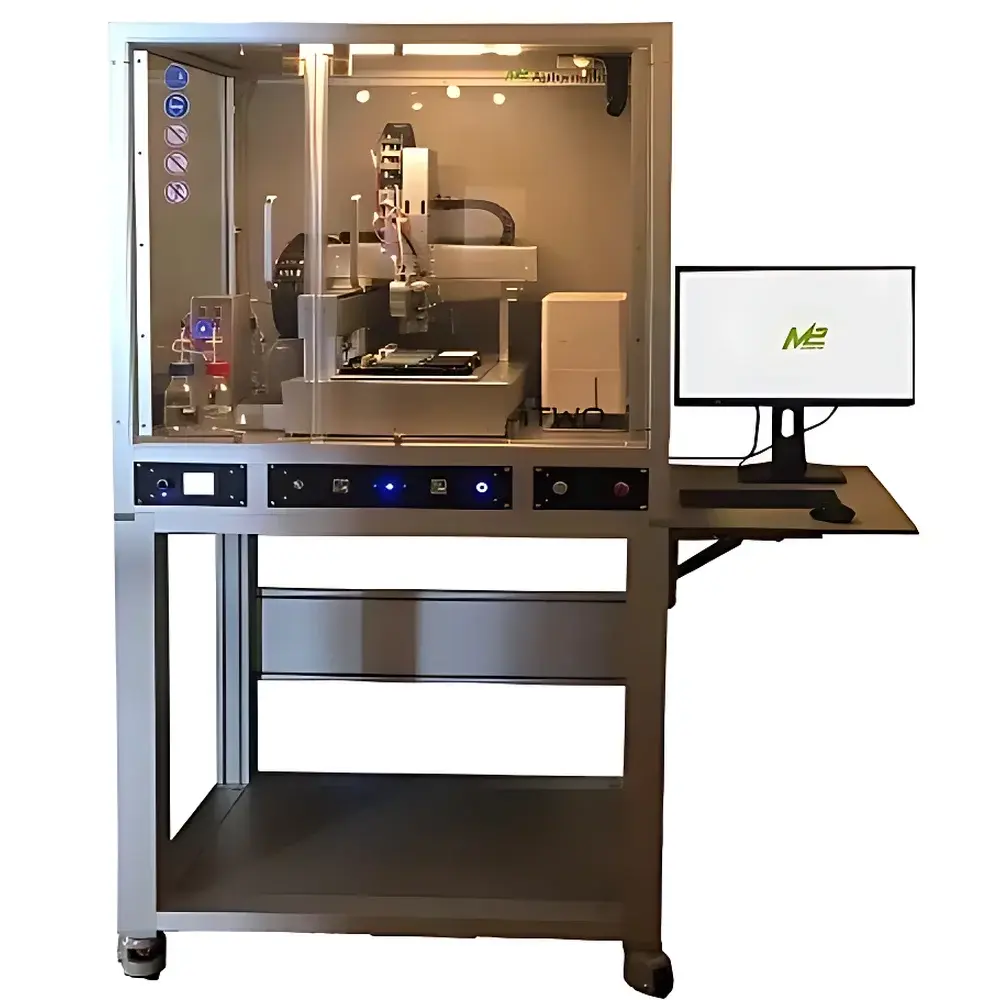
M24you iTWO Series Biochip Spotting System
| Brand | M24you |
|---|---|
| Origin | Germany |
| Manufacturer Type | Authorized Distributor |
| Product Category | Imported Instrument |
| Model | iTWO |
| Instrument Type | Microfluidic Biochip Spotting System |
| Substrate Compatibility | Unrestricted (Glass Slides, Microtiter Plates, Membranes, Discs, Microfluidic Chips) |
| Throughput Capacity | Up to 30 Standard Microscope Slides per Run |
| Spotting Volume Range | 30 pL to µL |
| Spotting Precision | CV < 2% |
| Maximum Spotting Rate | 1,000 droplets/sec |
| Positioning Accuracy | ±5 µm (repeatability) |
| Minimum Feature Size | 1 µm |
| Maximum Stage Translation Speed | 75 cm/s |
| Integrated Air Removal & Filtration | Onboard degassing and inline filtration for bubble-free dispensing |
| Imaging Quality Control | Dual-camera system — top-view macro camera + high-speed droplet-level imaging camera |
| Sample Carrier Compatibility | 96-well, 384-well, 1536-well plates, PCR tubes |
| Spotting Head Options | Piezoelectric pL-scale, M2MD nL-scale, solenoid valve-based, and multi-channel contact pin modules |
| Environmental Control | Integrated humidity, temperature, and laminar airflow regulation |
Overview
The M24you iTWO Series Biochip Spotting System is a high-precision, modular microfluidic dispensing platform engineered for reproducible fabrication of DNA, protein, antibody, glycan, and small-molecule microarrays. It operates on a hybrid actuation principle—combining piezoelectric droplet-on-demand (DOD), solenoid-driven valve gating, and contact-based pin transfer—to accommodate diverse biomolecular chemistries and surface chemistries without cross-contamination or carryover. Designed for R&D laboratories, core facilities, and GMP-aligned diagnostic assay development labs, the iTWO supports both discovery-phase probe screening and pre-clinical validation workflows. Its open architecture enables seamless integration into automated liquid handling ecosystems and conforms to foundational requirements for assay traceability under ISO/IEC 17025 and CLIA-compliant laboratory practices.
Key Features
- Multi-modal spotting engine: Simultaneous support for non-contact piezoelectric (pL–nL), electromagnetic valve (nL–µL), and contact pin (nL–µL) dispensing—selectable per experiment via software-defined head configuration.
- Substrate-agnostic stage: Accommodates rigid (glass slides, silicon wafers), flexible (nitrocellulose membranes, PET films), and structured substrates (microfluidic chips with integrated channels or wells).
- Real-time fluidic integrity assurance: Integrated inline 0.22 µm filtration and vacuum-assisted degassing eliminate nucleation sites prior to ejection—critical for viscous glycoprotein or polymer-conjugated probes.
- Dual optical QC subsystem: A top-mounted 5 MP macro camera monitors spot morphology, alignment, and substrate defects across full slide fields; a synchronized high-speed (≥10,000 fps) droplet imaging module captures individual jetting events to verify break-up dynamics, satellite droplet formation, and trajectory stability.
- Environmental chamber: Programmable temperature (15–30 °C ±0.5 °C), relative humidity (30–65% RH ±3%), and HEPA-filtered laminar airflow ensure consistent evaporation kinetics and minimize edge effects during drying-critical assays.
- Sub-5 µm repeatable positioning: Linear motor-driven XYZ stage with laser-interferometric feedback delivers ≤±5 µm repeatability over 30-slide batches—enabling sub-cellular resolution spatial mapping in tissue microarray applications.
Sample Compatibility & Compliance
The iTWO accepts standard SBS-format carriers (96-, 384-, and 1536-well plates), skirted and unskirted PCR tubes (0.2–2.0 mL), and custom sample reservoirs with Luer-lock or capillary interfaces. All wetted materials—including fluidic paths, nozzles, and gaskets—are USP Class VI-certified and compatible with aqueous buffers, DMSO solutions (≤10%), and low-viscosity glycerol formulations (<30 cP). The system meets mechanical safety requirements per IEC 61000-6-2/6-4 and carries CE marking for in vitro diagnostic (IVD) ancillary equipment. While not itself an IVD device, its output microarrays may be used in assays compliant with ISO 13485 quality management systems and FDA 21 CFR Part 11 when paired with validated electronic lab notebook (ELN) integration.
Software & Data Management
The proprietary SpotControl Suite provides a role-based interface supporting method creation, calibration logging, batch scheduling, and audit-trail generation. Each spotting run records timestamped metadata—including ambient conditions, nozzle health metrics, pressure transducer readings, and droplet image thumbnails—exportable in CSV, HDF5, or MIAME-compliant XML formats. The software enforces user access levels (operator, supervisor, administrator) and supports digital signature capture for GLP/GMP documentation. Integration APIs (RESTful JSON and OPC UA) allow bidirectional synchronization with LIMS platforms such as LabVantage and Thermo Fisher SampleManager.
Applications
- High-density oligonucleotide microarrays for transcriptomics and SNP genotyping
- Antibody and recombinant protein arrays for multiplexed immunoassay development
- Glycan array fabrication using printed neoglycoconjugates
- Cell-based microarrays with controlled seeding density gradients
- Microfluidic chip priming and reagent patterning for organ-on-chip models
- Reference material deposition for metrology standards in NIST-traceable calibration workflows
FAQ
What substrate types are supported beyond standard glass slides?
The iTWO accommodates polyethylene terephthalate (PET), polycarbonate, nitrocellulose, PVDF, functionalized silicon wafers, and custom microfluidic devices with planar mounting surfaces up to 25 mm thickness.
Can the system handle viscous samples such as PEGylated proteins or hydrogel precursors?
Yes—when configured with M2MD nanoliter heads or solenoid valves rated for ≤50 cP fluids, and coupled with heated fluid paths (optional upgrade) and pulse-width-modulated pressure control.
Is remote monitoring and troubleshooting supported?
All instruments include embedded Ethernet and optional LTE connectivity; diagnostics, live camera feeds, and real-time stage telemetry are accessible via secure TLS-encrypted web dashboard.
How is calibration traceability maintained?
Each instrument ships with NIST-traceable volumetric verification kits (gravimetric droplet mass measurement) and stage positioning certificates; annual recalibration services include ISO/IEC 17025-accredited reports.
Does the software support DOE (Design of Experiments) method templates?
Yes—SpotControl includes built-in factorial, response surface, and mixture design wizards with automatic parameter sweep sequencing and result overlay visualization.




