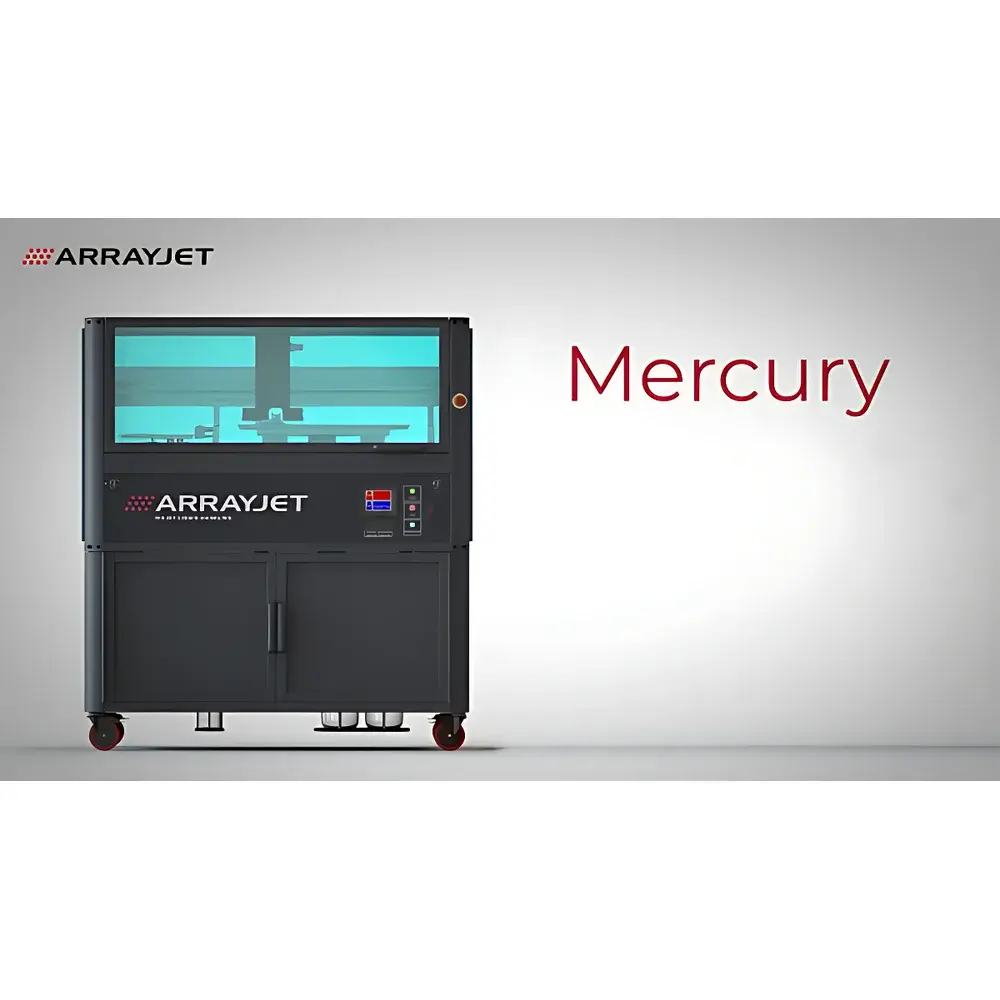
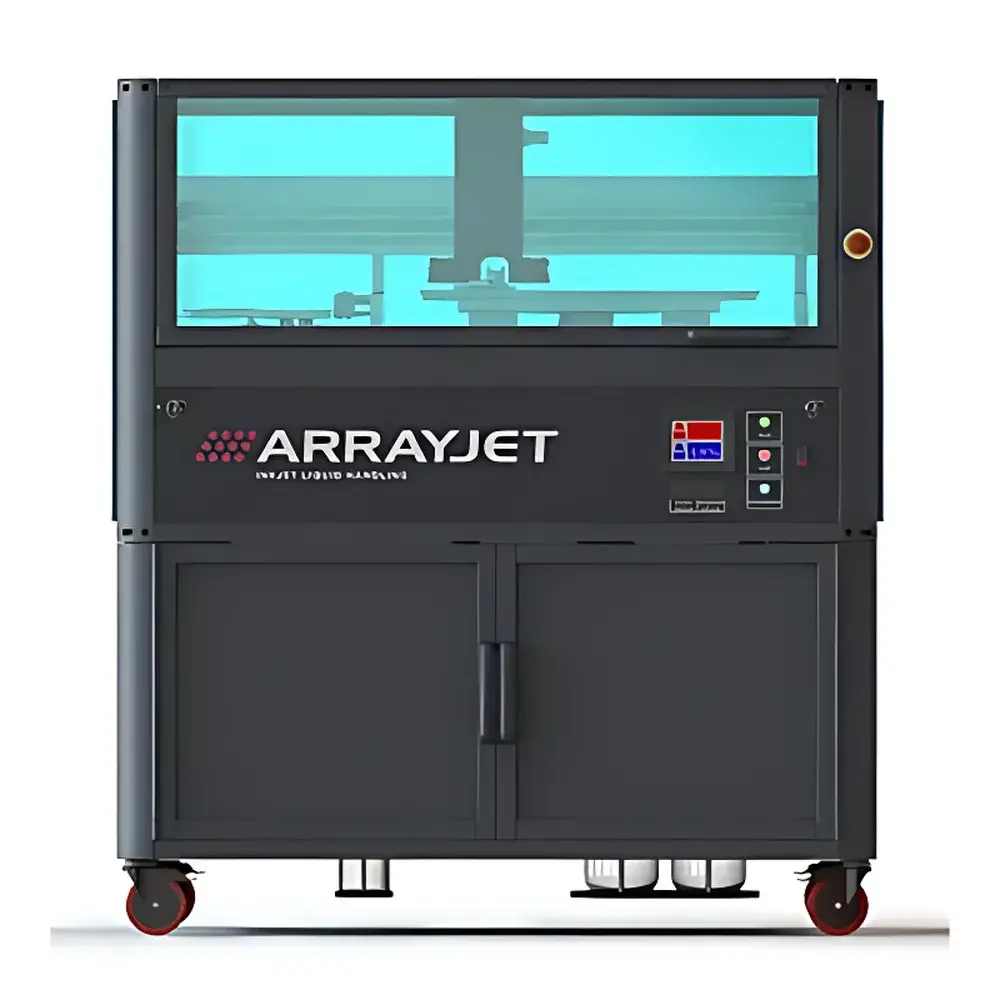
ArrayJet Mercury 100 Non-Contact Microarray Spotting System
| Brand | ArrayJet |
|---|---|
| Origin | United Kingdom |
| Model | Mercury 100 |
| Spotting Method | Non-contact piezoelectric inkjet |
| Spot Volume Range | picoliter to nanoliter (pL–nL) |
| Spotting Speed | 711 spots per second |
| Substrate Capacity | 6 × SBS-format microtiter plates or 100 standard microscope slides |
| Repeatability (CV) | < 5% |
| Compliance | Designed for GLP/GMP-aligned workflows, compatible with ISO 13485 and ASTM E2519-22 reference practices for microarray fabrication |
Overview
The ArrayJet Mercury 100 is a high-throughput, non-contact microarray spotting system engineered for precision deposition of biological reagents—including DNA, RNA, proteins, antibodies, glycans, and small molecules—onto diverse solid substrates. Utilizing proprietary piezoelectric inkjet technology, the Mercury 100 operates on the principle of controlled droplet ejection without physical contact between nozzle and substrate. This eliminates cross-contamination risks, minimizes sample carryover, and preserves integrity of viscous or precious biomaterials. Each spotting event is governed by real-time drop-on-demand actuation, enabling deterministic placement at sub-microliter volumes with high spatial fidelity. The system is purpose-built for laboratories requiring reproducible, scalable microarray fabrication under controlled environmental conditions—supporting both discovery-phase research and regulated assay development.
Key Features
- 128 parallel piezoelectric printheads operating in synchronized unison, delivering industry-leading throughput without compromising spot uniformity or positional accuracy.
- Integrated environmental control module maintaining precise regulation of temperature (±0.5 °C), relative humidity (±3% RH), and laminar airflow to suppress solvent evaporation during deposition—critical for maintaining consistent spot morphology and concentration homogeneity.
- Optical quality assurance subsystem performing in-line monitoring of droplet formation, trajectory, and landing position using high-speed imaging and machine vision algorithms; alerts users to nozzle clogging or misalignment before defective arrays are generated.
- Modular substrate handling platform accommodating up to six SBS-standard microtiter plates (96-, 384-, or 1536-well formats) or 100 standard 25 × 75 mm microscope slides per run—enabling flexible experimental design across assay types.
- Industrial-grade printhead architecture rated for >10⁹ actuation cycles per nozzle, with automated self-cleaning protocols and pressure-regulated fluidics to ensure long-term operational stability and minimal downtime.
Sample Compatibility & Compliance
The Mercury 100 accepts a broad spectrum of aqueous and glycerol-based biofluids, including oligonucleotide solutions (1–100 µM), recombinant proteins (0.1–10 mg/mL), monoclonal antibodies, peptide libraries, and synthetic compound stocks. It supports direct spotting onto functionalized glass slides (amine-, epoxy-, aldehyde-, or NHS-activated), nitrocellulose membranes, PVDF membranes, polymer-coated silicon wafers, and microfluidic chip surfaces. All hardware and firmware components comply with CE marking requirements under the EU Machinery Directive 2006/42/EC and Electromagnetic Compatibility Directive 2014/30/EU. Data integrity features—including electronic audit trails, user access controls, and immutable log files—are configurable to align with FDA 21 CFR Part 11, ISO/IEC 17025, and GLP documentation standards.
Software & Data Management
Operation is fully managed through Command Centre™ software—a Windows-based application built on a modular architecture supporting method creation, plate mapping, pattern definition, and real-time process supervision. The GUI includes drag-and-drop layout editors with support for custom grid geometries, variable pitch spacing, and multi-layer array designs. All spotting parameters—including voltage waveform profiles, dwell time, and droplet velocity—are programmable per channel and stored as version-controlled SOP templates. Raw image logs from optical QA, environmental sensor outputs, and motion controller diagnostics are timestamped and archived in vendor-neutral HDF5 format for traceability and third-party analysis. Export options include CSV, TIFF, and MIAME-compliant XML metadata bundles.
Applications
- High-density nucleic acid microarrays for gene expression profiling, SNP genotyping, and miRNA screening.
- Reverse-phase protein arrays (RPPA) for quantitative phosphoproteomics and pathway activation mapping across tissue lysates or cell extracts.
- Antibody and aptamer microarrays used in biomarker validation studies and companion diagnostic assay development.
- Carbohydrate microarrays for glycan-binding specificity profiling against lectins, viruses, or immune receptors.
- Small-molecule microarrays (SMMs) supporting target deconvolution, hit-to-lead optimization, and off-target profiling in early-stage drug discovery.
- Functionalization of biosensor surfaces—including SPR chips, electrochemical transducers, and CMOS-integrated lab-on-chip devices—with spatially resolved biorecognition elements.
FAQ
What types of substrates can the Mercury 100 accommodate?
Standard microscope slides (25 × 75 mm), SBS-format microtiter plates (96-/384-/1536-well), nitrocellulose/PVDF membranes, functionalized silicon wafers, and custom-patterned microfluidic devices.
Is the system compatible with viscous or particulate-containing samples?
Yes—printhead geometry and waveform tuning allow reliable dispensing of solutions up to 20 cP viscosity; filtration recommendations apply for samples containing particles >1 µm.
How is calibration and maintenance performed?
Automated nozzle health checks occur before each run; manual recalibration of X/Y/Z axes is required only after mechanical service events and follows NIST-traceable procedures documented in the instrument’s IQ/OQ protocol suite.
Can spotting methods be exported for regulatory submission?
Yes—Command Centre™ generates complete method packages including parameter sets, environmental logs, QA images, and digital signatures compliant with ALCOA+ data integrity principles.
Does ArrayJet provide installation qualification (IQ) and operational qualification (OQ) documentation?
Full GxP-ready qualification kits—including test scripts, acceptance criteria, and editable reports—are supplied with every Mercury 100 system and validated per ISO/IEC 17025 Annex A.3 guidelines.