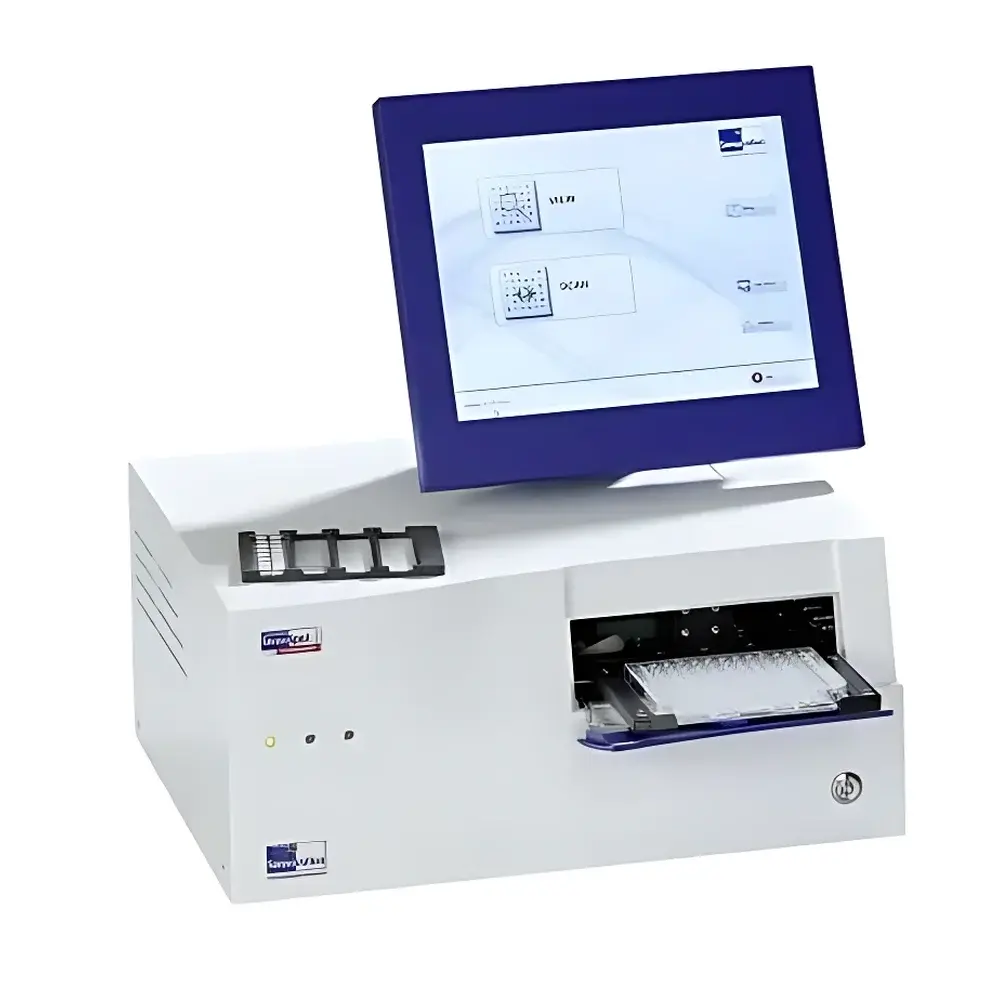
Sensovation SensoSpot Multifactor Biochip Scanner
| Brand | Sensovation |
|---|---|
| Origin | Germany |
| Instrument Type | Microarray Scanner |
| Substrate Compatibility | Glass Slides & SBS-Compliant Microtiter Plates |
| Scan Resolution | 6.7 µm |
| 96-Well Plate Scan Time | <3 min |
| Excitation Wavelengths | Blue/Red (440–510 nm / 590–640 nm), Green/Red (510–540 nm / 630–640 nm), Tri-Channel (415–480 nm / 530–550 nm / 615–645 nm) |
| Emission Wavelengths | Blue/Red (525–535 nm / 655–665 nm), Green/Red (570–600 nm / 670–720 nm), Tri-Channel (495–520 nm / 560–610 nm / 655–720 nm) |
| Sample Types | Nucleic Acids, Proteins, Glycans, Cells |
| Compliance | ISO 9001 & ISO 13485 Certified |
| Automation Interface | Compatible with Liquid Handling Workstations & Stackers |
Overview
The Sensovation SensoSpot Multifactor Biochip Scanner is a high-performance, compact microarray imaging platform engineered for quantitative multiplexed detection across diverse biomolecular assay formats. Utilizing dual- or triple-channel epifluorescence excitation and emission optics with precisely tuned bandpass filters, the system enables simultaneous acquisition of up to three spectrally resolved signals per scan—supporting both fluorescence-based and colorimetric readouts. Its optical architecture is optimized for high signal-to-noise ratio (SNR) and photometric linearity across dynamic ranges exceeding 4 orders of magnitude, ensuring reproducible quantification in low-abundance target detection. Designed specifically for regulated life science environments, the SensoSpot scanner integrates seamlessly into IVD development workflows and GLP-compliant research pipelines, delivering traceable, audit-ready data generation in accordance with ISO 13485 quality management requirements.
Key Features
- Tri-channel fluorescence excitation and emission capability with user-selectable filter sets (415–480 nm / 530–550 nm / 615–645 nm excitation; 495–520 nm / 560–610 nm / 655–720 nm emission)
- Sub-7 µm optical resolution (6.7 µm pixel size) enabling precise feature delineation on high-density nucleic acid, protein, and glycan arrays
- Rapid scanning kinetics: full 96-well microplate acquisition completed in under 3 minutes; parallel scanning of up to four standard glass slides per run
- Integrated industrial-grade PC with capacitive touchscreen interface—no external computer required; firmware supports over-the-air updates
- Auto-focus and intelligent spot-finding algorithm with adaptive thresholding, eliminating manual ROI definition for routine assays
- Native support for SBS-standard microtiter plates (96-, 384-, and 1536-well) and 25 × 75 mm microscope slides—including coated, epoxy-silanized, and NHS-activated surfaces
- Modular automation interface compliant with ANSI/SLAS standards for integration with liquid handlers, robotic stackers, and track-based systems
Sample Compatibility & Compliance
The SensoSpot platform accommodates a broad spectrum of biochip substrates and analyte classes without hardware modification. It natively supports nucleic acid microarrays (cDNA, oligonucleotide, SNP genotyping), antibody/antigen immunoarrays (for infectious disease serology, autoantibody profiling, and allergen screening), glycan arrays for lectin-binding characterization, and cell-based microarrays for phenotypic expression analysis. The instrument’s mechanical and optical design conforms to ISO 9001:2015 and ISO 13485:2016 standards, with full documentation packages available for regulatory submissions. All firmware and software modules comply with ALCOA+ data integrity principles, and audit trail functionality—including user action logging, parameter change history, and timestamped image metadata—is enabled by default to meet FDA 21 CFR Part 11 and EU Annex 11 expectations.
Software & Data Management
SensoVision™ software (v4.x) provides an integrated environment for image acquisition, feature extraction, normalization, statistical analysis, and report generation. Raw TIFF and HDF5 image files are stored with embedded EXIF-like metadata (laser power, PMT gain, exposure time, calibration date). Built-in statistical tools include coefficient of variation (CV) mapping, hierarchical clustering, principal component analysis (PCA), and differential expression analysis with Benjamini-Hochberg FDR correction. Quantitative results export directly to Excel-compatible CSV or XLSX formats, with customizable pass/fail logic based on user-defined thresholds (e.g., signal intensity > background + 3SD, CV < 15%). Data archiving follows hierarchical storage management (HSM) protocols, and optional network deployment allows centralized license management and role-based access control (RBAC) for multi-user laboratories.
Applications
- Gene expression profiling and alternative splicing analysis using spotted or in situ synthesized oligo arrays
- High-throughput genotyping and copy number variation (CNV) detection in pharmacogenomic and clinical trial cohorts
- Quantitative immunoassay development—including multiplexed mini-ELISA and cytokine panel screening
- Glycomics studies targeting host-pathogen interactions, cancer-associated carbohydrate antigens, and glyco-biomarker discovery
- Cell adhesion, viability, and receptor-ligand interaction assays on functionalized cell microarrays
- Custom assay validation for microfluidic chips (e.g., Sapphire digital PCR substrates) and spatially encoded biosensors
FAQ
Does the SensoSpot support spectral unmixing for highly overlapping fluorophores?
Yes—tri-channel acquisition combined with reference spectra libraries enables linear unmixing for common dye pairs (e.g., Cy3/Cy5, Alexa Fluor 488/647) when calibrated with single-stain controls.
Can raw image data be exported without proprietary compression?
Absolutely—all scans are saved as lossless 16-bit TIFF or HDF5 files containing full metadata, compatible with third-party analysis platforms including ImageJ/Fiji, R/Bioconductor, and Python (scikit-image, xarray).
Is remote monitoring or cloud-based data synchronization supported?
The system includes optional TLS-secured REST API endpoints for remote status polling and scheduled data push to on-premise NAS or validated cloud storage (AWS S3, Azure Blob) with configurable encryption-at-rest policies.
What maintenance is required to ensure long-term photometric stability?
Annual optical alignment verification and PMT gain calibration are recommended; built-in LED reference channels enable daily drift compensation without user intervention.
How is compliance with 21 CFR Part 11 enforced during result reporting?
Electronic signatures, immutable audit trails, and electronic record retention policies are enforced via role-based permissions and cryptographic hashing of all exported reports—fully validated per IQ/OQ/PQ protocols.
Related Products