
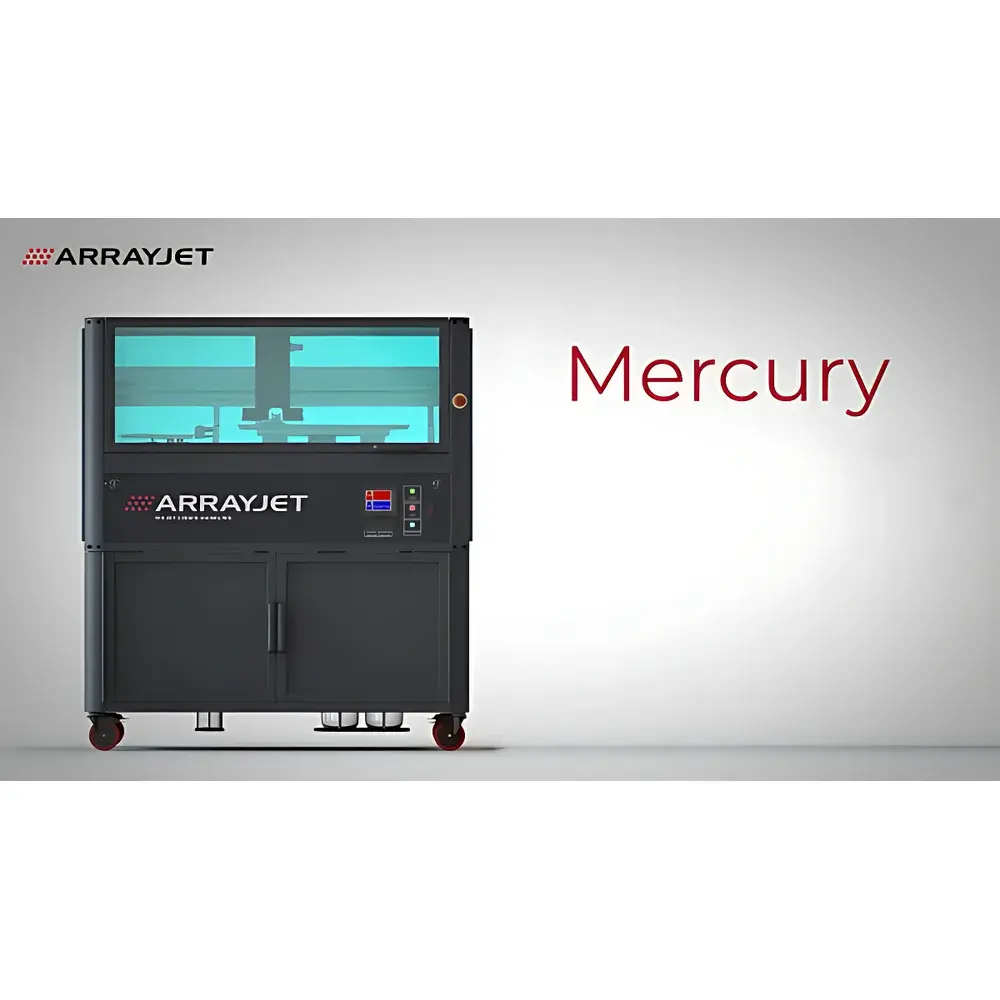
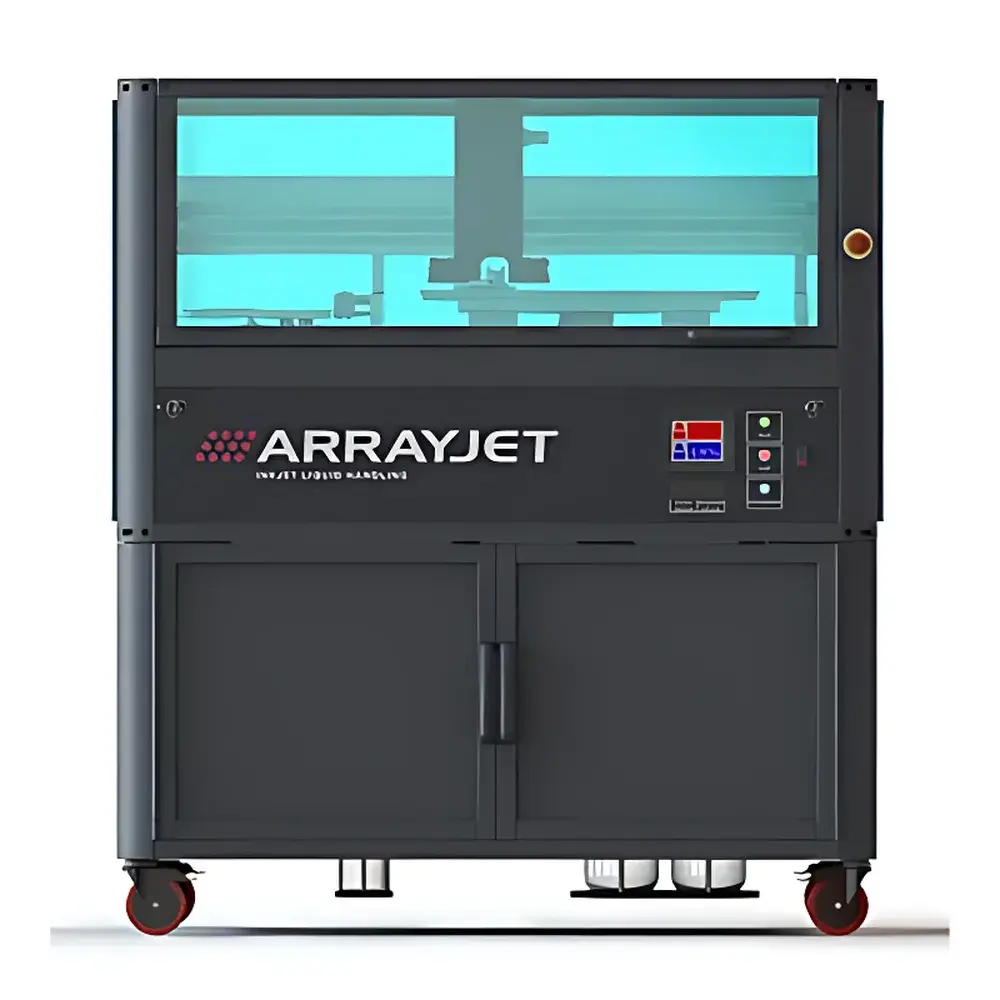
ArrayJet Mercury 1000 Non-Contact Microarray Spotting Instrument
| Brand | ArrayJet |
|---|---|
| Origin | United Kingdom |
| Model | Mercury 1000 |
| Spotting Method | Non-contact piezoelectric inkjet |
| Spot Volume Range | picoliter to nanoliter (pL–nL) |
| Spotting Speed | 711 spots per second |
| Substrate Capacity | 6 × SBS-compliant microtiter plates or 1,000 standard microscope slides |
| Repeatability (CV) | < 5% |
| Compliance | Designed for GLP/GMP-aligned workflows, compatible with ISO 13485 and ASTM E2539-22 reference practices for microarray fabrication |
Overview
The ArrayJet Mercury 1000 is a high-throughput, non-contact microarray spotting instrument engineered for precision deposition of biological reagents onto solid-phase substrates—including glass slides, nitrocellulose membranes, polymer films, and microtiter plates. It employs industrial-grade piezoelectric inkjet technology to deliver picoliter-to-nanoliter volumes with minimal sample waste and zero cross-contamination. Unlike contact-based pin spotters, the Mercury 1000 eliminates physical contact between dispensing nozzles and substrate surfaces—eliminating carryover, tip clogging, and surface damage while preserving biomolecular integrity. Its core architecture integrates real-time environmental control (temperature, humidity, and inert gas shroud) to suppress evaporation during deposition, ensuring consistent spot morphology, uniform probe concentration, and reproducible assay performance across thousands of arrays per run.
Key Features
- 128 parallel piezoelectric printheads enabling massively parallel spotting without mechanical scanning delays
- Dynamic droplet ejection control with closed-loop feedback for volume calibration and jet health monitoring
- Integrated environmental chamber maintaining ±0.5 °C temperature stability and <30% RH to prevent solute crystallization and meniscus drift
- Optical in-line quality assurance module with high-resolution CCD imaging for real-time spot detection, size verification, and positional accuracy validation
- Modular substrate handling system supporting simultaneous loading of up to six SBS-standard plates or 1,000 microscope slides via automated cassette indexing
- Robust mechanical design with granite base and air-isolated optical table integration for sub-micron positional repeatability (CV < 5% across full working area)
Sample Compatibility & Compliance
The Mercury 1000 accommodates diverse biological and synthetic samples—including DNA oligonucleotides, PCR amplicons, antibodies, recombinant proteins, glycans, peptides, and small-molecule libraries—without requiring viscosity modification or carrier additives. It accepts standard 384-well and 1536-well plates, as well as custom reservoirs with liquid levels monitored via capacitive sensing. All fluidic pathways are chemically inert (perfluoroalkoxy-lined tubing, sapphire nozzles), minimizing adsorption and degradation. The system supports audit-trail-enabled operation compliant with FDA 21 CFR Part 11 requirements when paired with validated Command Centre™ software configurations. Documentation packages align with ISO/IEC 17025 and ASTM E2539-22 standards for microarray manufacturing process validation.
Software & Data Management
Operation is fully managed through ArrayJet’s Command Centre™ software—a Windows-based platform featuring intuitive drag-and-drop layout design, batch scripting, and visual preview rendering prior to execution. Users define spotting patterns using industry-standard formats (e.g., GAL, GPR, or custom CSV mapping), assign probe identities to wells, and configure environmental setpoints per substrate batch. Software logs all operational parameters—including ambient conditions, nozzle firing statistics, spot coordinates, and QC image metadata—with timestamped, encrypted storage. Export options include TIFF, PNG, and HDF5 for downstream analysis in tools such as GenePattern, R/Bioconductor, or proprietary LIMS environments. Optional API integration enables orchestration within automated lab workflows (e.g., integration with Hamilton STAR or Tecan Fluent systems).
Applications
- High-density nucleic acid microarrays for gene expression profiling, SNP genotyping, and miRNA screening
- Reverse-phase protein arrays (RPPA) for quantitative phosphoproteomics and biomarker validation
- Antibody and aptamer microarrays for serological diagnostics and host-pathogen interaction studies
- Glycan arrays for carbohydrate-binding specificity mapping and vaccine development
- Small-molecule microarrays supporting target deconvolution, hit validation, and ADMET profiling
- Functionalized surfaces for semiconductor-integrated biosensors and microfluidic device priming
FAQ
What types of substrates can the Mercury 1000 accommodate?
Standard microscope slides (25 × 75 mm), coated or uncoated; nitrocellulose, PVDF, and activated glass; 96-, 384-, and 1536-well SBS plates; custom polymer films and sensor chips.
Is the system compatible with viscous or particulate-containing samples?
Samples must be filtered to ≤0.22 µm and maintain viscosities below 20 cP at operating temperature; suspensions require centrifugation and stabilization protocols validated per application.
How is spot consistency verified during operation?
The integrated optical QA module captures >100× magnified images of every 10th spot row; software calculates diameter, circularity, intensity uniformity, and positional deviation against reference templates.
Can the Mercury 1000 be integrated into a cleanroom or regulated manufacturing environment?
Yes—fully enclosed chassis with HEPA-filtered airflow option, optional VHP-compatible housing, and full IQ/OQ/PQ documentation support for GMP-grade deployment.
What maintenance intervals are recommended for long-term reliability?
Daily nozzle purge cycle; weekly alignment calibration; quarterly printhead inspection and cleaning; annual full-system metrology validation per ISO 10012.



