
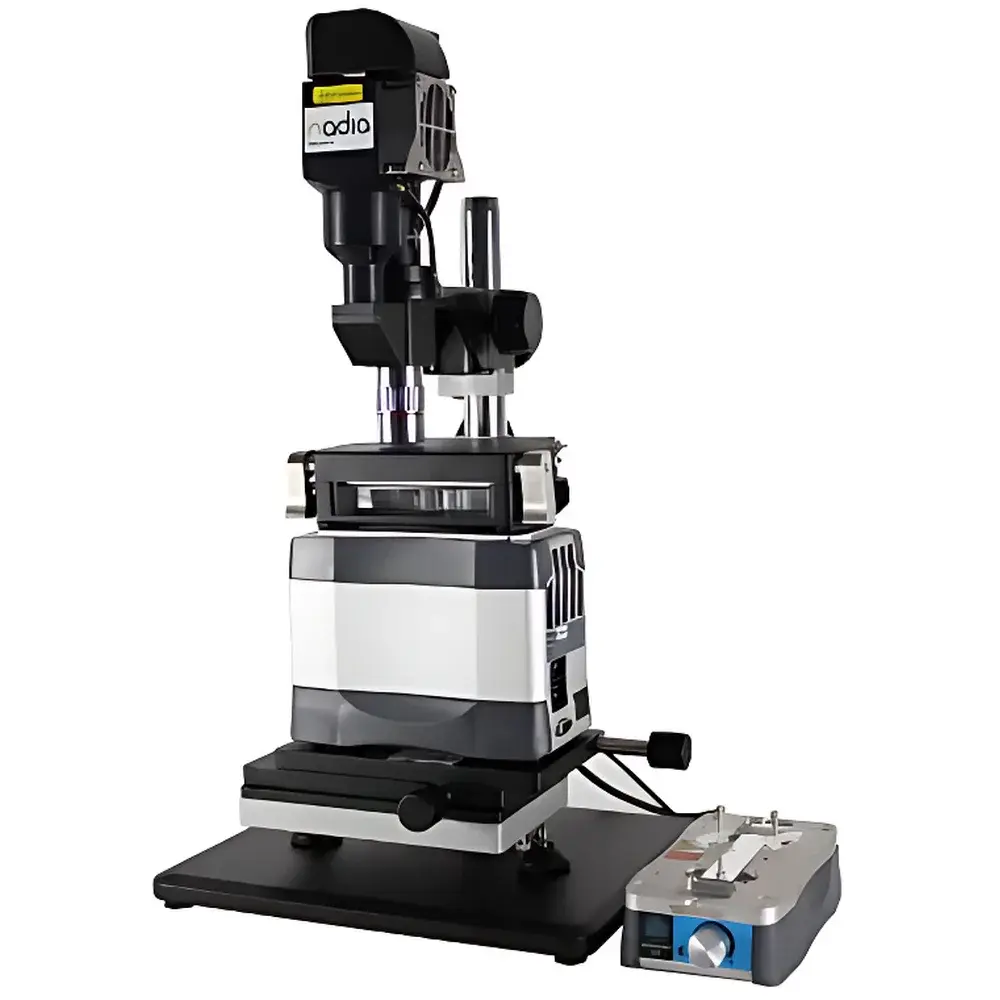
Nadia Innovate Single-Cell Encapsulation System by Dolomite Bio
| Brand | Dolomite Bio |
|---|---|
| Model | Nadia Innovate |
| Origin | United Kingdom |
| Instrument Type | Microfluidic Droplet-Based Single-Cell Capture Platform |
| Throughput | Up to 50,000 cells per run (max. 6,000 cells per sample) |
| Parallel Channels | 1–8 independent microfluidic lanes |
| Temperature Control Range | 4–40 °C (±0.5 °C stability) |
| Pressure Control | Digital pneumatic regulation (0–300 kPa, resolution 1 kPa) |
| Stirring Speed | 0–1,200 rpm (magnetic bead suspension optimization) |
| Real-Time Imaging | Integrated high-resolution CMOS camera (1280 × 960 px, 30 fps), calibrated for droplet size and monodispersity assessment |
| Compatibility | Mammalian cells (5–40 µm), nuclei, spheroids, and agarose-encapsulated samples |
| Software Interface | Nadia Instrument Control Suite v3.2 (Windows-based, audit-trail enabled) |
Overview
The Nadia Innovate Single-Cell Encapsulation System is a research-grade, open-platform microfluidic instrument engineered for precise, reproducible generation of monodisperse aqueous droplets containing individual cells and barcoded beads—enabling robust single-cell RNA sequencing (scRNA-seq), single-nucleus RNA sequencing (snRNA-seq), and agarose-embedded single-cell workflows. Unlike closed, fixed-parameter systems, Nadia Innovate employs a pressure-driven, co-flow microfluidic architecture with independently controllable fluidic inputs, allowing users to systematically tune interfacial tension, shear rate, and mixing kinetics to match biological variability across cell types, viability states, and lysis sensitivity. Its core principle relies on deterministic droplet formation at a T-junction or flow-focusing geometry, where aqueous cell-bead suspension and fluorinated oil phases meet under precisely regulated pressure differentials—yielding sub-nanoliter droplets with <5% coefficient of variation in diameter. This physical foundation ensures consistent reverse transcription efficiency and library complexity across experimental conditions.
Key Features
- Modular multi-channel operation: Supports 1–8 parallel microfluidic cartridges, enabling comparative condition screening or batched sample processing without cross-contamination.
- Dynamic parameter control: Independent digital regulation of oil pressure, aqueous phase pressure, magnetic stir speed (0–1,200 rpm), and thermal setpoint (4–40 °C) permits empirical optimization of encapsulation efficiency and cell integrity.
- On-chip real-time visualization: Integrated CMOS imaging system with calibrated optics enables live monitoring of droplet generation frequency, size distribution, and co-encapsulation events—critical for assay development and troubleshooting.
- Thermally stabilized reaction environment: Peltier-controlled cartridge holder maintains temperature uniformity within ±0.5 °C, preserving transcriptomic fidelity during on-droplet lysis and RT steps.
- Open protocol architecture: Full access to low-level hardware commands via Nadia Instrument Control Suite allows custom script deployment for non-standard workflows (e.g., sequential reagent addition, timed bead release).
- Seamless method transfer: Optimized protocols developed on Nadia Innovate are directly portable to the Nadia Standard platform, ensuring scalability from R&D to production-grade scRNA-seq runs.
Sample Compatibility & Compliance
The system accommodates primary human and murine cells (including PBMCs, dissociated tumor tissue, neural progenitors), intact nuclei (for snRNA-seq), and hydrogel-embedded specimens (e.g., agarose-encapsulated organoids). It supports input suspensions with concentrations ranging from 100 to 2,000 cells/µL and tolerates cell diameters from 5 to 40 µm. All fluidic components contact only USP Class VI-certified materials; disposable cartridges are sterilized via gamma irradiation and supplied with endotoxin testing documentation (<0.25 EU/mL). The platform complies with ISO 13485 design controls for IVD-related development use and supports 21 CFR Part 11-compliant electronic records when deployed with validated software configurations and user access controls.
Software & Data Management
Nadia Instrument Control Suite v3.2 provides a Windows-based GUI with role-based user permissions, full audit trail logging (per ALCOA+ principles), and timestamped parameter history export (CSV/JSON). Experimental metadata—including pressure traces, temperature logs, and frame-captured droplet images—is automatically embedded into run reports. Raw image data can be exported for third-party droplet segmentation analysis (e.g., using Python-based OpenCV or MATLAB toolboxes). The software includes preconfigured methods for 10x Genomics Chromium-compatible chemistry, Drop-seq, and in-house barcoded bead formulations, all editable at the script level.
Applications
- Tumor heterogeneity mapping via scRNA-seq of treatment-naïve and drug-resistant subclones.
- Immune cell atlas construction across tissue compartments (e.g., tumor-infiltrating lymphocytes vs. peripheral blood mononuclear cells).
- Stem cell differentiation trajectories inferred from time-series snRNA-seq of induced pluripotent stem cell (iPSC) lineages.
- Neuronal subtype classification in complex brain regions using low-input nuclear isolation protocols.
- Host–pathogen interaction profiling in infected macrophages or epithelial cells under controlled cytokine stimulation.
- Microbial community functional annotation via single-cell mRNA capture from mixed anaerobic cultures.
FAQ
Is Nadia Innovate compatible with commercial scRNA-seq chemistries such as 10x Genomics or Parse Biosciences?
Yes—pre-validated cartridge geometries and pressure profiles are provided for 10x Genomics Single Cell 3′ v3.1, v4, and Feature Barcode kits, as well as Parse Biosciences Evercode WTA. Custom configurations support proprietary bead designs.
Can I perform on-chip cell staining or antibody conjugation prior to encapsulation?
Yes—the open fluidic architecture allows integration of pre-encapsulation reagent lines (e.g., viability dyes, surface antibody cocktails) via auxiliary inlets, subject to compatibility testing with oil-phase surfactants.
What maintenance is required for long-term operational stability?
Cartridge holders and pressure transducers undergo annual calibration traceable to NPL standards; routine cleaning involves ethanol flushes and compressed air purging per SOP-FLUID-07. No consumable wear parts require replacement between runs.
Does the system support GLP/GMP-aligned workflows?
When deployed with validated software configuration, electronic signature modules, and documented change control procedures, Nadia Innovate meets baseline requirements for non-clinical GLP studies and early-phase assay development under GMP Annex 11 guidance.





