
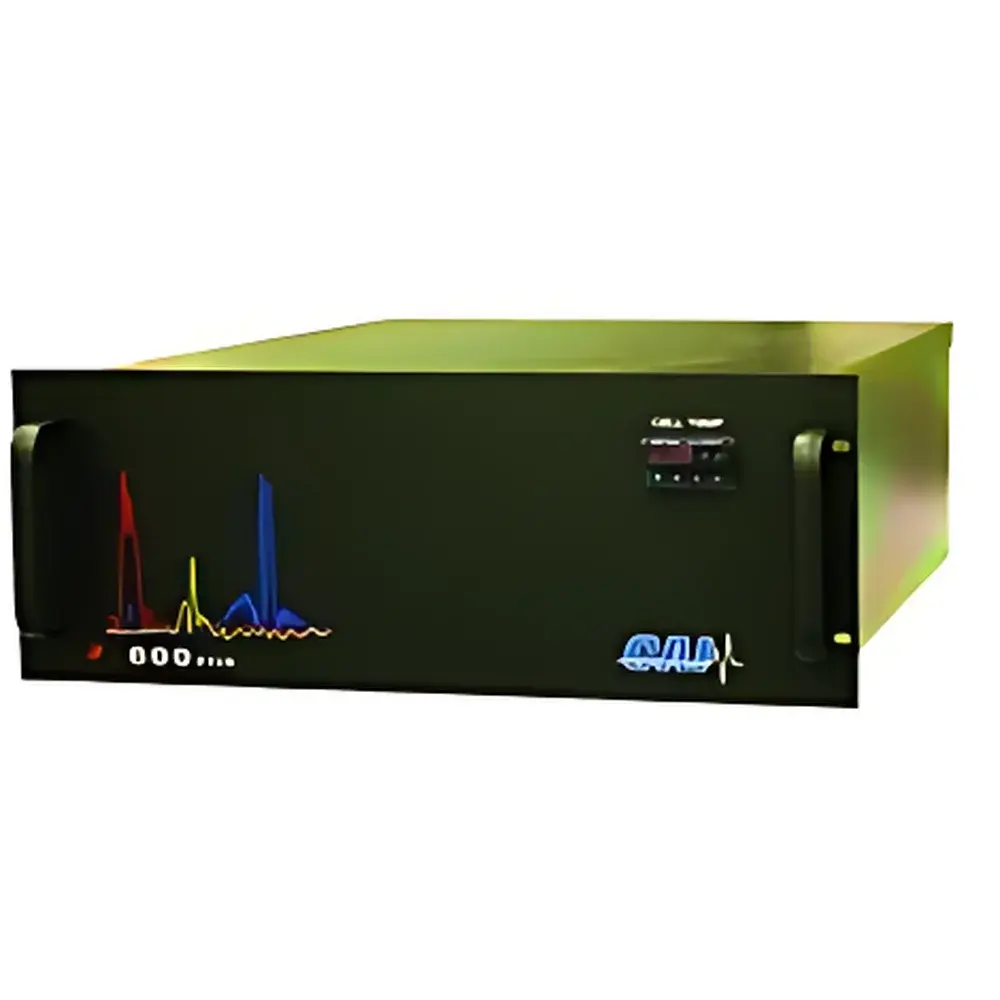
CAI 600 SCFTIR Short-Path Fourier Transform Infrared Gas Analyzer
| Brand | California Analytical Instruments (CAI) |
|---|---|
| Origin | USA |
| Model | CAI 600 SCFTIR |
| Principle | Infrared Absorption Spectroscopy (FTIR) |
| Type | Online Multicomponent Gas Analyzer |
| Detector | DTGS |
| Spectral Resolution | 0.8 cm⁻¹ |
| Spectral Range | 305–7500 cm⁻¹ |
| Optical Path Length | 8.2 m (multipass, short cell) |
| Cell Material | 316 Stainless Steel |
| Cell Temperature Options | 50 °C or 150 °C |
| Cell Volume | 200 mL |
| Window Materials | KBr, ZnSe, CaF₂ |
| Sample Flow Rate | 0.2–1.0 L/min |
| Response Time | Scan-dependent (1–300 s per spectrum) |
| Detection Range | ppm to % v/v |
| Interferometer | Permanent-alignment, cube-corner retroreflector design with wear-free bearings |
| Operating Environment | 5–40 °C, <80% RH non-condensing |
| Power | 115/230 VAC ±10%, 50/60 Hz |
| Dimensions | 7.0″ H × 19″ W × 18″ D |
| Weight | ~45 lbs (20.4 kg) |
| Compliance | Designed for EPA Method 320, ASTM D6348, ISO 12039, and EN 15267-3 applications |
| Software Platform | OPUS (Bruker), Windows XP or later |
Overview
The CAI 600 SCFTIR is a robust, online Fourier Transform Infrared (FTIR) gas analyzer engineered for continuous, multi-component quantitative analysis of industrial and environmental gas streams. Unlike dispersive or NDIR analyzers limited to pre-defined gases, the 600 SCFTIR leverages broadband mid-infrared absorption spectroscopy—measuring molecular vibrational-rotational transitions across 305–7500 cm⁻¹—to simultaneously quantify up to 20+ gases in a single scan. Its short-path, heated multipass optical cell (200 mL volume, 8.2 m effective path length) enables high-sensitivity detection of trace species (ppm-level) while maintaining linearity and stability for percent-level concentrations—ideal for demanding applications such as SCR ammonia slip monitoring, CEMS compliance, and biogas composition tracking. Critically, the system operates without liquid nitrogen cooling; its thermoelectrically stabilized DTGS (Deuterated Triglycine Sulfate) detector delivers consistent performance with zero cryogen logistics, eliminating LN₂ handling hazards, refilling downtime, and associated infrastructure costs.
Key Features
- Short-path, heated sample cell constructed from electropolished 316 stainless steel—available in 50 °C or 150 °C configurations—to prevent condensation and adsorption of polar or reactive gases (e.g., NH₃, HCl, HCHO)
- High-stability Michelson interferometer with monolithic cube-corner retroreflectors and frictionless bearing design—permanently aligned, requiring no field recalibration over instrument lifetime
- 0.8 cm⁻¹ unapodized spectral resolution—sufficient to resolve overlapping bands of complex mixtures (e.g., NO₂/SO₂, CH₄/C₂H₆, N₂O/CO₂) without chemometric ambiguity
- Modular optical window selection (KBr, ZnSe, CaF₂) optimized for humidity, acidity, or UV exposure—enabling long-term operation in wet, corrosive, or particulate-laden streams
- Integrated back-purge port (¼” Swagelok compression fitting) for positive-pressure inert gas purging of optical compartments—critical for field deployment in dusty or humid environments
- Low-maintenance architecture: no moving gratings, no consumable filters, no optical realignment—designed for >5 years of unattended operation in 24/7 process settings
Sample Compatibility & Compliance
The 600 SCFTIR is validated for quantitative analysis of over 35 IR-active gases—including CO, CO₂, CH₄, C₃H₈, N₂O, NH₃, NO₂, SO₂, HCl, HF, HCHO, SF₆, and VOCs such as benzene, toluene, and formaldehyde—without hardware modification. Its heated sample interface accommodates gas streams with dew points up to 90 °C and relative humidity >95% RH when configured with thermal management. The analyzer meets functional requirements of U.S. EPA Methods 320 (FTIR for stack gas), 323 (halogenated organics), and Appendix A to 40 CFR Part 60; supports ASTM D6348 (gaseous emissions by FTIR); and aligns with ISO 12039 (stationary source emissions) and EN 15267-3 (QAL3 verification for automated monitoring systems). Data integrity complies with GLP/GMP expectations through audit-trail-enabled software logging and secure user-access controls.
Software & Data Management
Control and spectral processing are performed via Bruker’s industry-standard OPUS software suite, installed on an external Windows PC (XP or later). OPUS provides full access to raw interferograms, real-time spectral acquisition, library-based qualitative identification (NIST/EPA/CAI reference libraries), and multivariate quantification using classical least-squares (CLS) or partial least-squares (PLS) regression. All calibration models are stored with metadata (date, operator, gas standards used, cell temperature), and spectra are timestamped with millisecond precision. Export formats include ASCII, CSV, and XML—compatible with SCADA, DCS, and LIMS platforms. Optional integration with custom LabVIEW or .NET-based middleware enables OEM-level OEM system embedding or remote diagnostics via secure TCP/IP.
Applications
- Continuous Emissions Monitoring Systems (CEMS) for coal, biomass, and waste-to-energy plants—meeting MACT and NSPS regulatory reporting requirements
- Ammonia slip monitoring upstream/downstream of selective catalytic reduction (SCR) systems in power generation and cement kilns
- Real-time combustion optimization and diesel/gasoline engine exhaust characterization (including unregulated pollutants)
- VOC abatement system efficiency verification (e.g., thermal oxidizers, carbon beds, biofilters) per EPA 40 CFR Part 63 Subpart SS
- Landfill and anaerobic digester biogas quality control—tracking CH₄, CO₂, H₂S, siloxanes, and moisture for energy recovery compliance
- Agricultural emission studies—quantifying NH₃ volatilization from manure storage and application, N₂O from soil flux chambers
- Industrial hygiene and workplace safety—monitoring exposure limits for HF, HCl, phosgene, and other toxic industrial chemicals
FAQ
Does the 600 SCFTIR require liquid nitrogen cooling?
No. It uses a thermoelectrically cooled DTGS detector, eliminating LN₂ dependency, associated safety protocols, and logistical overhead.
Can it measure humid or corrosive gas streams?
Yes—its heated sample cell (up to 150 °C), corrosion-resistant 316SS construction, and selectable IR-transparent windows (ZnSe for HCl/HF, CaF₂ for high-humidity service) ensure stable operation in challenging matrices.
How is calibration performed and maintained?
Calibration is performed using certified gas standards traceable to NIST. The interferometer’s permanent alignment and temperature-stabilized optics minimize drift; typical recalibration intervals range from 3–6 months depending on operating conditions and regulatory requirements.
Is the system compliant with 21 CFR Part 11 for pharmaceutical applications?
While the base OPUS software does not ship with Part 11 features enabled, CAI provides documentation packages and configuration guidance to support validation under FDA-regulated environments—including electronic signature workflows, audit trails, and role-based access control implementation.
What is the minimum detectable concentration for NH₃?
At 0.8 cm⁻¹ resolution and 100-scan co-addition, the practical limit of detection (LOD) for NH₃ is approximately 0.2 ppmv in a dry N₂ matrix; LOD increases modestly in high-humidity streams but remains sub-ppm with appropriate cell heating and background subtraction.
Related Products







