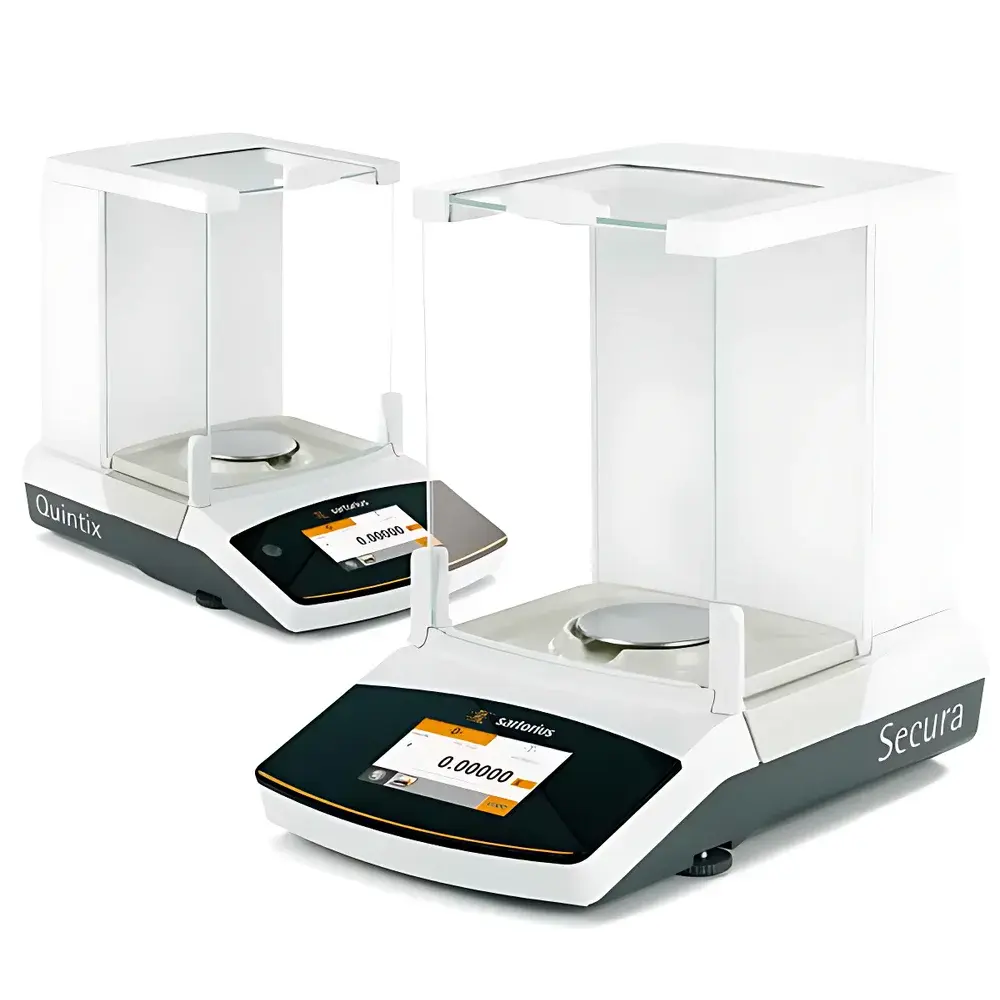
Sartorius Quintix35-1CN Analytical Balance with 0.01 mg Readability
| Brand | Sartorius |
|---|---|
| Origin | Shanghai, China |
| Model | Quintix35-1CN |
| Type | Analytical Balance |
| Maximum Capacity | 60 g |
| Readability | 0.01 mg |
| Repeatability | 0.03 mg |
| Calibration | Automatic Internal (isoCAL) |
| Pan Diameter | 80 mm (90 mm optional) |
| Stabilization Time | ≤6 s |
| Linear Error | ±0.1 mg |
| Operating Temperature Range | +10 °C to +30 °C |
| isoCAL Trigger Interval | 4 h |
| Display Update Rate | 0.2–0.4 s |
| Dimensions (D×W×H) | 376 × 214 × 316 mm |
| Net Weight | 7.8 kg |
Overview
The Sartorius Quintix35-1CN is a high-precision analytical balance engineered for demanding laboratory applications requiring consistent 0.01 mg readability and traceable measurement integrity. Built upon Sartorius’ proprietary electromagnetic force compensation (EMFC) transducer technology, it delivers exceptional stability and resolution across its 60 g maximum capacity range. Unlike mechanical or strain-gauge-based systems, the EMFC principle ensures linear response, minimal drift, and immunity to environmental fluctuations such as minor air currents or temperature gradients—critical for microgram-level weighing in regulated environments. Designed and assembled in Shanghai under Sartorius’ global quality management system (ISO 9001 certified), the Quintix35-1CN meets the metrological requirements of ISO/IEC 17025-accredited laboratories and supports compliance with pharmacopeial standards including USP , EP 2.1.3, and JP 2.03.
Key Features
- Full-color 4.3-inch capacitive touchscreen interface with intuitive icon-driven navigation—no manual required for routine operations including tare, unit conversion, density determination, and statistics.
- Integrated isoCAL™ automatic internal calibration and adjustment system, triggered either at user-defined intervals (default: every 4 hours) or by temperature change ≥1.5 K—ensuring continuous traceability without operator intervention.
- Direct PC connectivity via USB-B port; supports native data export to Excel-compatible CSV files and seamless integration with LIMS via Sartorius LabX® software (optional licensed module).
- Modular design with interchangeable draft shield configurations (standard 218 mm height, optional extended enclosure); pan diameter 80 mm (90 mm available on request) accommodates standard weighing vessels and crucibles.
- Robust aluminum die-cast housing with anti-static coating and integrated leveling feet with bubble indicator—optimized for benchtop stability in shared lab spaces.
- GLP/GMP-compliant audit trail functionality when paired with LabX, recording operator ID, timestamp, weight value, calibration events, and environmental metadata (temperature, humidity if external sensor connected).
Sample Compatibility & Compliance
The Quintix35-1CN is validated for use with solid, powdered, and low-viscosity liquid samples within standard laboratory ambient conditions (+10 °C to +30 °C). Its 60 g capacity and 0.01 mg resolution support critical applications such as reference standard preparation, catalyst mass dosing, residual solvent quantification, and gravimetric titration. The balance conforms to OIML R 76-1 Class I accuracy requirements for analytical balances and satisfies essential performance criteria outlined in ASTM E898–22 (“Standard Guide for Selection and Use of Laboratory Balances”). All factory calibrations are traceable to national metrology institutes (NMI) through DAkkS-accredited Sartorius calibration laboratories. Optional IQ/OQ documentation packages are available for GxP-regulated installations.
Software & Data Management
Data integrity is enforced through dual-path digital workflows. Local storage retains up to 1,000 weighing records with full metadata (date/time, operator, gross/net/tare values, stability flag). For networked environments, LabX software provides centralized instrument control, real-time remote monitoring, automated report generation (PDF/Excel), and 21 CFR Part 11-compliant electronic signatures and audit trails. The built-in USB-A port enables direct printing to Sartorius YDP series printers (e.g., YDP30) without drivers—ideal for GLP-compliant hardcopy archiving. Export protocols include ASCII, SCS, and Modbus TCP for integration into MES or ERP platforms.
Applications
- Pharmaceutical QC: Active pharmaceutical ingredient (API) assay, excipient blending verification, and dissolution sample preparation per USP .
- Materials science: Precise formulation of nanocomposites, catalyst loading ratios, and thin-film deposition mass tracking.
- Environmental testing: Gravimetric analysis of particulate matter (PM₂.₅/PM₁₀ filters), total suspended solids (TSS), and ash content in soil/water samples (EPA Method 160.1).
- Academic research: Stoichiometric reagent weighing in synthetic chemistry, isotope ratio sample preparation, and microcalorimetry reference mass assignment.
- Reference lab metrology: Secondary standard dissemination, uncertainty budgeting, and inter-laboratory comparison exercises.
FAQ
What does “0.01 mg readability” mean in practice?
It indicates the smallest increment the display can resolve—i.e., the balance reports mass values in 0.00001 g steps. Note that readability ≠ accuracy; actual measurement uncertainty depends on repeatability (≤0.03 mg), linearity (±0.1 mg), and environmental control.
Is isoCAL compliant with ISO/IEC 17025 requirements?
Yes—isoCAL provides documented, time-stamped internal calibration events with traceable reference masses. When combined with external verification using certified weights, it fulfills clause 6.5.2 (Equipment Verification) of ISO/IEC 17025:2017.
Can this balance be used in a fume hood?
Not recommended. Draft shields are designed for ambient lab airflow control; operation inside a fume hood introduces turbulence and pressure differentials that degrade repeatability and stabilization time.
Does the Quintix35-1CN support RS-232 communication?
No—this model features USB-B (device) and USB-A (host) ports only. RS-232 is available on legacy Secura and Entris models; for serial integration, use a certified USB-to-RS232 adapter with Sartorius-provided drivers.
How often must external calibration be performed?
Per ISO/IEC 17025 and manufacturer guidance, external calibration with traceable weights should occur at least annually—or more frequently based on risk assessment (e.g., high-use labs, critical applications, or after physical relocation or impact).