
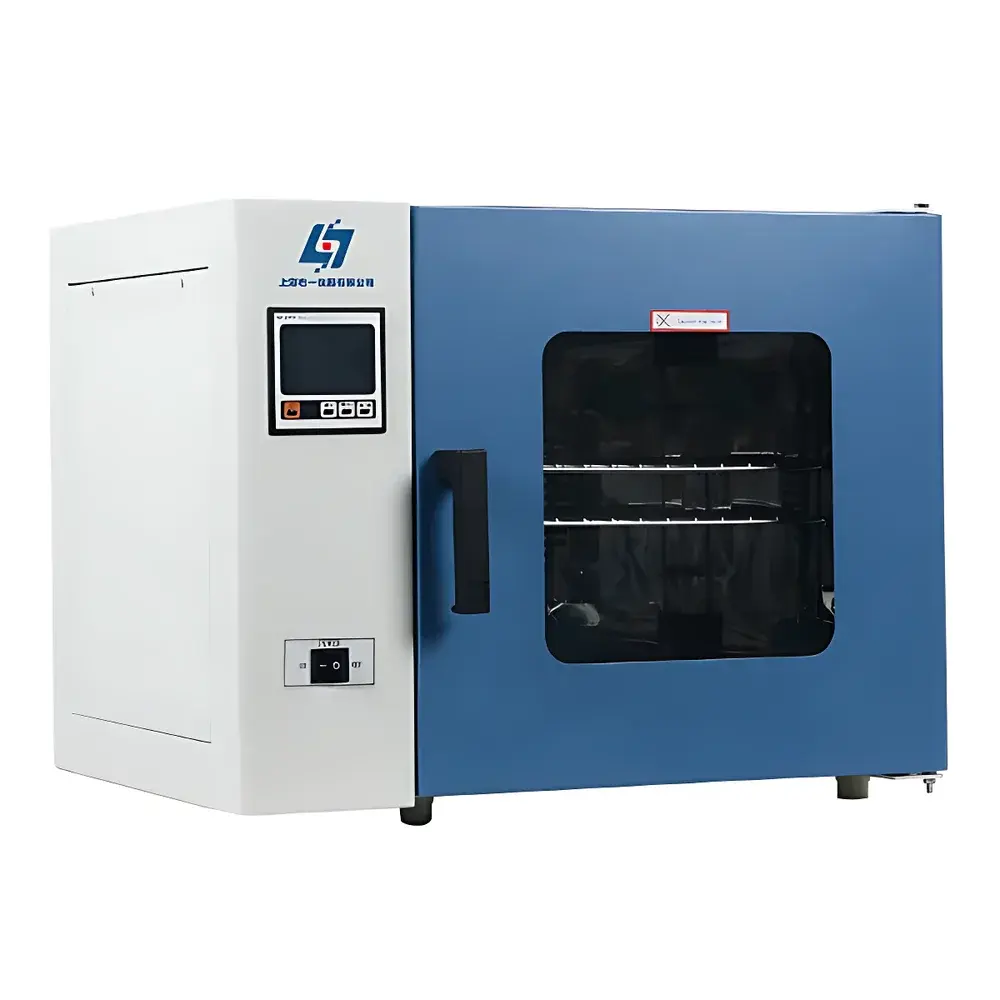
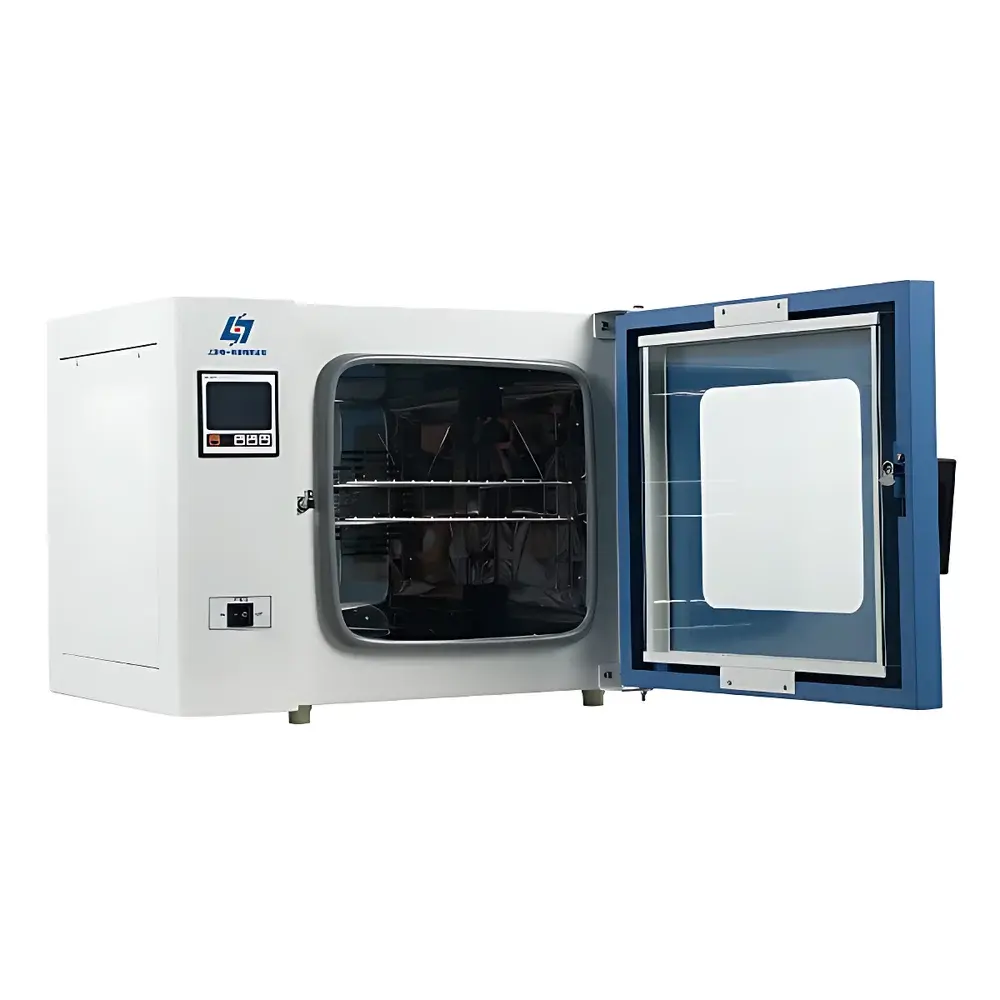
Yoyi DHG-9055A Forced-Air Constant-Temperature Drying Oven
| Brand | Yoyi |
|---|---|
| Origin | Shanghai, China |
| Manufacturer Type | Direct Manufacturer |
| Equipment Category | Domestic |
| Model | DHG-9055A |
| Temperature Range | RT+10°C to 300°C |
| Temperature Uniformity | ±2.5% (at 100°C) |
| Temperature Fluctuation | ±1°C |
| Temperature Resolution | 0.1°C |
| External Dimensions (W×D×H) | 705×610×530 mm |
| Internal Chamber Dimensions (W×D×H) | 420×350×390 mm |
| Internal Chamber Material | Mirror-Finish Stainless Steel (SUS304) |
| Heating Method | Electric Resistance Heating |
| Power Input | 1100 W |
| Working Environment | 5–40°C ambient, ≤80% RH |
| Standard Compliance | GB/T 30435–2013 |
Overview
The Yoyi DHG-9055A Forced-Air Constant-Temperature Drying Oven is an engineered laboratory-grade thermal processing system designed for precise, repeatable, and uniform heat treatment of samples across academic, industrial, and regulatory environments. It operates on the principle of forced convection—using a rear-mounted centrifugal blower and optimized air duct architecture to circulate heated air uniformly throughout the chamber. This design ensures rapid thermal equilibration and minimizes axial and radial temperature gradients, meeting the stringent spatial uniformity requirement of ±2.5% at 100°C per GB/T 30435–2013. The oven’s operational range spans from ambient +10°C to 300°C, supporting applications including moisture removal, polymer curing, pre-weighing desiccation, sterilization validation, and thermal stability testing of pharmaceutical excipients and electronic components.
Key Features
- Microprocessor-based PID temperature controller with intuitive LCD menu interface—enabling simultaneous display of setpoint, real-time chamber temperature, and remaining hold time
- Robust chamber construction: mirror-finish SUS304 stainless steel interior and cold-rolled steel exterior with electrostatic epoxy coating for corrosion resistance and long-term dimensional stability
- Dual-layer tempered glass observation window with silicone gasket seal—providing unobstructed visual monitoring while maintaining thermal integrity and minimizing heat loss
- High-efficiency forced-air circulation system with rear-mounted blower and directional airflow ducts—enhancing thermal homogeneity and reducing recovery time after door opening
- Intelligent power-loss recovery function: automatically resumes prior settings (setpoint, timer, alarm thresholds) following unexpected power interruption or system reset
- Independent over-temperature cut-off circuit (optional)—mechanically isolated from the main controller for fail-safe operation in GLP/GMP-critical workflows
- Standard rear-mounted passive ventilation ports—enabling continuous vapor exhaust without manual damper adjustment, critical for solvent evaporation or moisture-laden drying cycles
Sample Compatibility & Compliance
The DHG-9055A accommodates diverse sample types—including Petri dishes, weighing boats, crucibles, glassware, PCB assemblies, and polymer films—within its 50 L stainless steel chamber. Its design supports both open-container drying and sealed-vessel conditioning (with optional inert gas purge). The unit complies with GB/T 30435–2013, the national standard governing performance verification of electric heating ovens in China, covering test protocols for temperature uniformity, fluctuation, recovery time, and insulation efficiency. While not certified to ISO/IEC 17025 or ASTM E145, its documented repeatability (±1°C fluctuation) and traceable calibration capability make it suitable for internal method development, routine QC release testing, and non-regulated R&D environments where documented thermal consistency is required.
Software & Data Management
The base configuration includes local data logging via the onboard controller, storing up to 10 programmable temperature profiles with ramp/soak segments. Optional RS485 communication (Modbus RTU protocol) enables integration with LabVIEW, SCADA, or custom Python-based acquisition systems for time-stamped temperature logging and remote parameter control. An embedded thermal printer (optional) provides hard-copy records compliant with ALCOA+ principles—supporting audit-ready documentation for internal SOPs. All optional I/O interfaces—including inert gas inlet with calibrated float flowmeter (0–10 L/min), 25 mm/50 mm test ports, and electronic door lock—are mechanically decoupled from core thermal control circuits to preserve system integrity during extended validation runs.
Applications
- Moisture content determination per USP <731> and AOAC 950.46 using gravimetric loss-on-drying protocols
- Baking and curing of adhesives, coatings, and composite laminates in materials science labs
- Pre-conditioning of filters, membranes, and chromatographic media prior to analytical use
- Thermal aging studies of elastomers, packaging films, and battery separator materials per ISO 188 and ASTM D573
- Residue ashing support for elemental analysis workflows (ICP-OES, AAS) when paired with ceramic crucibles
- Stabilization of reference standards and hygroscopic reagents under controlled low-humidity conditions
FAQ
What is the maximum recommended operating temperature for continuous use?
The DHG-9055A is rated for sustained operation up to 300°C; however, prolonged exposure above 250°C may accelerate degradation of door gaskets and reduce long-term calibration stability.
Does the oven support programmable multi-step temperature profiles?
Yes—when equipped with the optional multi-segment programmable controller (part #Y-DTC-PRO), users can define up to 30 ramp-and-soak stages with independent dwell times and rate limits.
Can this oven be validated for GMP environments?
While the base unit lacks factory-issued IQ/OQ documentation, its stable thermal performance, digital logging capability, and optional alarm-trace features allow third-party qualification per Annex 15 and WHO TRS 986 guidelines.
Is the internal chamber volume verified per ISO 17025 requirements?
Chamber volume is calculated geometrically (420 × 350 × 390 mm = 57.3 L); volumetric calibration certificates are available upon request through accredited service partners.
What maintenance intervals are recommended for optimal performance?
Blower motor lubrication and door gasket inspection are advised every 12 months; temperature sensor verification using NIST-traceable dry-block calibrators is recommended semiannually.



