
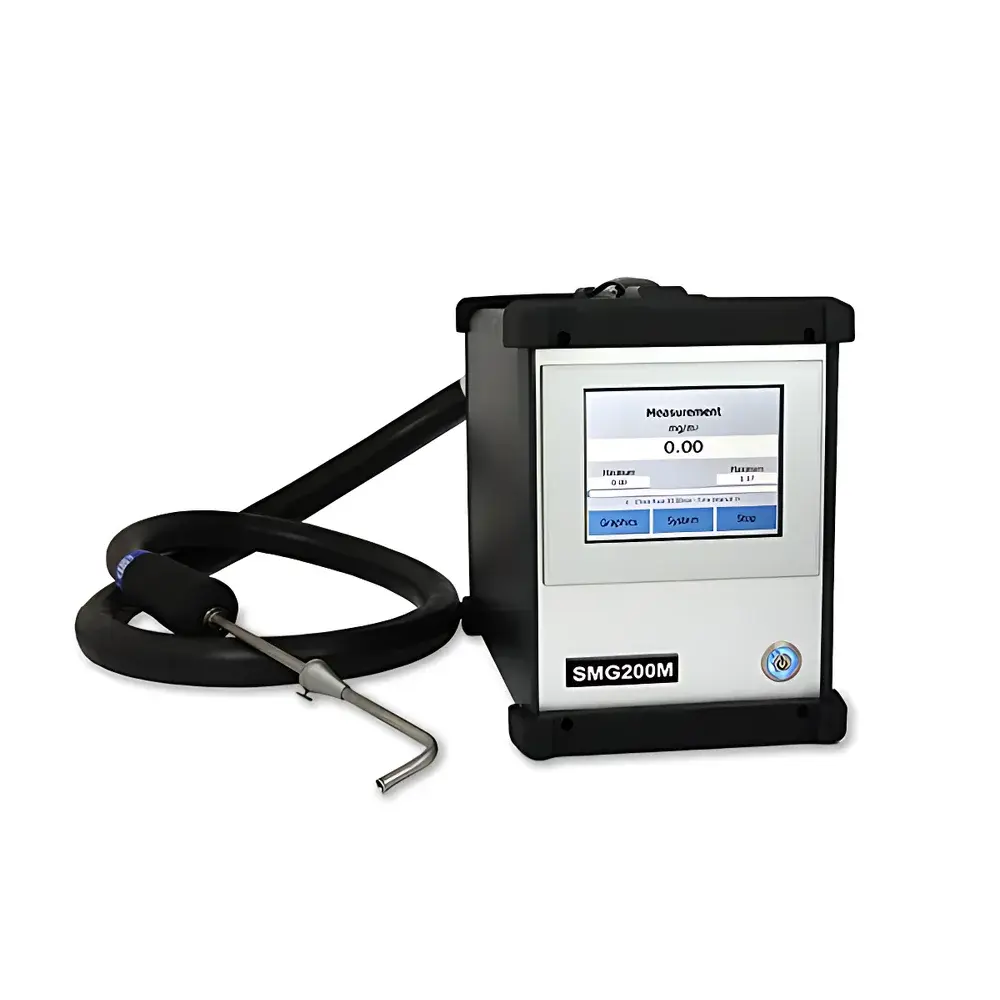
SMG200M Portable Particulate Matter (PM) and Flue Gas Sampling Analyzer
| Origin | Germany |
|---|---|
| Manufacturer Type | Authorized Distributor |
| Origin Category | Imported |
| Model | SMG200M |
| Instrument Type | Flue Gas and Particulate Sampler |
| Sample Media | Flue Dust, Exhaust Gases |
| Flow Accuracy | ±3% |
| Sampling Flow Rate | 0.88 NL/min |
| Flue Gas Velocity Range | 2.88 NL/min |
| Moisture Content Tolerance | ≤1% |
| Particle Size Detection Range | 0.04–10 µm |
| Max. Measurable Mass Concentration | 250 mg/m³ |
| Max. Medium Temperature | 500 °C |
| Max. Dew Point Measurement | 80 °C |
Overview
The SMG200M Portable Particulate Matter and Flue Gas Sampling Analyzer is an engineered solution for in-situ, real-time quantification of airborne particulate mass concentration and flue gas parameters in industrial emission stacks and ducts. Based on the principle of laser light scattering (Mie scattering), the instrument detects particles by measuring the angular intensity distribution of scattered light from a collimated 650 nm diode laser beam interacting with suspended aerosols. This optical detection method enables high-sensitivity, non-intrusive measurement without particle collection or gravimetric weighing—ideal for continuous compliance monitoring and process optimization. Designed for field deployment, the SMG200M integrates thermal management systems to sustain operation at medium temperatures up to 500 °C and dew point conditions up to 80 °C, ensuring stable performance in hot, humid, or condensing flue environments. Its compact, ruggedized chassis meets IP54 ingress protection standards, supporting battery-powered operation for extended mobile surveys.
Key Features
- Laser-based optical sensing with calibrated response across 0.04–10 µm particle diameter range
- Real-time mass concentration output (0–250 mg/m³) with ±3% volumetric flow accuracy maintained via integrated mass flow controller
- Heated sampling probe system (standard 3 m length, optional 2 m or custom lengths up to 10 m) with active temperature control to prevent condensation and wall deposition
- Touchscreen HMI with dual-mode data visualization: time-series graphs and numeric readouts, configurable display units (mg/m³, µg/m³, ppm equivalents)
- Onboard data logging (≥32,000 records) with timestamp, GPS-tagged metadata (when paired with external module), and USB export capability for post-processing in Excel or third-party analytics platforms
- Firmware-upgradable architecture supporting new calibration curves, particle-type recognition profiles (e.g., carbonaceous vs. metallic ash), and regulatory mode presets (e.g., EN 13284-1, ISO 9096)
Sample Compatibility & Compliance
The SMG200M is validated for sampling heterogeneous particulate-laden streams including coal-fired boiler exhaust, cement kiln emissions, waste incinerator off-gas, and metallurgical process fumes. It complies with key international standards governing stack testing methodology: EN 13284-1 (determination of low-range dust concentration in waste gas), ISO 9096 (stationary source emissions — manual determination of mass concentration of particulate matter), and ASTM D6331 (standard test method for determination of particulate matter emissions from stationary sources). All internal wetted components—including heated probe tubing, ceramic filter holders, and optical chamber windows—are chemically inert (316L stainless steel, fused silica, PTFE-lined) to resist corrosion from acidic condensates (SO₂, HCl) and alkaline fly ash. The system supports GLP-compliant audit trails via encrypted log files and user-access-level controls (operator/admin modes).
Software & Data Management
Data acquisition and configuration are managed through embedded firmware (v3.2+), accessible via intuitive touchscreen interface or optional PC-based SMG-Link™ desktop software (Windows 10/11 compatible). The software provides automated report generation per EU Directive 2010/75/EU (IED) Annex V requirements, including uncertainty budgeting per GUM (Guide to the Expression of Uncertainty in Measurement). Raw scatter signal waveforms, temperature/pressure compensation logs, and sensor health diagnostics are stored in CSV and binary formats. USB export supports direct integration into LIMS environments and enables traceable data transfer compliant with FDA 21 CFR Part 11 when used with digital signature modules and role-based access control.
Applications
- Regulatory stack testing for environmental permit compliance (e.g., EPA Method 5I, EN 14385)
- Performance evaluation of electrostatic precipitators (ESPs), fabric filters, and wet scrubbers
- Routine QA/QC during commissioning of new combustion systems or retrofit installations
- Source apportionment studies requiring spatially resolved PM concentration gradients across multi-point duct traverses
- Mobile emission inventories for municipal solid waste facilities and biomass co-firing plants
FAQ
What calibration standards does the SMG200M support?
The instrument accepts NIST-traceable polystyrene latex (PSL) microsphere calibrations and certified reference aerosols (e.g., Arizona Test Dust, ISO 12103-1 A2) for factory and field verification.
Can the SMG200M operate unattended for extended periods?
Yes—internal rechargeable Li-ion battery supports ≥6 hours of continuous operation; external 24 V DC input enables indefinite runtime with appropriate power supply.
Is the device suitable for explosive atmospheres?
The base SMG200M is not ATEX-certified; however, explosion-proof variants (SMG200M-Ex d IIB T4) are available upon request with IECEx and ATEX Zone 1 certification.
How often does the optical sensor require cleaning or recalibration?
Under typical industrial use, optical path cleaning is recommended every 200 operating hours; full recalibration is advised annually or after sensor replacement, following manufacturer-provided SOPs.
Does the system meet data integrity requirements for regulatory submissions?
Yes—audit trail functionality, electronic signatures (via optional dongle), and immutable log file encryption satisfy ALCOA+ principles and align with EU Annex 11 and US FDA guidance on computerized system validation.







