
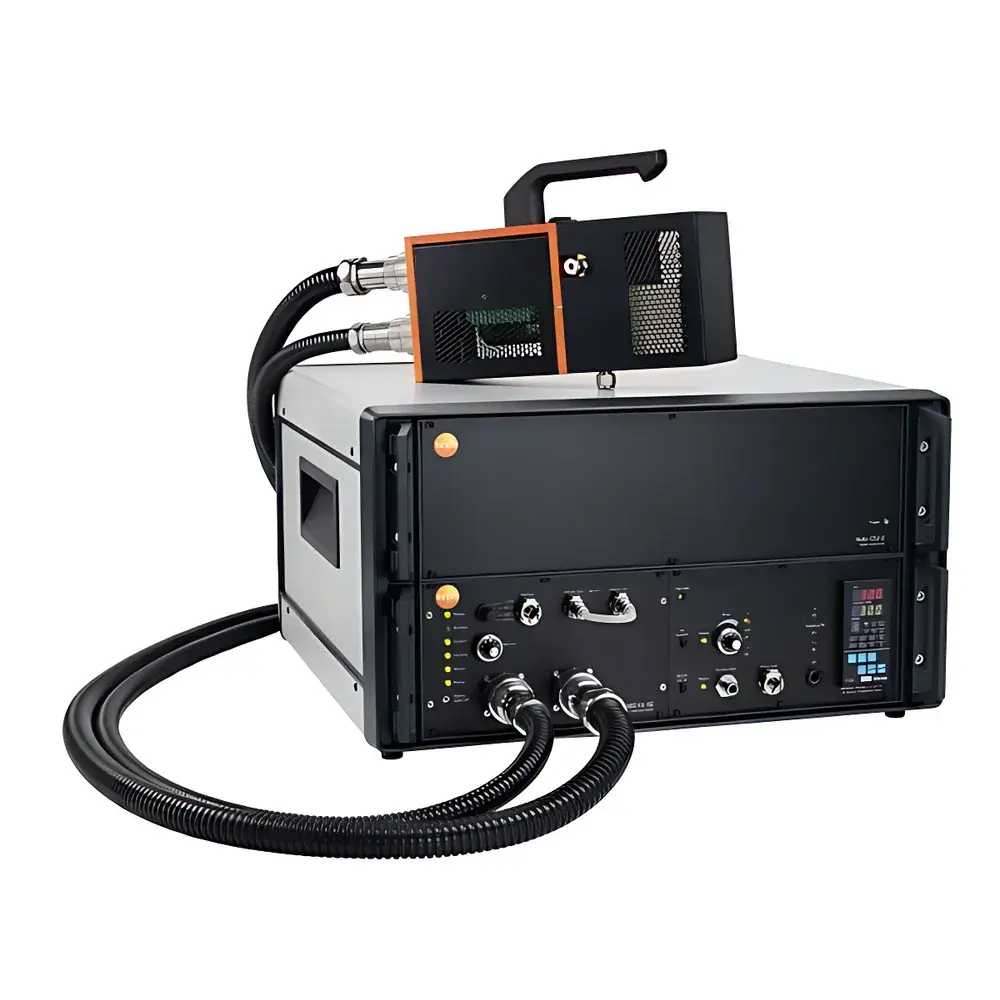
PMP1000 Engine Particle Number Emission Measurement System
| Origin | Germany |
|---|---|
| Manufacturer Type | Authorized Distributor |
| Origin Category | Imported |
| Model | PMP1000 |
| Pricing Range | USD 135,000–205,000 (FOB) |
| Instrument Type | Online Continuous Monitoring System |
| Measurement Principle | Condensation Particle Counting (CPC) with Volatile Particle Remover (VPR) |
| Maximum Permissible Error | <1% |
| Zero Drift | <1% per 24 h |
| Span Drift | <1% per 24 h |
| Repeatability | <1% (CV) |
Overview
The PMP1000 Engine Particle Number Emission Measurement System is a fully integrated, type-approved online analyzer engineered for regulatory-compliant solid particle number (PN) concentration measurement in engine exhaust—designed and manufactured in Germany to meet the most stringent international vehicle emission standards. It implements the UN/ECE R83 (Rev.3, Amend.2) and R49 test protocols, as adopted in EU Regulation (EC) No. 692/2008 (Euro 5/6), China’s GB 18352.3–2013 Annex CF and GB 18352.6–2016, and the GPRE-PMP draft specification. The system operates on the principle of thermally conditioned dilution followed by laser-based condensation particle counting (CPC), ensuring selective quantification of non-volatile solid particles ≥23 nm (50% counting efficiency) while removing >99% of volatile nucleation-mode artifacts via a three-stage Volatile Particle Remover (VPR): heated primary dilution (≥150 °C), high-temperature evaporation tube (up to 400 °C), and secondary dilution cooling. This architecture minimizes thermal diffusion losses and eliminates re-nucleation, enabling trace-level PN detection with metrological traceability to NIST-traceable calibration aerosols.
Key Features
- Full compliance with PMP-defined architecture: PCF (Particle Size Cut-Off Filter), PND1 (Heated Primary Diluter), ET (Evaporation Tube), PND2 (Secondary Diluter/Cooler), and certified CPC detector
- Adjustable heating stages: PND1 temperature selectable at 80 °C / 120 °C / 150 °C; ET temperature programmable from ambient to 400 °C in 1 °C increments
- Wide dynamic range: PN concentration measurement from 1 to 23,000 #/cm³ (individual particle counting mode) with linearity R² ≥ 0.98 across full scale
- Ultra-low background noise: <0.001 #/cm³, validated under ISO 27891 clean-air conditions
- T90 response time ≤ 3 seconds for step changes in PN concentration, supporting transient cycle testing (e.g., WLTC, FTP-75)
- Robust thermal management: Exhaust sampling temperature maintained at 47 °C ±5 °C (CVS mode) or 191 °C (direct sampling), with active dew-point suppression
- Modular mechanical design: VIPR unit (550 × 300 × 600 mm) and CPC detector (226 × 254 × 223 mm) support integration into CVS, PFDS, or direct-sampling configurations
Sample Compatibility & Compliance
The PMP1000 accepts raw or diluted exhaust streams from diesel, gasoline, CNG, LPG, and biofuel-powered engines—including those equipped with aftertreatment systems such as DOC, DPF, SCR, and GPF. It supports both constant-volume sampling (CVS) and partial-flow dilution (PFDS) architectures per ISO 8178-4 and SAE J1094. All hardware and firmware comply with GLP-aligned design controls and are qualified for audit under ISO/IEC 17025:2017 (testing laboratories) and ISO 9001:2015. Data acquisition meets FDA 21 CFR Part 11 requirements for electronic records and signatures when operated with compliant software. System validation reports include traceable uncertainty budgets per EURAMET cg-18 and VDI 3950 Part 3.
Software & Data Management
The embedded control interface provides real-time visualization of dilution ratios, temperatures, flow rates, and PN concentration trends. Raw data streams (including timestamped CPC pulse counts, VPR stage temperatures, and dilution air mass flows) are output via Ethernet (TCP/IP) or RS-485 in ASCII or binary formats compatible with AVL PUMA, Horiba MEXA, and ETAS INCA. Optional software modules enable automated calibration verification (per ISO 29463-3), drift correction logging, and report generation aligned with UN/ECE R83 Annex 7 test documentation templates. Audit trails record all parameter modifications, calibration events, and user logins with ISO/IEC 27001–compliant encryption.
Applications
- Regulatory certification testing for light-duty and heavy-duty vehicles under Euro 6d, China 6b, and US EPA Tier 3
- DPF loading, filtration efficiency, and regeneration kinetics analysis under controlled soot accumulation protocols
- Fuel formulation studies: impact of aromatic content, oxygenates, and lubricant additives on nucleation-mode particle formation
- Non-road mobile machinery (NRMM) emissions characterization per ISO 8178 series, including marine auxiliary engines and locomotive prime movers
- Stationary source monitoring: biomass combustion, waste incineration, and distributed power generation systems
- Development and validation of predictive PN emission models for engine control unit (ECU) calibration
FAQ
What particle size range does the PMP1000 measure?
It measures solid particle number concentration for particles ≥23 nm (50% counting efficiency ±12%) and ≥41 nm (>90% counting efficiency), in accordance with PMP specifications and ISO 27891 Annex B.
Can the system operate without a CVS tunnel?
Yes—it supports direct sampling (hot raw exhaust), partial-flow dilution (PFDS), and full CVS integration, with configurable thermal conditioning for each mode.
Is the instrument suitable for field deployment or only laboratory use?
The PMP1000 is rated for continuous operation in ambient temperatures from 5 °C to 45 °C and relative humidity up to 80% non-condensing; it is routinely deployed in mobile test labs and chassis dynamometer facilities.
How is calibration traceability ensured?
Primary calibration uses NIST-traceable polystyrene latex (PSL) spheres and SRM 1963 aerosol standards; secondary verification employs catalytic stripper + CPC intercomparison per ISO/CD 20581.
Does the system support remote diagnostics and firmware updates?
Yes—via secure HTTPS-enabled web interface and optional VPN tunneling; all updates undergo cryptographic signature verification prior to installation.
Related Products







