
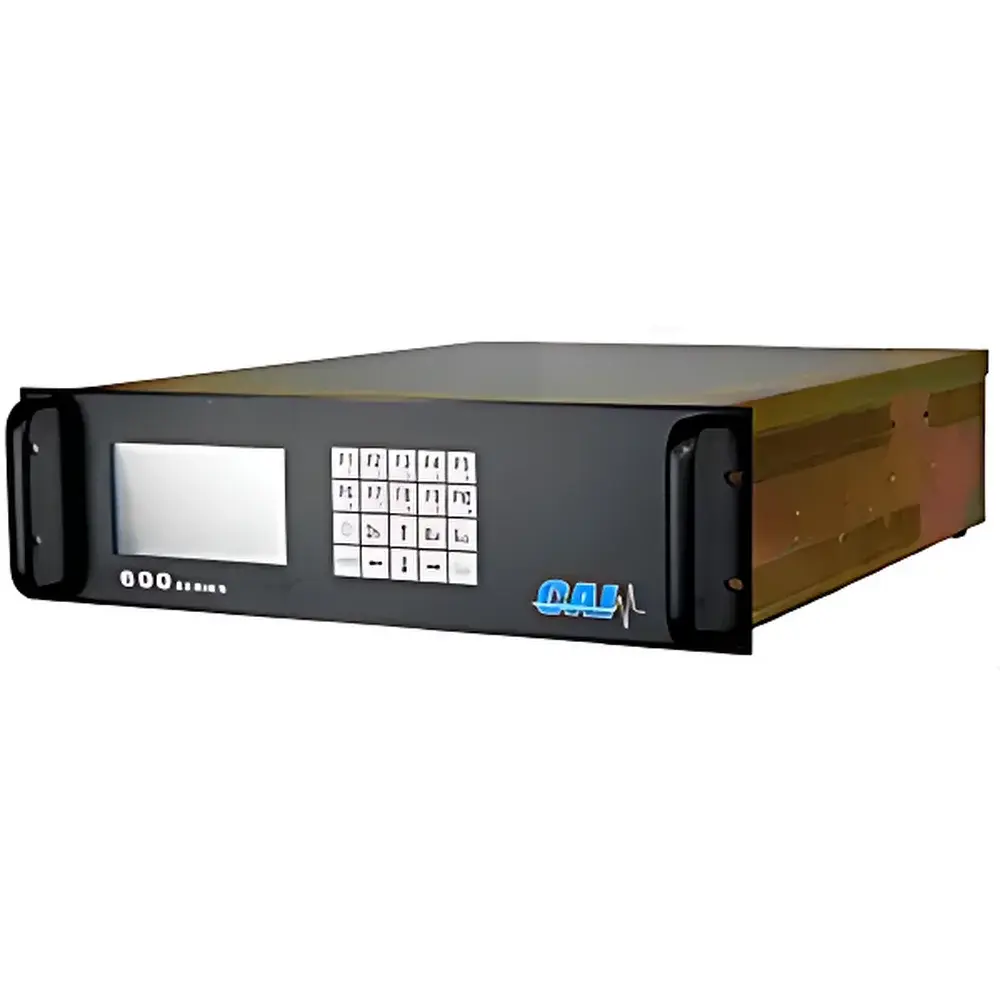
CAI 600FID Flame Ionization Detector Analyzer
| Brand | California Analytical Instruments (CAI) |
|---|---|
| Origin | USA |
| Model | CAI 600FID |
| Instrument Type | Benchtop Laboratory FID Analyzer |
| Detection Principle | Flame Ionization Detection (FID) |
| Detection Range | 0–300,000 ppm C (as CH₄ or C₃H₈) |
| Resolution | 10 ppb C |
| Accuracy | <1% of full scale |
| Response Time (T₉₀) | 1.5 s |
| Fuel Options | 40% H₂/60% He (120 mL/min) or 100% H₂ (60 mL/min) |
| Carrier/Air Supply | Ultra-pure air or synthetic air (<1 ppm carbon), 220–300 mL/min |
| Detector Temperature Stability | Oven-controlled, isothermal operation |
| Compliance | CE Marked, ETL Listed to UL 61010-1 and CAN/CSA C22.2 No. 61010-1 |
| Communication Interfaces | RS-232, TCP/IP, Modbus RTU/TCP |
| Analog Outputs | User-configurable voltage/current (0–5 V, 0–10 V, 4–20 mA) |
| Calibration | Automated zero/span with internal solenoid valves (optional zero/span gas modules) |
| Linearity | <1% of full scale |
| Repeatability | <0.5% of full scale |
| Zero/Span Drift | <1% FS/24 h |
| O₂ Interference | <3% (with H₂/He fuel) |
| CH₄ vs. C₃H₈ Response Factor | 1.15 (C₃H₈ relative to CH₄ as carbon equivalent) |
Overview
The CAI 600FID Flame Ionization Detector Analyzer is a benchtop laboratory-grade hydrocarbon measurement system engineered for high-precision, real-time quantification of total hydrocarbons (THC) in gaseous samples. It operates on the well-established flame ionization detection (FID) principle—a robust, linear, and widely accepted technique standardized in EPA Method 25A and referenced in ISO 8573-5, ASTM D6348, and EN 12619. In the FID, sample gas is introduced into a hydrogen-air (or hydrogen-helium) flame where organic compounds undergo pyrolytic ionization. The resulting ions are collected under a polarized electrostatic field across two electrodes—typically a polarizing electrode and a high-impedance collector—generating a current proportional to the carbon mass flow rate. This current is amplified via low-noise, high-stability electronics and converted into a calibrated concentration output (ppm C, % CH₄, or % C₃H₈). All critical components—including the combustion chamber, jet nozzle, collector electrode, and sample path—are maintained at a precisely controlled oven temperature to prevent condensation, adsorption, or catalytic decomposition—ensuring integrity for volatile organic compound (VOC) and non-methane hydrocarbon (NMHC) analysis across diverse industrial and regulatory applications.
Key Features
- Four user-definable measurement ranges spanning 0–30 ppm to 0–3% CH₄ (equivalent to 0–300,000 ppm C), enabling seamless transition from trace-level environmental monitoring to high-concentration process control.
- Fully automated zero and span calibration with optional integrated solenoid valves for zero air, span gas, and sample selection—supporting scheduled, triggered, or manual calibration routines.
- Electronically regulated fuel and oxidant flow control (EPC) ensuring stable flame conditions independent of inlet pressure fluctuations; eliminates mechanical regulators and improves long-term baseline stability.
- Real-time diagnostics accessible via front-panel display or remote interface—including detector temperature, combustion chamber status, fuel/air pressures, flow rates, and EPC actuator health.
- Multi-protocol digital connectivity: native support for RS-232 serial, Ethernet (TCP/IP), and Modbus RTU/TCP—enabling integration into SCADA, DCS, and LIMS environments compliant with ISA-88/ISA-95 architecture.
- Configurable analog outputs (voltage or current) with full-scale range mapping per channel; supports redundant signal routing to PLCs or data loggers without external signal conditioning.
- CE-marked and ETL-listed to UL 61010-1 and CAN/CSA C22.2 No. 61010-1—certified for use in Class I, Division 2 hazardous locations when installed per manufacturer guidelines.
Sample Compatibility & Compliance
The CAI 600FID is validated for continuous analysis of complex gas matrices including stack emissions, biogas, landfill gas, catalytic oxidizer effluent, fermentation off-gas, and vehicle exhaust. Its thermal management architecture prevents condensation of high-boiling VOCs (e.g., xylenes, naphthalene) and eliminates memory effects associated with cold spots. The analyzer meets performance criteria specified in U.S. EPA Method 25A for THC determination in stationary source emissions and is routinely deployed in MACT (Maximum Achievable Control Technology) and CEMS (Continuous Emission Monitoring Systems) compliance monitoring. It supports GLP/GMP data integrity requirements through audit-trail-enabled firmware (with timestamped calibration logs, alarm history, and configuration changes), and its communication stack is compatible with FDA 21 CFR Part 11–compliant systems when paired with validated host software.
Software & Data Management
The CAI 600FID communicates via open protocols—no proprietary drivers required. Its embedded web server provides browser-based configuration, real-time trend visualization, and firmware updates over standard Ethernet. Remote monitoring and control are supported via Modbus TCP register mapping, allowing direct integration into PI System, Ignition SCADA, or custom LabVIEW or .NET-based platforms. While CAI does not ship proprietary desktop software, the device’s ASCII command set and register documentation enable rapid development of validated analytical workflows—including automated calibration scheduling, multi-point span verification, and NMHC correction algorithms per EPA Method 25A Appendix A. All analog and digital I/O states are time-synchronized and logged with millisecond resolution, supporting ISO/IEC 17025-compliant uncertainty budgeting.
Applications
- EPA Method 25A-compliant THC monitoring in CEMS and MACT applications
- VOC abatement system efficiency verification (e.g., thermal/catalytic oxidizers, carbon adsorption beds)
- Process gas analysis in chemical synthesis, petrochemical refining, and polymer manufacturing
- Fermentation off-gas profiling for biofuel production and bioreactor optimization
- Carbon bed breakthrough detection in solvent recovery systems
- Vehicle exhaust characterization during chassis dynamometer testing
- Indoor air quality (IAQ) and occupational exposure assessment in confined spaces
FAQ
What gases can interfere with FID response?
Oxygen concentrations up to 21% cause <3% signal suppression when using H₂/He fuel; nitrogen, CO₂, and water vapor exhibit negligible interference. Halogenated or highly oxygenated organics (e.g., CH₃Cl, CH₃OH) yield substoichiometric response and require compound-specific correction factors.
Is the CAI 600FID suitable for unattended 24/7 operation?
Yes—its solid-state EPC, oven-stabilized detector, and self-diagnostics enable >6 months mean time between maintenance (MTBM) under typical lab or industrial conditions. Optional internal zero/span gas modules extend autonomous operation intervals.
Can the analyzer measure NMHC specifically?
Yes—when coupled with a methane-specific catalytic converter or GC pre-separator, or via dual-FID differential configuration (not included), NMHC is derived by subtracting CH₄ from total THC per EPA Method 25A protocol.
What certifications apply to the CAI 600FID?
It carries CE marking, ETL listing to UL 61010-1 and CAN/CSA C22.2 No. 61010-1, and conforms to EMC Directive 2014/30/EU. It is not intrinsically safe but may be installed in Zone 2/Class I Div 2 areas with appropriate barrier systems.
How is linearity verified across multiple ranges?
Linearity is factory-verified using NIST-traceable hydrocarbon standards (CH₄, C₃H₈) at ≥5 points per range. Users may perform multi-point validation via the built-in calibration wizard using external certified gases.
Related Products







