
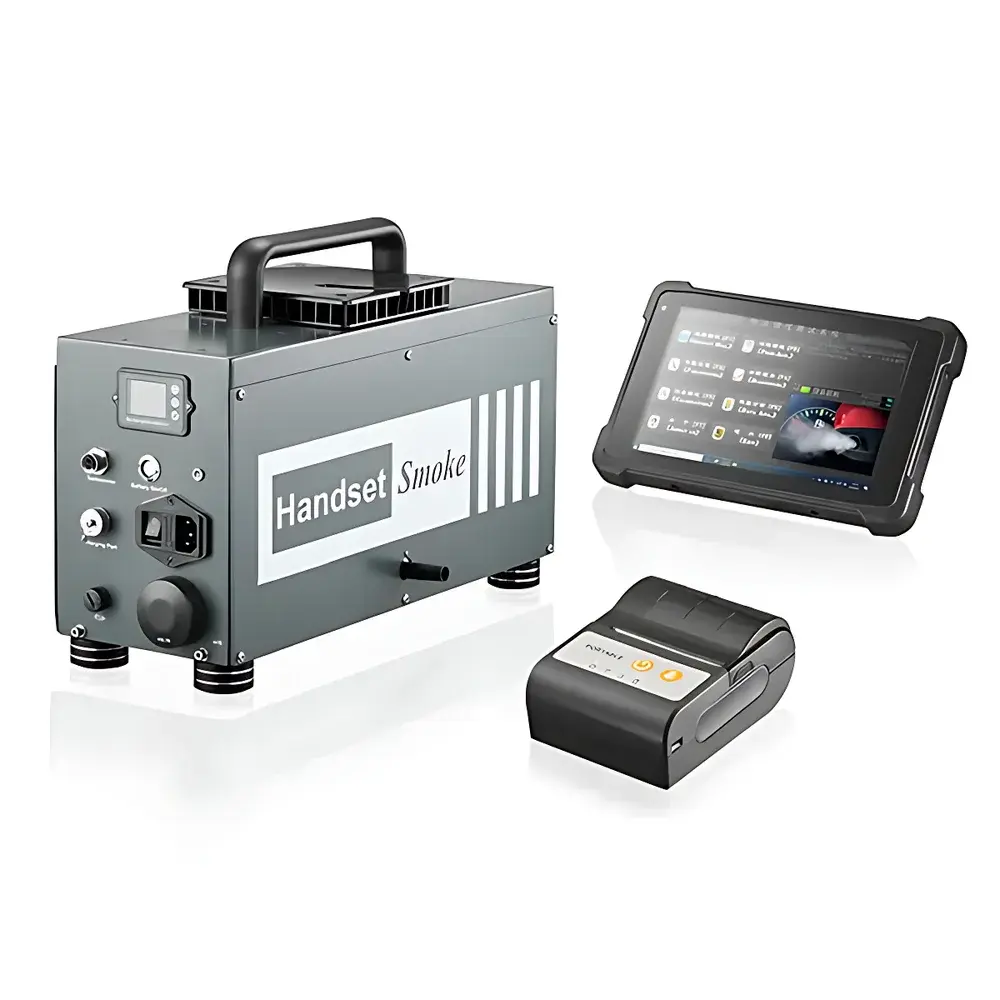
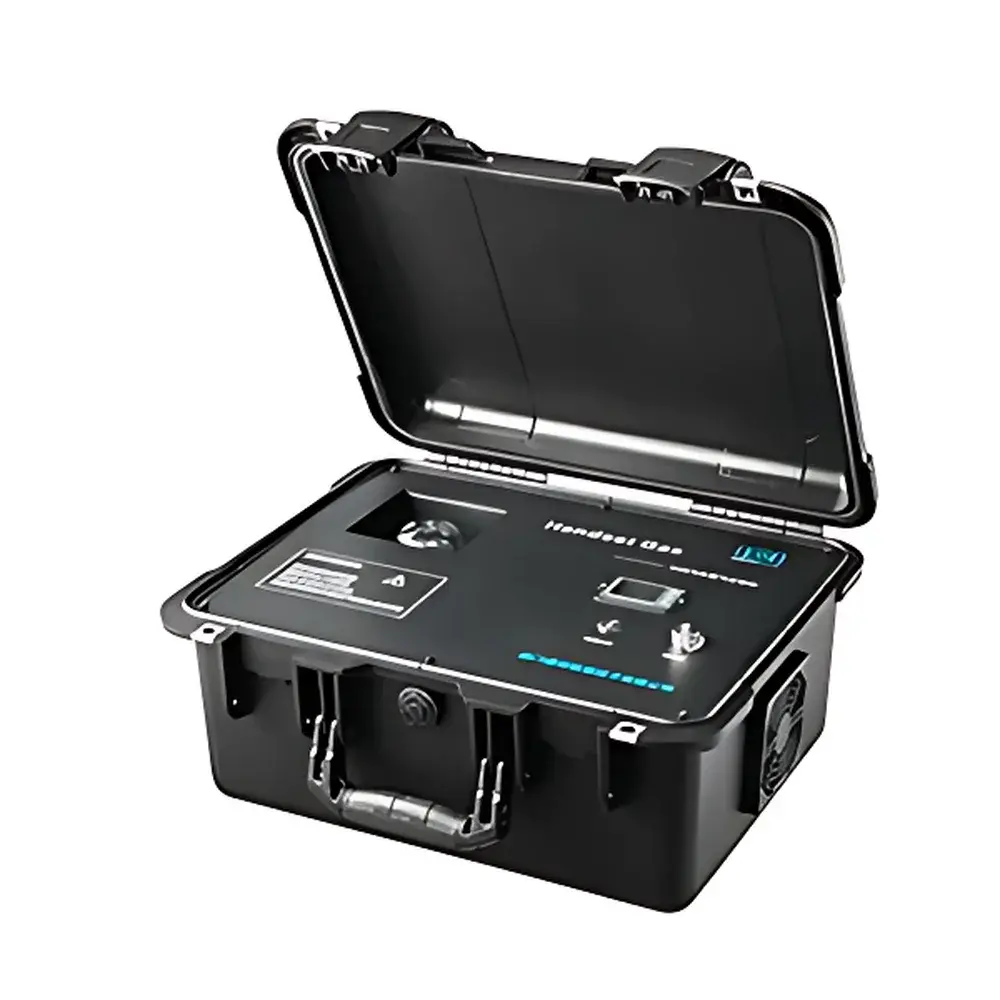
TCT Handset GS3000 Portable Diesel NOx and Opacity Analyzer
| Brand | TCT (Xiamen Tongchuang) |
|---|---|
| Origin | Fujian, China |
| Model | Handset GS3000 |
| Instrument Type | Portable |
| Detection Principle | NDIR (CO, CO₂, HC), NDUV (NO, NO₂), Filtered Light Absorption (Opacity N & K) |
| Max. Permissible Error | ±10% |
| Zero Drift | ±1% FS/24h |
| Span Drift | ±3% FS/24h |
| Repeatability | ≤2% |
| Compliance | ISO 3930, OIML R99 Class 00, ISO 11614, EU 2014/45/EU |
| Power Supply | AC/DC + 240 Wh Rechargeable Battery (≥6 h operation) |
| Connectivity | Wi-Fi, Bluetooth, 4G (optional) |
| Calibration | 10-point linear calibration for NO/NO₂ with thermostatic control |
| Gas Pre-treatment | Multi-stage filtration (particulate, oil, moisture removal) |
| Opacity Path Length | 215 mm |
Overview
The TCT Handset GS3000 is a field-deployable, integrated emissions analyzer engineered specifically for regulatory-grade measurement of nitrogen oxides (NO, NO₂, NOx) and optical opacity (N-value and K-value) in diesel-powered vehicle exhaust. Unlike conventional analyzers requiring catalytic NOx conversion, the GS3000 employs dual-spectrum optical detection: non-dispersive ultraviolet (NDUV) resonance spectroscopy for direct, interference-resistant quantification of NO and NO₂—without cross-sensitivity to H2O or CO2; and non-dispersive infrared (NDIR) absorption for simultaneous CO, CO2, and hydrocarbon (HC) analysis. A parallel optical path feeds raw exhaust into a precision filter-based opacity meter compliant with ISO 11614 and EU 2014/45/EU, featuring a 215 mm standardized light path and automatic electronic neutral-density (50%) filter verification. The instrument’s architecture integrates gas pre-conditioning—comprising particulate traps, coalescing filters, and membrane dryers—to protect optical cells and electrochemical sensors from fouling during extended field use. Designed for mobile enforcement and workshop diagnostics, it meets OIML R99 Class 00 and ISO 3930 metrological accuracy requirements for roadside emission testing.
Key Features
- Direct NDUV detection of NO and NO₂—eliminates reliance on catalytic converters and associated conversion efficiency uncertainties
- Thermostatically stabilized 10-point linear calibration for NO/NO₂ channels, ensuring long-term baseline stability and traceable accuracy
- Integrated multi-stage gas conditioning system: stainless-steel particulate filter, oil mist separator, and Nafion™-based moisture removal
- ISO 11614–compliant opacity module with auto-aligning optics, active fan cooling, and temperature-compensated photodetector array
- Onboard 240 Wh Li-ion battery enabling ≥6 hours of continuous operation under typical duty cycles (including Wi-Fi and display use)
- Dual power input support: 100–240 VAC or 12–24 VDC with real-time state-of-charge indication
- Embedded Bluetooth 5.0 and IEEE 802.11n Wi-Fi for wireless data streaming to tablets or cloud platforms
- Optional OBD-II interface supporting SAE J1979 PID retrieval—including engine speed (RPM), coolant temperature, and DTC readout
- Automated zero/span validation with onboard reference gases and self-diagnostic firmware reporting
- Ruggedized IP54-rated enclosure with shock-absorbing rubber overmold and ergonomic hand-carried form factor
Sample Compatibility & Compliance
The Handset GS3000 is validated for use across diverse diesel combustion sources, including light- and heavy-duty road vehicles, off-road construction machinery, marine auxiliary engines, and stationary generator sets. It accommodates exhaust temperatures up to 600 °C via high-temp probe options and supports sampling line lengths up to 5 m without signal degradation. All gaseous measurements adhere to ISO 3930:2000 (exhaust gas analyzers—performance requirements and test procedures) and OIML R99:2008 (Class 00 accuracy class for NOx). Opacity measurements satisfy ISO 11614:2020 (determination of light extinction coefficient and opacity of diesel exhaust) and EU Regulation No. 2014/45/EU Annex III, Section 6.3. The system supports GLP-aligned audit trails when connected to certified data management software, with timestamped calibration logs, sensor health diagnostics, and user-accessible configuration history.
Software & Data Management
The GS3000 runs embedded Linux-based firmware with a responsive 7-inch capacitive touchscreen GUI supporting multilingual operation (English, German, French, Spanish, Chinese). Measurement data—including time-stamped concentration traces, opacity transients, and OBD parameters—are stored locally in CSV and SQLite formats with configurable retention policies. Wireless connectivity enables real-time upload to secure cloud portals compliant with GDPR and ISO/IEC 27001 frameworks. Optional PC software provides post-processing tools for lambda calculation, excess air ratio derivation, and NOx speciation ratio (NO₂/NOx) trending. All firmware updates are cryptographically signed and delivered over HTTPS; calibration records include digital signatures per ISO/IEC 17025 traceability requirements. Bluetooth-printed reports embed QR codes linking to full raw datasets and calibration certificates.
Applications
- Regulatory roadside enforcement by environmental protection agencies and traffic authorities
- In-service conformity (ISC) testing for diesel fleets under EU Regulation (EU) 2016/427 and U.S. EPA 40 CFR Part 1065
- Verification of diesel oxidation catalysts (DOC), selective catalytic reduction (SCR), and diesel particulate filters (DPF)
- Pre- and post-repair emission diagnostics in certified repair facilities
- Mobile laboratory deployments for urban air quality studies and hotspot identification
- Manufacturer R&D support for aftertreatment system development and durability validation
- Marine port authority inspections under IMO MARPOL Annex VI Tier III compliance protocols
FAQ
Does the GS3000 require external NO-to-NO₂ conversion hardware?
No. The NDUV optical module measures NO and NO₂ independently using distinct UV absorption bands, eliminating conversion-related uncertainty and calibration drift.
What is the recommended calibration frequency under routine field use?
Annual full calibration is sufficient for metrological compliance when operated within specified ambient conditions (15–35 °C, <80% RH); zero and span checks are recommended before each daily shift.
Can the instrument store and export raw spectral data for third-party analysis?
Yes—raw absorbance spectra (NDIR and NDUV) and photodiode voltage traces (opacity channel) are accessible via USB mass storage mode or encrypted Wi-Fi transfer.
Is the opacity module compatible with alternative path lengths or custom probe geometries?
The 215 mm path length is fixed per ISO 11614; however, optional extension kits allow integration with fixed-position chassis dynamometer sampling ducts.
How does the system handle condensation during cold-start diesel testing?
The integrated Nafion™ dryer maintains dew point suppression below −10 °C, while heated sample lines (optional) prevent condensate formation upstream of the analyzer core.







