
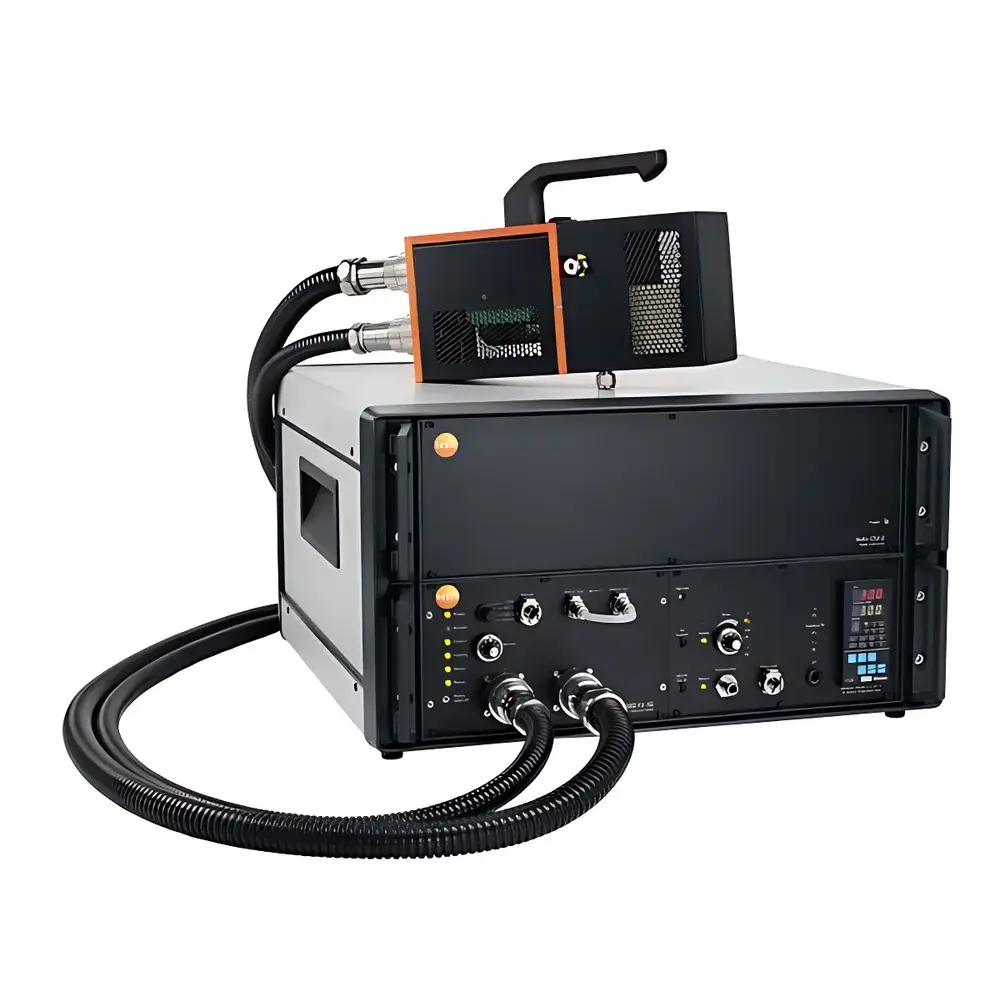
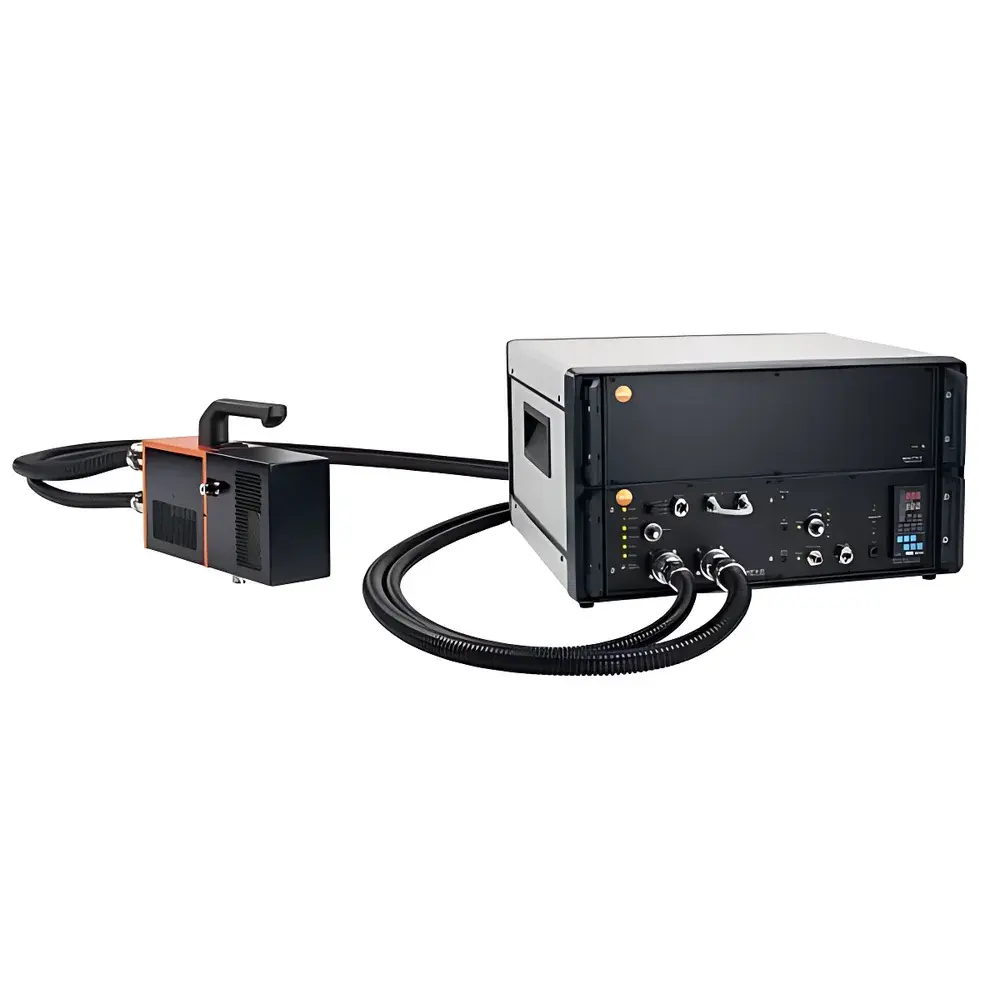
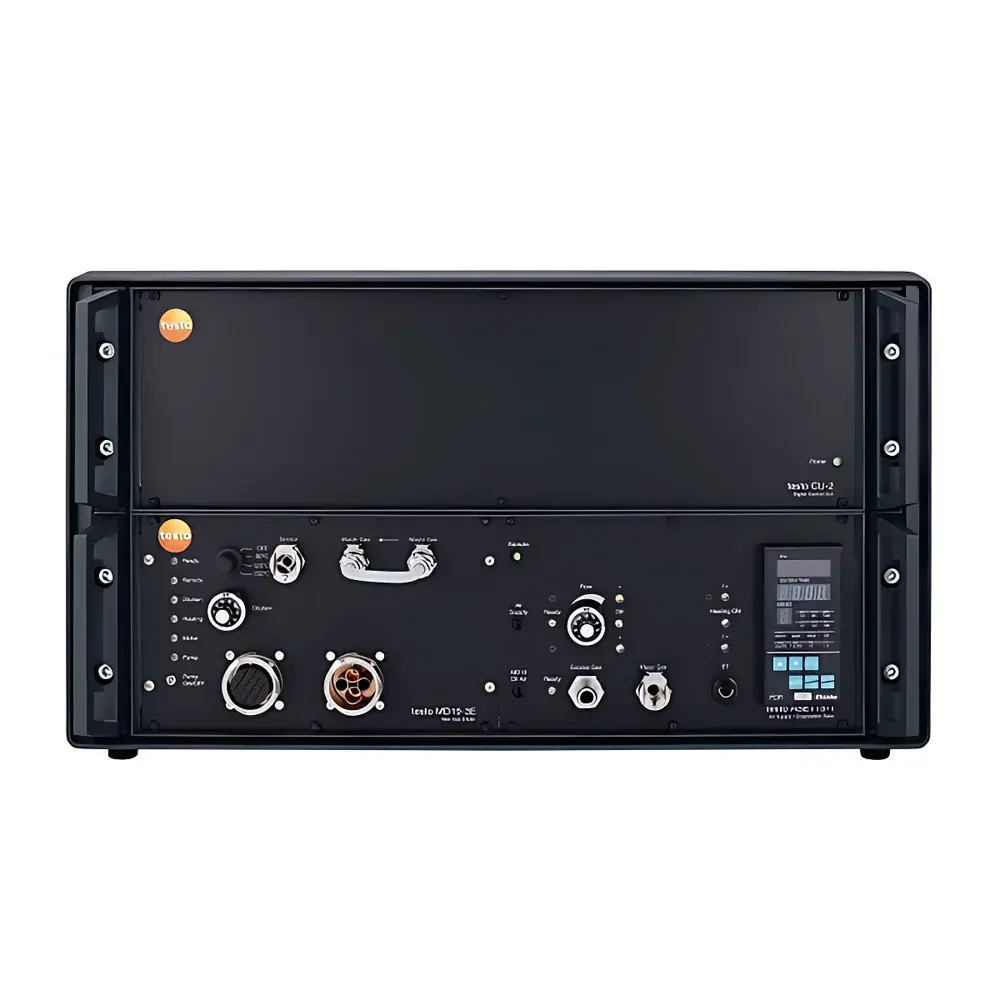
testo ViPR Volatile Particle Sampler
| Origin | Germany |
|---|---|
| Manufacturer Type | Authorized Distributor |
| Origin Category | Imported |
| Model | testo ViPR |
| Price Range | USD 9,200 – 13,200 (est.) |
| Instrument Type | Online |
| Measurement Principle | Thermal Denuding + Dilution-Based Solid-Particle Isolation |
| Max. Permissible Error | ±1% FS |
| Zero Drift | ≤1% FS/24h |
| Span Drift | ≤1% FS/24h |
| Repeatability | ≤1% RSD |
Overview
The testo ViPR Volatile Particle Sampler is a fully integrated, PMP-compliant (Particle Measurement Programme) online sampling and conditioning system engineered for the accurate quantification of solid particulate number concentration in raw automotive exhaust gas. It operates on a rigorously validated thermal denuding principle: exhaust gas undergoes two-stage dilution—first in the testo MD19-3E rotating-disk diluter, then through the testo ASE15-1 active evaporation tube—where volatile species are thermally stripped while solid nuclei remain intact. This selective removal ensures that only non-volatile, solid particles reach the downstream Condensation Particle Counter (CPC), eliminating artifacts from semi-volatile organic compounds (SVOCs) and sulfate nucleation. Designed to meet UNECE Regulation No. 83 (light-duty vehicles) and Regulation No. 49 (heavy-duty engines), the ViPR delivers traceable, metrologically sound particle number (PN) data aligned with Euro 5b–Euro 7 compliance testing requirements and WLTC/RDE real-driving emission protocols.
Key Features
- Modular, PMP-certified architecture comprising testo MD19-3E rotating-disk diluter, testo ASE15-1 heated evaporation tube, and testo CU-2 digital control unit — all pre-aligned and factory-calibrated per ISO 29463-3 and PMP Annex 3 specifications.
- Integrated volatile particle removal (VPR) module employing dual-stage dilution and controlled thermal conditioning (150 °C ± 2 °C in evaporation zone) to suppress nucleation-mode artifacts and ensure >99.5% volatility rejection efficiency for hydrocarbons and sulfates.
- Compact 19″ rack-mountable chassis with HEPA-filtered inlet, cyclonic pre-separator (PCF2.5), and internal pressure/temperature/flow monitoring sensors compliant with ISO 20000-1 traceability standards.
- Real-time analog I/O interface supporting up to five independent channels (±10 V, 16-bit resolution) for synchronized triggering with engine dynamometer signals, CVS mass flow meters, or external analyzers (e.g., CO₂, NOₓ).
- Automated calibration sequence execution via embedded firmware; supports periodic zero/span verification using certified PMP reference aerosols (e.g., CAST soot, SRM 1691).
Sample Compatibility & Compliance
The testo ViPR interfaces directly with both full-flow Constant Volume Samplers (CVS) and tailpipe configurations without hardware reconfiguration. Its sample inlet accommodates nominal flow rates from 10 to 200 L/min (standardized at 298 K, 101.3 kPa), with automatic flow compensation across ambient temperature (5–40 °C) and barometric pressure (80–106 kPa) ranges. All wetted materials (316L stainless steel, borosilicate glass, PTFE-lined tubing) comply with EPA 40 CFR Part 1065 subpart J material compatibility requirements. System-level validation adheres to UNECE R83 Annex 4B, R49 Annex 4A, and EU Commission Regulation (EU) 2017/1151 Annex IIIA—ensuring full audit readiness for type-approval laboratories under ISO/IEC 17025:2017 and GLP frameworks.
Software & Data Management
Data acquisition is managed via testo’s proprietary ViPR Control Suite (v3.2+), a Windows-based application supporting ASTM E2915-21 structured logging, 21 CFR Part 11-compliant user access control (role-based permissions, electronic signatures), and automated audit trail generation for all calibration events, parameter changes, and alarm conditions. Raw particle counts, dilution ratios, and environmental metadata are timestamped to UTC with <100 ms latency and exported in CSV/SQLite formats compatible with AVL PUMA, Horiba MEXA, and Siemens Simcenter Testlab workflows. Optional OPC UA server integration enables seamless SCADA connectivity for centralized fleet testing facilities.
Applications
- Regulatory certification testing for light- and heavy-duty vehicles against Euro 6d, China 6b, and US Tier 3 standards.
- RDE (Real Driving Emissions) measurement campaigns requiring portable, vibration-resistant PN sampling with on-board power support (110–240 V AC or 24 V DC option).
- Aftertreatment development—including DPF, GPF, and SCR system evaluation—via differential PN analysis upstream/downstream of filtration units.
- Engine calibration optimization for low-sooting combustion strategies (e.g., HCCI, RCCI) where solid particle formation kinetics must be decoupled from volatile condensation effects.
- Reference-grade inter-laboratory comparison studies under EMPIR Metrology for Sustainable Mobility projects.
FAQ
What regulatory standards does the testo ViPR explicitly support?
It fulfills UNECE R83, R49, EU 2017/1151, and ISO 8716:2020 requirements for solid particle number measurement and is pre-validated against PMP Phase 2a and 2b protocols.
Can the ViPR operate without a CPC?
No—it is a complete sampling and conditioning system designed exclusively for integration with certified CPCs (e.g., TSI 3776, Grimm 5.400) meeting PMP counting efficiency criteria (50% at 23 nm, >90% at ≥40 nm).
Is field recalibration possible without returning to a service center?
Yes—zero/span verification can be performed on-site using NIST-traceable aerosol generators and calibrated flow meters; full PMP recertification requires accredited lab intervention.
Does the system support remote diagnostics and firmware updates?
Yes—via Ethernet or optional LTE module; secure SSH/TLS-enabled remote access allows OEM engineering teams to monitor operational health and deploy critical patches without physical presence.
What is the typical maintenance interval for the evaporation tube and dilution stages?
Under continuous operation, the ASE15-1 evaporation tube requires cleaning every 200 hours; MD19-3E rotating disk inspection is recommended every 500 hours, per testo Maintenance Manual Rev. 4.1.
Related Products







