
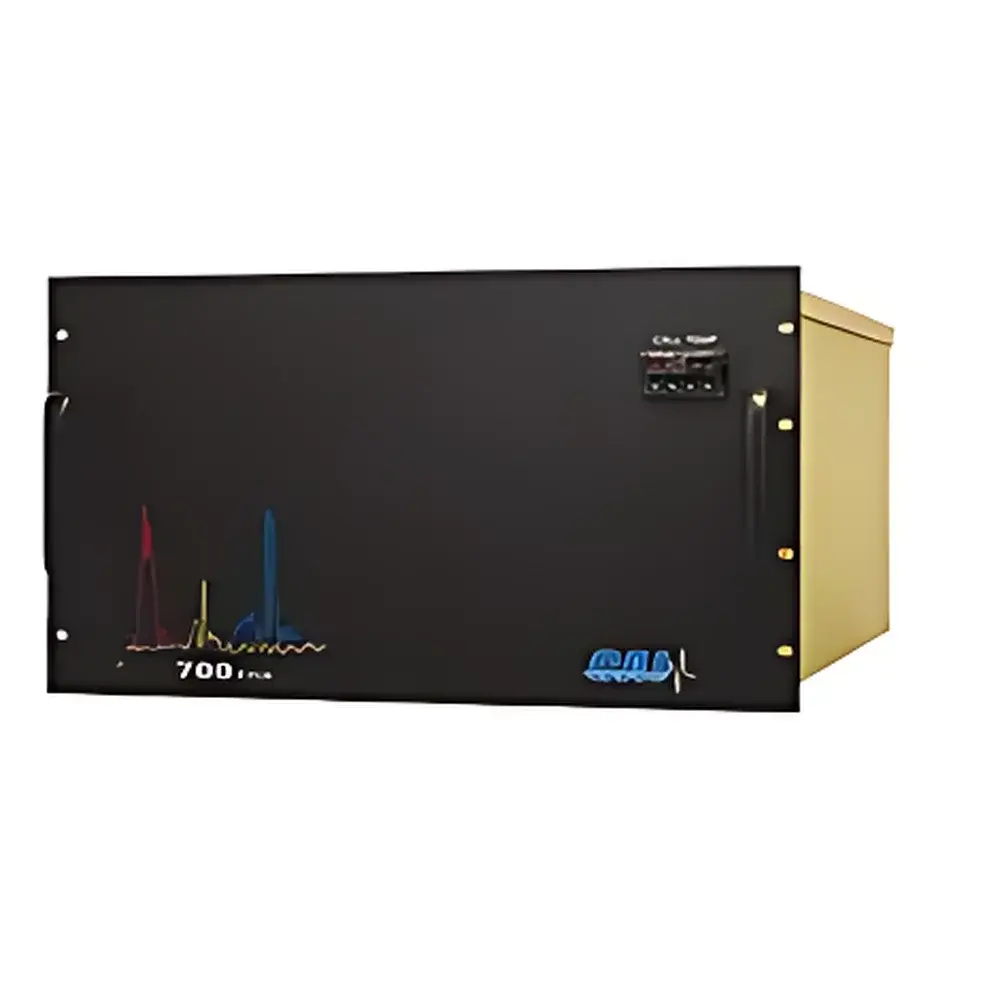
CAI 700FTIR Low-Concentration Fourier Transform Infrared Gas Analyzer
| Brand | California Analytical Instruments (CAI) |
|---|---|
| Origin | USA |
| Model | CAI 700FTIR |
| Principle | Infrared Absorption Spectroscopy |
| Type | Online Multicomponent Gas Analyzer |
| Response Time | 20 s – 5 min (typically 1 min) |
| Repeatability | ±1% of reading for CH₄, CO, CO₂, N₂O, NO, NO₂, SF₆, and other IR-active gases |
| Spectral Resolution | 0.8 cm⁻¹ (standard), adjustable up to 128 cm⁻¹ |
| Spectral Range | 305–7500 cm⁻¹ |
| Effective Optical Path Length | 10.2 m |
| Sample Cell Material | 316 Stainless Steel |
| Sample Cell Temperature | 50 °C or 191 °C (heated, thermostatically controlled) |
| Detector | DTGS (Deuterated Triglycine Sulfate) |
| Sampling Flow Rate | 0.2–5 L/min |
| Operating Ambient | 5–40 °C, <90% RH (non-condensing) |
| Power | 115 VAC/60 Hz or 230 VAC/50 Hz |
| Dimensions | 10.5" H × 19" W × 28" D |
| Weight | ~90 lbs (40.8 kg) |
| Window Material | ZnSe (standard), optional alternatives available |
| Cell Volume | 550 mL |
| Inlet/Outlet | 3/8" tubing |
| Purge Fitting | 1/4" Swagelok compression |
| Mirror Coating | Gold-coated SS 316 |
| Interferometer | Robust, permanently aligned, cube-corner retroreflector design with frictionless bearings |
Overview
The CAI 700FTIR Low-Concentration Fourier Transform Infrared Gas Analyzer is an online, real-time multicomponent gas analysis system engineered for high-sensitivity, quantitative measurement of trace and major gaseous species in complex industrial and environmental matrices. Based on the physical principle of Fourier Transform Infrared (FTIR) absorption spectroscopy, the instrument detects molecular vibrational transitions across a broad mid- to near-infrared spectral range (305–7500 cm⁻¹). Unlike dispersive or filter-based analyzers, FTIR enables simultaneous, non-destructive quantification of dozens of analytes—including CH₄, CO, CO₂, N₂O, NO, NO₂, NH₃, SO₂, HCl, HF, VOCs, and SF₆—within a single spectrum, without cross-interference calibration drift. Its thermally stabilized, heated sample cell (operable at 50 °C or 191 °C) accommodates hot, humid, or condensable streams—critical for CEMS, SCR ammonia slip, biomass syngas, landfill gas, and diesel exhaust applications. The absence of liquid nitrogen cooling eliminates cryogenic handling hazards, infrastructure dependencies, and associated downtime, enabling true field-deployable operation with laboratory-grade spectral fidelity.
Key Features
- Zero-cryogen operation: Eliminates reliance on liquid nitrogen, reducing safety risks, operational complexity, and total cost of ownership.
- High-sensitivity optical path: 10.2-meter folded-path cell with gold-coated 316 stainless steel mirrors ensures robust signal-to-noise ratio for sub-ppb to percent-level detection.
- Thermally managed sample cell: Precisely controlled heating (50 °C or 191 °C) prevents condensation and maintains sample integrity during high-moisture or low-volatility gas analysis.
- Permanently aligned interferometer: Cube-corner retroreflector design with frictionless bearings delivers long-term mechanical stability and zero realignment requirement over instrument lifetime.
- Modular expandability: Optional pressure compensation, intelligent multi-point sampling manifold, analog output modules (4–20 mA / 0–10 V), and custom sampling accessories support integration into diverse process control architectures.
- Compact footprint & transport-ready: Dimensions of 10.5″ × 19″ × 28″ and weight under 90 lbs enable rack-mounting, mobile lab deployment, or space-constrained installation in analyzer shelters.
Sample Compatibility & Compliance
The CAI 700FTIR is validated for continuous analysis of wet, hot, corrosive, and particulate-laden gas streams typical of combustion processes, biogas upgrading, waste incineration, and chemical manufacturing. Its ZnSe optical windows and 316 stainless steel flow path resist degradation from acidic components (e.g., HCl, HF, SO₂) and organic vapors. The heated cell mitigates wall adsorption effects for reactive species such as NO₂ and NH₃. From a regulatory standpoint, the system supports compliance with EPA Methods 320 and PS-15, ISO 12039, EN 15267-3, and ASTM D6348 for continuous emissions monitoring. Data integrity features—including audit-trail-enabled software logging, user-access controls, and timestamped spectral archives—facilitate adherence to GLP, GMP, and FDA 21 CFR Part 11 requirements when configured with appropriate IT governance protocols.
Software & Data Management
Control and data processing are executed via OPUS spectroscopy software (Bruker), preconfigured for CAI hardware integration. The software runs on standard Windows platforms (Windows XP or later) and supports both rack-mounted industrial PCs and portable laptops. It provides real-time spectral acquisition, multivariate quantitative analysis using classical least-squares (CLS) or partial least-squares (PLS) algorithms, dynamic baseline correction, and automated water/CO₂ interference subtraction. All raw interferograms, processed spectra, concentration time-series, and diagnostic logs are stored in vendor-neutral formats (e.g., JCAMP-DX, CSV) for third-party validation, statistical process control (SPC), or regulatory submission. Optional custom software development—such as LabVIEW-based SCADA interfaces or SQL Server–backed historical databases—is available to meet site-specific automation and data governance requirements.
Applications
- Continuous Emissions Monitoring Systems (CEMS) for stack gas compliance (NOₓ, SO₂, CO, CO₂, N₂O, CH₄).
- Ammonia slip monitoring across selective catalytic reduction (SCR) and selective non-catalytic reduction (SNCR) systems.
- Greenhouse gas flux studies (CH₄, N₂O, CO₂) in agricultural, landfill, and wastewater treatment settings.
- Biomass and landfill gas quality control: real-time tracking of H₂, CO, CH₄, CO₂, O₂, and tar-related VOCs.
- Automotive and engine testing: transient exhaust analysis for RDE, PEMS, and chassis dynamometer applications.
- VOC abatement efficiency verification: quantification of aromatic, oxygenated, and halogenated compounds pre- and post-treatment.
- High-purity gas certification: detection of trace impurities (e.g., H₂O, CO, CO₂, hydrocarbons) in semiconductor-grade N₂, Ar, He, and H₂.
FAQ
Does the 700FTIR require liquid nitrogen cooling?
No. The CAI 700FTIR uses a thermoelectrically stabilized DTGS detector, eliminating all dependency on liquid nitrogen.
What is the minimum detectable concentration for CO₂ and CH₄?
Detection limits are application-dependent but typically reach low-ppb levels for CO₂ and sub-ppb for CH₄ under optimal signal averaging and path-length conditions.
Can the instrument operate continuously in high-humidity flue gas?
Yes—the heated sample cell (up to 191 °C) and heated optical windows prevent condensation and maintain measurement stability even at >80% RH.
Is the system compliant with EPA or EU emissions reporting standards?
When deployed with certified calibration protocols and QA/QC procedures, it meets the performance specifications of EPA PS-15 and EN 15267-3 for CEMS applications.
How is spectral calibration maintained over time?
The interferometer employs a permanently aligned, monolithic cube-corner design with no moving parts subject to wear; wavelength calibration is referenced to internal HeNe laser stabilization, ensuring long-term reproducibility without manual recalibration.
Related Products







