
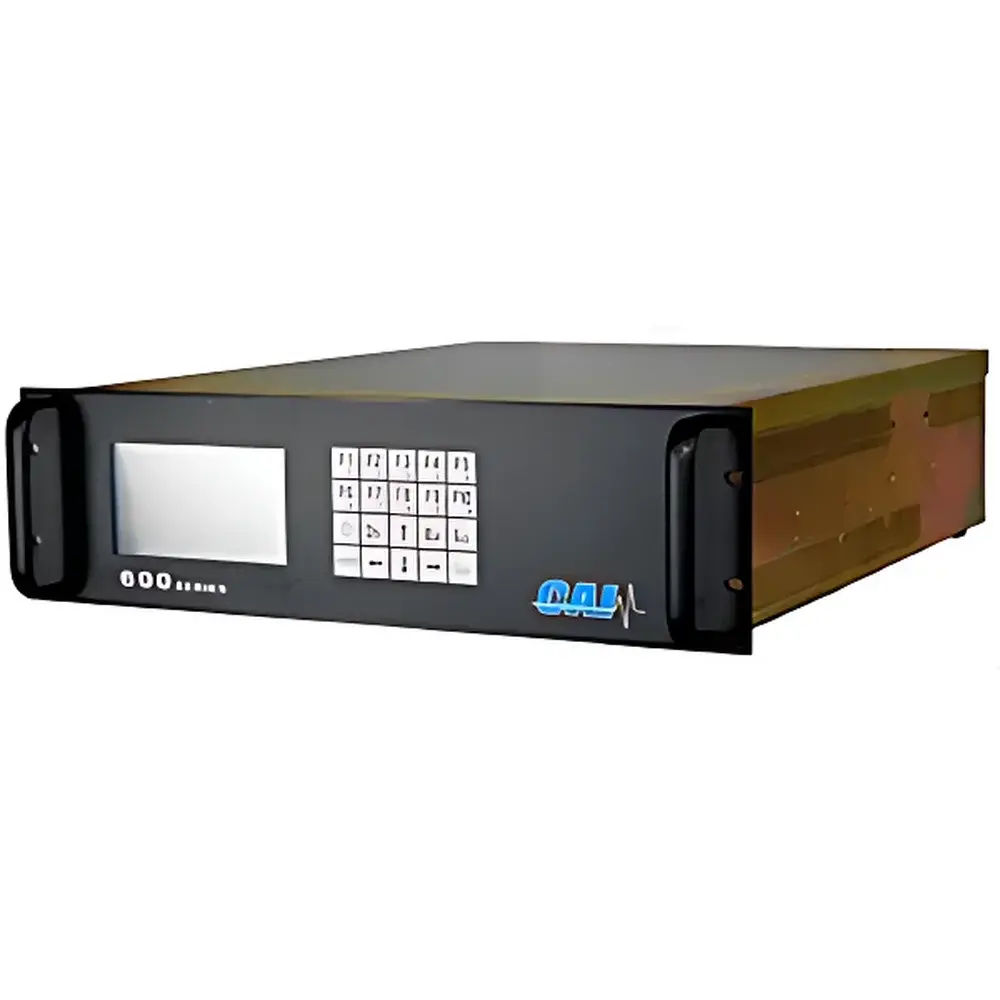
CAI 600MHFID Methane Analyzer
| Brand | California Analytical Instruments (CAI) |
|---|---|
| Origin | USA |
| Model | 600MHFID |
| Detection Principle | Flame Ionization Detection (FID) |
| Measurand | Methane (CH₄) and Total Hydrocarbons (THC) |
| Range Options | User-Configurable from 0–30 ppm to 3% CH₄ |
| Accuracy | ±0.5% of full scale |
| Repeatability | <0.5% of full scale |
| Response Time (T90) | <1.5 s |
| Drift | <1% FS/24 h (zero/span) |
| Detector Oven Temperature | 191 °C (HFID mode) |
| Sample Flow Rate | ~2.0 L/min |
| Fuel Gas | 40% H₂/60% He (120 cc/min) or 100% H₂ (60 cc/min) |
| Air Supply | Ultra-low carbon air (<1 ppm C), 220–300 cc/min |
| Minimum Detectable Level | 10 ppb C |
| Linearity | <1% of full scale |
| Output Interfaces | RS232, TCP/IP, Modbus RTU/TCP |
| Analog Outputs | Voltage/current, user-scalable |
| Compliance | CE Marked, ETL Listed to UL 61010-1 and CAN/CSA C22.2 No. 61010-1 |
| Dimensions | 5″ H × 19″ W × 23″ D |
| Weight | 50 lbs |
| Power | 115/230 VAC ±10%, 50/60 Hz, max 750 W |
Overview
The CAI 600MHFID Methane Analyzer is a high-performance, laboratory- and field-deployable flame ionization detector (FID) engineered for continuous, real-time quantification of methane (CH₄) and total hydrocarbons (THC) in process, stack, and ambient gas streams. Based on the fundamental principle of hydrocarbon combustion in a hydrogen-air flame—followed by ionization and charge collection—the instrument delivers exceptional sensitivity, linearity, and stability across a dynamic concentration range spanning from sub-ppb carbon-equivalent levels up to 3% CH₄. Its heated FID (HFID) configuration maintains all critical sample pathways—including the burner, detector electrodes, and sampling manifold—at a precisely controlled 191 °C oven temperature, eliminating condensation artifacts and ensuring quantitative recovery of high-boiling-point hydrocarbons. This thermal integrity is essential for compliance with U.S. EPA Method 25A and related regulatory protocols governing emissions monitoring, VOC abatement verification, and combustion efficiency assessment.
Key Features
- Heated FID architecture with programmable 191 °C detector oven and integrated heated sampling pump (optional)
- Four user-definable measurement ranges (e.g., 0–30 ppm, 0–300 ppm, 0–3,000 ppm, 0–3% CH₄), each optimized for signal-to-noise ratio and dynamic response
- Electronic proportional pressure control (EPC) for fuel (H₂ or H₂/He blend) and zero/combustion air, enabling stable flame operation and minimized drift
- Dual-mode detection capability: simultaneous THC and CH₄ measurement with NMHC (non-methane hydrocarbons) calculation via catalytic methanizer bypass
- Catalytic non-methane cutter achieves >98% conversion efficiency for ethane and heavier hydrocarbons, with <10% methane slip—validated per EPA-recommended performance criteria
- Comprehensive diagnostics: real-time monitoring of burner temperature, catalyst bed temperature, sample/fuel/air pressures and flows, EPC status, and system voltage
- Remote operability via TCP/IP and Modbus RTU/TCP; local control via backlit 3″ × 5″ LCD interface with four-level password protection
- Auto-calibration and span-gas adjustment routines scheduled via internal clock or triggered externally through digital I/O or network command
Sample Compatibility & Compliance
The 600MHFID is validated for use with representative gas matrices encountered in regulated industrial applications—including flue gas from coal-, oil-, and natural gas-fired boilers; exhaust from internal combustion engines and stationary reciprocating engines; off-gas from bio-digesters and landfill gas treatment systems; and effluent from thermal oxidizers and carbon adsorption beds. It meets the physical and functional requirements of U.S. EPA Methods 25A (for THC) and 25B (for CH₄), and supports data acquisition architectures compliant with 40 CFR Part 60, Subpart Ja (MACT), and Part 75 (CEMS). Its CE marking and ETL listing to UL 61010-1 and CAN/CSA C22.2 No. 61010-1 confirm conformance with international electrical safety standards for measurement and control equipment. While not inherently 21 CFR Part 11–compliant, its audit-trail-capable firmware and secure communication interfaces support integration into GLP/GMP-aligned data systems when paired with validated third-party software platforms.
Software & Data Management
The analyzer provides native ASCII-based serial (RS232) and Ethernet (TCP/IP) communication protocols, supporting both polled and unsolicited data streaming modes. All analog outputs (0–5 V, 0–10 V, 4–20 mA) are fully scalable per user-defined range and engineering unit (e.g., ppm CH₄, % THC, mg/m³ NMHC). Modbus RTU/TCP register mapping enables seamless integration with SCADA, DCS, and PLC environments without proprietary middleware. Internal memory logs calibration events, alarm states, and diagnostic parameters at user-configurable intervals. Although CAI does not ship bundled PC software, the device’s open protocol architecture allows interoperability with industry-standard platforms—including LabVIEW, MATLAB, Ignition SCADA, and custom .NET/C# applications—facilitating automated report generation, trend analysis, and regulatory submission workflows.
Applications
- EPA Method 25A/25B-compliant continuous emissions monitoring (CEM) for methane and THC in stationary source stacks
- Performance verification of VOC abatement technologies (e.g., regenerative thermal oxidizers, catalytic oxidizers, activated carbon beds)
- Fermentation and anaerobic digestion process control, including biogas quality assurance and carbon bed breakthrough detection
- Mobile source testing: diesel and natural gas vehicle exhaust characterization under transient and steady-state conditions
- Occupational health and safety monitoring in confined spaces where methane accumulation poses explosion risk
- Research-grade quantification of hydrocarbon speciation in atmospheric chemistry studies when coupled with GC pre-separation
FAQ
What gases can the 600MHFID quantify?
It measures total hydrocarbons (THC) as carbon-equivalent (C₁), methane (CH₄), and calculates non-methane hydrocarbons (NMHC) using a catalytic methanizer bypass path.
Is the instrument suitable for wet or corrosive sample streams?
No. The 600MHFID requires conditioned, dry, particle-free gas. A dedicated sample conditioning system—including particulate filtration, moisture removal (e.g., Nafion dryer or chilled mirror), and acid gas scrubbing—is mandatory for stack or biogas applications.
Does it require daily calibration?
Not necessarily. With stable environmental conditions and proper maintenance, calibration checks every 24–72 hours meet most regulatory requirements; drift remains <1% FS/24 h for zero and span.
Can it operate unattended for extended periods?
Yes. Its solid-state electronics, EPC-controlled gas delivery, and embedded diagnostics enable reliable 7×24 operation in remote or hazardous locations when installed in an appropriate NEMA-rated enclosure.
What is the minimum detectable concentration?
The instrument achieves a lower limit of detection (LLD) of 10 ppb carbon-equivalent under optimal signal averaging and low-noise operating conditions.
Related Products







