
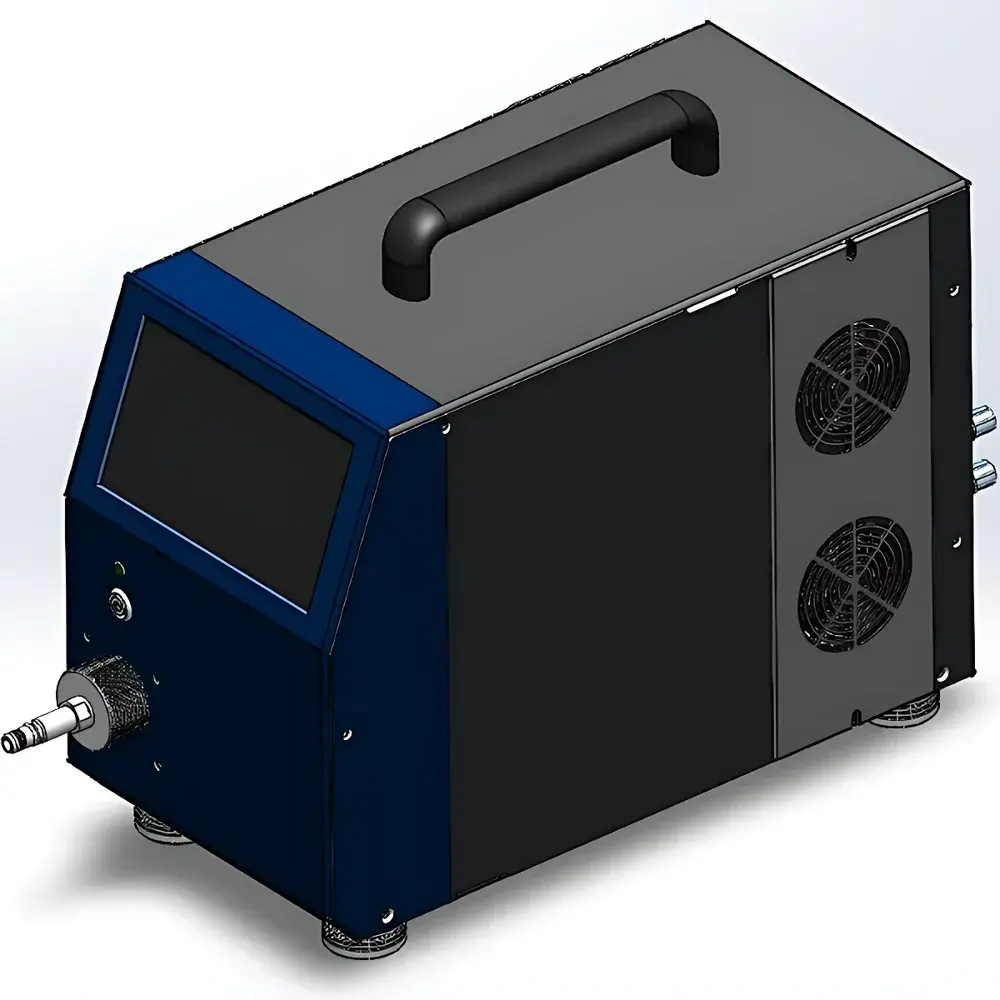
TCT PAAA1000 Portable Tunable Diode Laser Absorption Spectroscopy (TDLAS) Ammonia Analyzer
| Brand | TCT |
|---|---|
| Model | PAAA1000 |
| Type | Portable Gas Analyzer |
| Measurement Principle | Tunable Diode Laser Absorption Spectroscopy (TDLAS) |
| Target Gases | NH₃, O₂ |
| Detection Method | In-situ hot-wet measurement with 190 °C heated optical cell and sampling path |
| Range (NH₃) | 0–20 ppm to 0–100 ppm (selectable), Resolution: 0.01 ppm |
| Range (O₂) | 0–25 %, Resolution: 0.01 % |
| Accuracy (NH₃) | ≤ ±2.0 % F.S. (linearity & repeatability), Zero/ Span Drift: ≤ ±2.0 % F.S./24 h |
| Accuracy (O₂) | ≤ ±1.5 % F.S., Drift: ≤ ±0.01 %/24 h or ±2 % F.S./month |
| Response Time (T90) | 2 s at 3 L/min |
| Operating Temperature | +15 °C to +50 °C |
| Storage Temperature | −40 °C to +80 °C |
| Enclosure Rating | IP44 |
| Dimensions | 202 mm × 470 mm × 338 mm |
| Weight | 13–15 kg |
| Power Supply | 100–250 VAC, 50/60 Hz |
| Compliance | HJ/T 47–1999, HJ/T 397–2007, JJG 968–2002, DL/T 1916–2018, JJG 1105–2015 |
Overview
The TCT PAAA1000 is a field-deployable, high-precision ammonia (NH₃) and oxygen (O₂) analyzer engineered for real-time, in-situ measurement of low-concentration NH₃ in hot, humid flue gas streams from stationary emission sources. It employs Tunable Diode Laser Absorption Spectroscopy (TDLAS)—a physics-based, spectroscopic technique that exploits the narrow, molecule-specific absorption lines of NH₃ near 1531.7 nm—to deliver selective, interference-free quantification. Unlike extractive NDIR or electrochemical sensors, TDLAS eliminates cross-sensitivity to H₂O, CO₂, SO₂, NOₓ, and particulate-laden matrices. The instrument operates in hot-wet mode: the entire gas path—including sampling probe, heated filter (0.1 µm), transport line, and measurement cell—is maintained at a constant 190 °C. This prevents NH₃ dissolution into condensate and suppresses ammonium salt formation (e.g., NH₄HSO₄), ensuring trace-level accuracy (<0.01 ppm resolution) and long-term stability under demanding industrial conditions.
Key Features
- True in-situ TDLAS detection with sub-ppm NH₃ sensitivity and <2 s T90 response at 3 L/min flow
- Integrated high-temperature sampling system: 220 °C controllable probe tip, 190 °C heated filtration (0.1 µm sintered metal), and thermostatically stabilized optical cell
- Simultaneous dual-gas analysis: NH₃ (0–20 ppm or 0–100 ppm full scale) and O₂ (0–25 %) within a single compact chassis
- Dual-concentration reporting: Real-time display of both wet-base and dry-base NH₃ concentration, with automatic moisture compensation
- Onboard electrochemical O₂ sensor with integrated desiccant module to eliminate water vapor poisoning
- Automated diagnostics: Self-checking gas-tightness verification, scheduled purge cycles at maximum flow, and timed condensate drainage
- Intuitive wireless operation via Android/iOS app with live parameter monitoring, configuration, and data export
- Flexible unit conversion: mg/m³ (at STP or user-defined T/P), µmol/mol (ppm), and % O₂—all selectable on-device
- Robust sampling pump: Chemically resistant diaphragm design, continuous-duty rated, with thermal overload protection and real-time flow telemetry
- Comprehensive fault logging: Context-aware alarms for temperature deviation, pressure loss, laser power degradation, and calibration timeout
Sample Compatibility & Compliance
The PAAA1000 is validated for direct measurement in flue gases containing up to 30 % absolute water vapor—common in coal-fired boilers, cement kilns, waste incinerators, and SCR/SNCR de-NOₓ systems. Its heated architecture ensures compatibility with high-dust environments (up to 10 g/m³) when paired with the optional high-efficiency sintered filter. The analyzer meets Chinese environmental monitoring standards including HJ/T 47–1999 (sampling equipment), HJ/T 397–2007 (stationary source emission testing), and DL/T 1916–2018 (portable NH₃ escape monitoring). While not CE-marked or EPA-certified out-of-the-box, its TDLAS methodology aligns with ISO 14956:2022 (ambient air quality—performance criteria for automated analyzers) and ASTM D6522–22 (standard test method for determination of NO, NO₂, and NOₓ emissions). Data integrity supports GLP-compliant workflows via timestamped audit trails and configurable user access levels.
Software & Data Management
Embedded firmware provides local storage of ≥100,000 measurement records with UTC timestamps, GPS coordinates (via optional external module), and full diagnostic metadata. Data export is supported via LAN (TCP/IP Modbus TCP), RS232 (ASCII protocol), analog outputs (4–20 mA isolated), and encrypted Wi-Fi/4G LTE. The companion desktop software (Windows/Linux/macOS) enables spectral view, calibration curve management, drift correction history, and customizable report generation compliant with HJ 75–2017 CEMS validation templates. All configuration changes and calibration events are logged with operator ID and digital signature—supporting 21 CFR Part 11 readiness when deployed with enterprise identity management.
Applications
The PAAA1000 serves as a primary tool for regulatory compliance verification and process optimization across multiple sectors. In power generation, it quantifies NH₃ slip downstream of SCR catalysts to optimize reagent injection and prevent air heater fouling. Cement and steel producers deploy it for kiln and sinter plant stack audits, where high alkali content and variable moisture challenge conventional methods. Chemical and fertilizer plants use it for fugitive emission surveys, reactor off-gas characterization, and scrubber efficiency validation. Environmental inspection agencies rely on its portability and metrological traceability during unannounced stack tests. Research institutions apply it in atmospheric chemistry studies requiring high-temporal-resolution NH₃ flux measurements in boundary layer profiling.
FAQ
What is the minimum detectable NH₃ concentration?
The instrument achieves a limit of detection (LOD) of 0.03 ppm (3σ) under standard operating conditions (190 °C cell, 3 L/min flow, 1 s integration time).
Can the PAAA1000 measure other gases besides NH₃ and O₂?
The core TDLAS platform is configured for NH₃ and O₂; additional species (e.g., HCl, HF, CO) require hardware modification and separate calibration—contact TCT technical support for feasibility assessment.
Is field calibration required before each use?
Zero calibration using certified nitrogen is recommended before critical measurements; span calibration with NH₃/N₂ standard gas (traceable to NIM) is advised every 7 days or after exposure to extreme contamination.
How does the heated sampling system handle high-dust flue gas?
The 0.1 µm sintered metal filter retains >99.9% of particles ≥1 µm; for ash-laden streams (>5 g/m³), we recommend installing an inline cyclonic pre-separator upstream of the probe.
Does the analyzer support remote firmware updates?
Yes—secure over-the-air (OTA) updates are delivered via encrypted HTTPS connection through the embedded cellular or Wi-Fi interface, with rollback capability and version-signed binaries.
Related Products







