
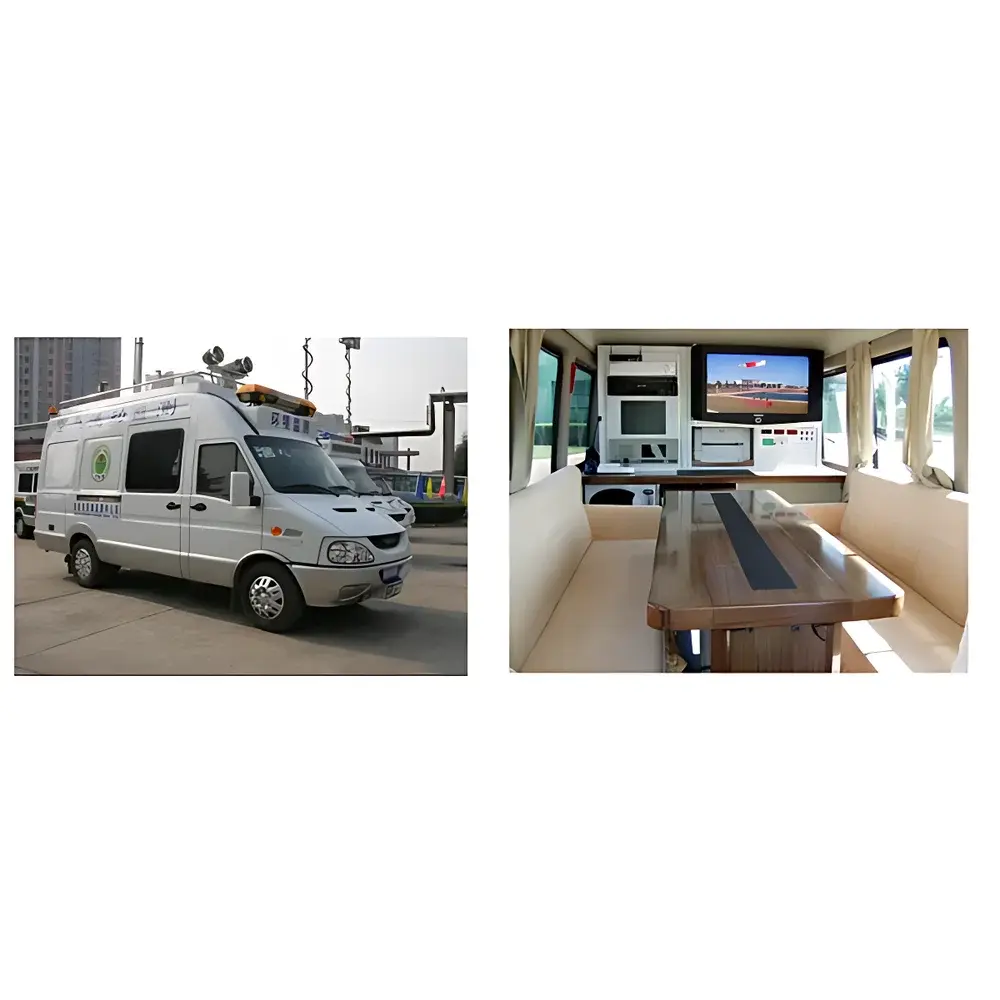
TCT VEMEIS2.0 Mobile Emission Inspection Vehicle
| Brand | TCT (Xiamen Tongchuang) |
|---|---|
| Origin | Fujian, China |
| Manufacturer Type | Authorized Distributor |
| Regional Classification | Domestic (PRC) |
| Model | VEMEIS2.0 |
| Price Range | USD 14,000 – 43,000 (FOB) |
| Instrument Type | Online Continuous Monitoring System |
| Detection Principle | NDIR (HC, CO, CO₂), Electrochemical (NO, NO₂, O₂), λ Calculation (Air–Fuel Ratio), Opacity-Based Smoke Measurement (N, K, soot mass), Charged Particle Counting (PN) |
| Max. Permissible Error | ±10% (system-level regulatory compliance) |
| Zero Drift | ±1% FS/24h |
| Span Drift | ±3% FS/24h |
| Repeatability | ≤3% RSD |
Overview
The TCT VEMEIS2.0 Mobile Emission Inspection Vehicle is a fully integrated, road-deployable environmental monitoring platform engineered for regulatory-grade in-service vehicle emissions testing under real-world operational conditions. Designed to meet the stringent metrological and procedural requirements of China’s national motor vehicle emission standards—including GB 18285–2018 (gasoline vehicles, two-speed idle method), GB 3847–2018 (diesel vehicles, free-acceleration opacity test), GB 19758–2005 and GB 14621–2002 (motorcycle idle testing), and GB 18352.6–2016 (particle number measurement)—the system functions as a certified mobile laboratory. Its architecture combines optical, electrochemical, and thermal sensing modalities with synchronized engine parameter acquisition (RPM, oil temperature, ignition timing) to deliver traceable, auditable, and legally defensible measurement data. Unlike stationary analyzers or handheld units, the VEMEIS2.0 integrates hardware, calibration traceability, data governance, and network-ready telemetry into a single ISO 17025-aligned field unit—enabling direct use in environmental law enforcement without requiring secondary validation.
Key Features
- Integrated mobile office cabin with ergonomic operator workstation, onboard UPS, climate control, and dual-screen HMI for simultaneous instrument operation and administrative reporting.
- Regulatory mode auto-selection: system firmware enforces standardized test sequences per GB standard—eliminating manual protocol deviation and ensuring audit-ready compliance.
- Multi-sensor fusion architecture: simultaneous acquisition of gaseous pollutants (HC, CO, CO₂, NO, NO₂, O₂), air–fuel ratio (λ), diesel smoke opacity (N, K, soot mass), and particle number concentration (PN) from 600 to 1.3 × 10⁹ #/cm³.
- Real-time data encryption and wireless transmission via LTE/5G to centralized environmental monitoring platforms, supporting MQTT and HTTPS protocols for secure API integration.
- Embedded vehicle database compliant with China’s National Motor Vehicle Environmental Information Management System (NMVEIMS), enabling VIN-based model-year lookup, emission type classification, and historical trend benchmarking.
- Automated calibration verification: on-board zero/span gas delivery module with pressure-compensated flow control ensures daily drift correction traceable to NIST-traceable reference gases.
Sample Compatibility & Compliance
The VEMEIS2.0 supports testing across light-duty gasoline vehicles, heavy-duty diesel trucks, motorcycles, and three-wheeled motor vehicles operating under ambient temperatures from −10 °C to +45 °C. All measurement subsystems conform to metrological requirements defined in JJF 1172–2007 (Calibration Specification for Motor Vehicle Exhaust Gas Analyzers) and are verified against certified reference materials per CNAS-CL01:2018. The opacity meter complies with ISO 11614:2021 for filter-based and full-stream smoke measurement; the PN counter meets ISO 29463–3:2022 filtration efficiency criteria for sub-23 nm charged particle detection. Data integrity adheres to GLP principles, with timestamped audit trails, electronic signatures, and tamper-evident storage meeting China’s Ministry of Ecology and Environment (MEE) Technical Guidelines for Emission Supervision Data Management (HJ 1220–2021).
Software & Data Management
The embedded Linux-based firmware runs TCT’s proprietary EmissionInsight™ v3.2 software suite, featuring role-based access control (RBAC), configurable test templates, and automated report generation in PDF/XML formats compliant with MEE Form No. 12. All raw sensor outputs, calibration logs, GPS-tagged location metadata, and video-captured test sessions are stored locally on encrypted SSD with RAID 1 redundancy. Cloud synchronization enables remote diagnostics, over-the-air (OTA) firmware updates, and statistical aggregation across municipal fleets. Data export supports CSV, SQLite, and HL7-compliant schemas for interoperability with provincial environmental information systems and national big-data platforms. Full audit trail functionality satisfies requirements for 21 CFR Part 11–equivalent electronic record retention (≥5 years).
Applications
- On-road random inspection (ORI) and roadside enforcement by municipal ecological environment bureaus.
- Periodic in-use compliance screening at vehicle inspection stations (VIS) and traffic police checkpoints.
- Verification testing for retrofit programs targeting high-emitting vehicles (HEVs) and non-road mobile machinery (NRMM).
- Supporting low-emission zone (LEZ) enforcement through real-time fleet emission profiling and hotspot identification.
- Research-grade emission factor development in collaboration with academic institutions and national laboratories (e.g., CMA-certified testing per GB/T 18352.6–2016 Annex D).
FAQ
Does the VEMEIS2.0 support remote calibration verification?
Yes—integrated zero/span gas cylinders with mass-flow controllers enable automated daily calibration checks; results are logged with digital signatures and uploaded to central servers.
Can the system be used for official enforcement without additional accreditation?
Yes—the entire platform has been type-approved by China’s Institute of Metrology (CIM) under Certificate No. CIM-TCT-VEMEIS2.0-2023-087 and is listed in the MEE’s “Approved Equipment Catalog for Mobile Emission Monitoring” (2023 Edition).
What is the minimum detectable particle size for PN measurement?
The charged particle counter detects particles down to ~6 nm (electrical mobility diameter) when operated at optimal voltage settings; sizing resolution is dependent on DMA voltage sweep range and CPC condensation efficiency.
Is GPS and video recording mandatory during testing?
Yes—geotagged coordinates and synchronized HD video (1080p@30fps) are required per MEE Order No. 45 (2022) for evidentiary validity in administrative litigation.
How is data security ensured during wireless transmission?
All telemetry uses TLS 1.3 encryption with device-specific X.509 certificates; no plaintext credentials or raw sensor values are transmitted without end-to-end encryption and HMAC-based message authentication.
Related Products







