
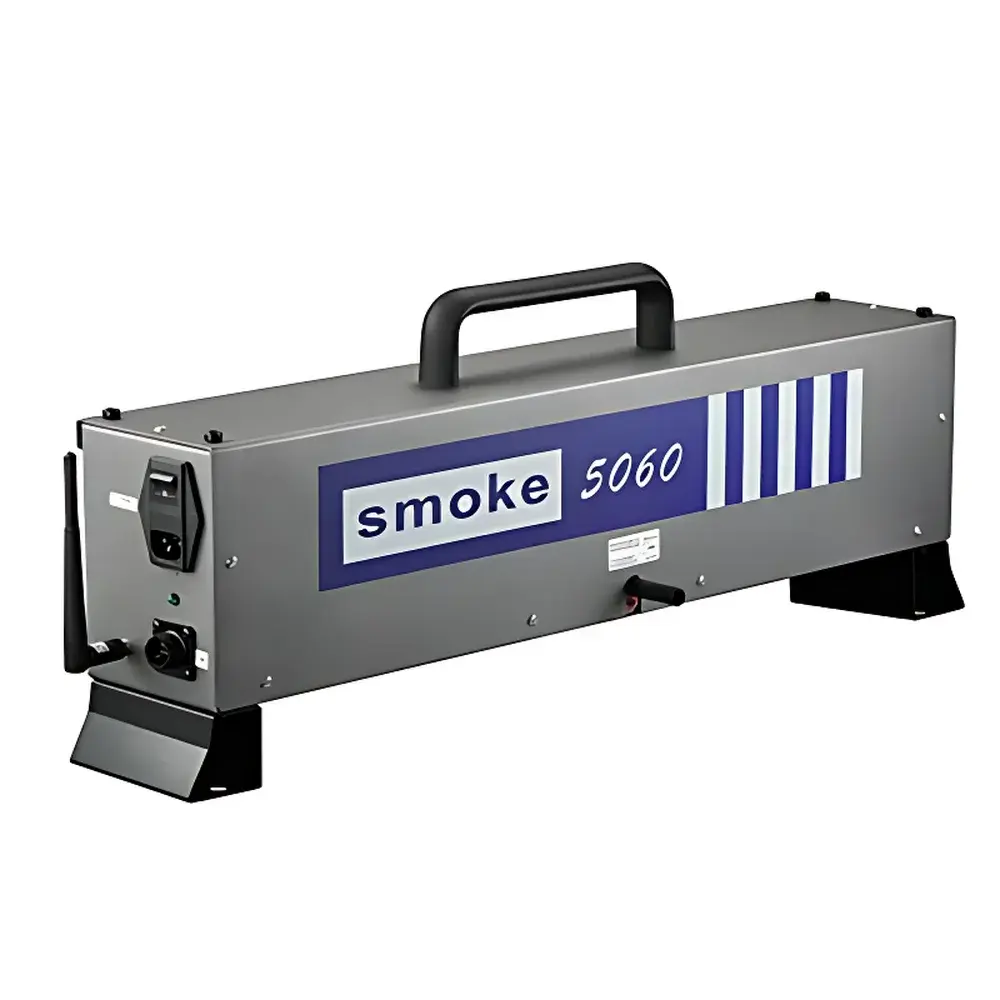
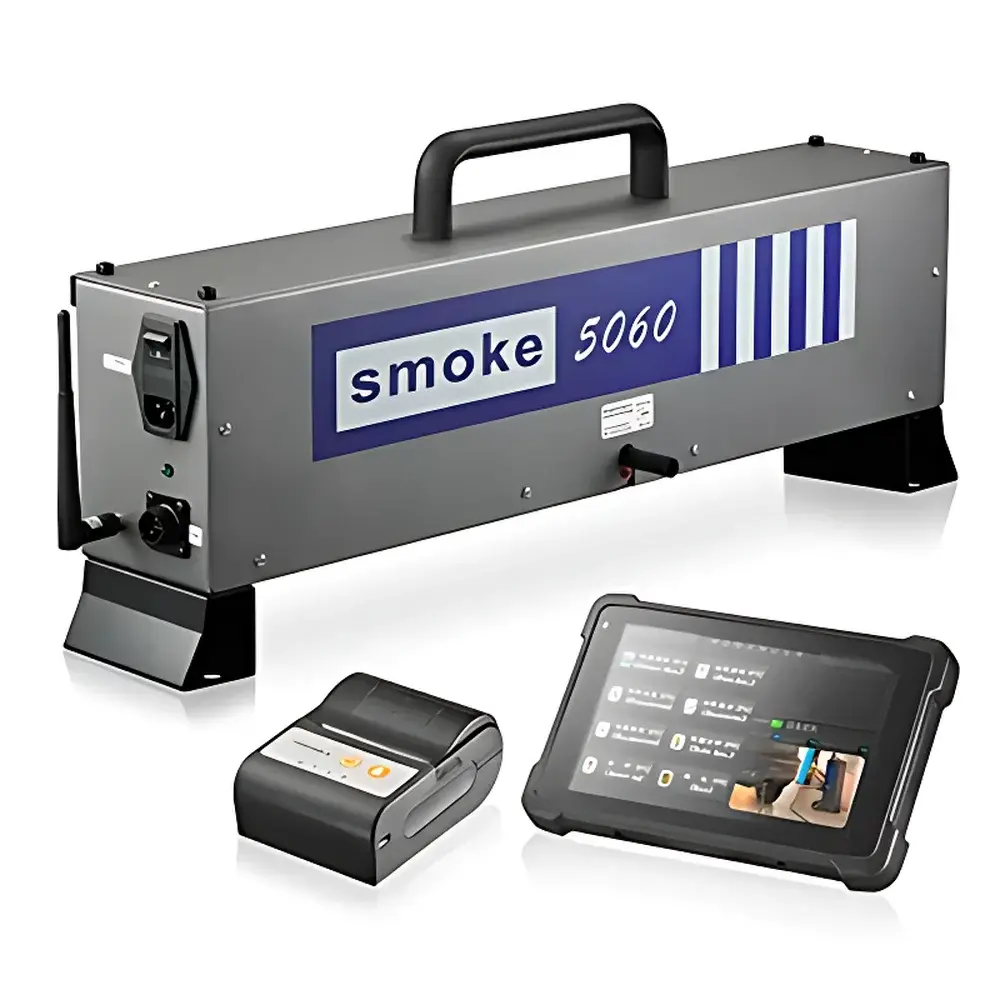
TCT Handset Smoke(H) Portable Opacity Meter
| Brand | TCT |
|---|---|
| Origin | Fujian, China |
| Model | Handset Smoke(H) |
| Instrument Type | Portable |
| Measurement Principle | Optical Attenuation (Opacity-based) |
| Max. Permissible Error | ±0.01% |
| Zero Drift | ≤0.01% over 0–100% opacity range |
| Span Drift | ±0.01% |
| Repeatability | ±0.01% |
| Effective Optical Path Length | 430 mm ± 0.05 cm |
| N-value Range | 0–99.99% (Resolution: 0.01%) |
| K-value Range | 0–16.00 m⁻¹ (Resolution: 0.001 m⁻¹) |
| Engine RPM Input (Optional) | 400–9,999 rpm (Resolution: 10 rpm) |
| Oil Temperature Input (Optional) | −13°C to +150°C (Resolution: 1°C) |
| Warm-up Time | 3–6 min (ambient-dependent) |
| Operating Temp. | +5°C to +40°C |
| Storage Temp. | −32°C to +55°C |
| Sample Gas Temp. | 0–256°C |
| Physical Response Time (T₁₀%–₉₀%) | <0.2 s at 75 L/min flow rate |
| Electrical Response Time | 0.9 s |
| Data Acquisition Rate | 50 Hz |
| Power Supply | 230 VAC / 0.9 A, 50–60 Hz |
| Battery | 300 Wh rechargeable Li-ion |
| Connectivity | Bluetooth 5.0 (OBD-II interface), Wi-Fi (host-to-tablet), USB-C |
| Compliance | ISO 11614, EU Directive 2014/45/EU |
Overview
The TCT Handset Smoke(H) is a portable, high-precision opacity meter engineered for regulatory-grade measurement of diesel exhaust smoke opacity (N), smoke number (Ns), and extinction coefficient (K). It operates on the principle of optical attenuation—quantifying the reduction in light intensity transmitted through a defined path length of exhaust gas—using a stable, collimated infrared light source and a calibrated photodetector array. With a certified optical path length of 430 mm ± 0.05 cm, it meets the geometric and metrological requirements of ISO 11614 and EU Directive 2014/45/EU for in-service vehicle emissions testing. Designed for field-deployable compliance verification, the instrument delivers traceable, repeatable opacity data under dynamic operating conditions—including free-acceleration, free-load, and cold-start test cycles—without reliance on fixed laboratory infrastructure.
Key Features
- Optical architecture with temperature-stabilized IR source and dual-channel photometric detection ensures long-term signal integrity and minimizes thermal drift.
- Integrated OBD-II interface via Bluetooth 5.0 enables synchronized acquisition of engine RPM and oil temperature—critical for normalized smoke evaluation per ISO 8178 and EU type-approval protocols.
- Intelligent zero-point calibration and span verification executed automatically prior to each test sequence, eliminating manual intervention and reducing operator-induced error.
- Active thermal management system—including programmable heating elements and adaptive fan control—maintains optimal detector and optical chamber temperature across ambient ranges from +5°C to +40°C.
- Onboard 300 Wh lithium-ion battery supports ≥4 hours of continuous operation under typical field conditions (including real-time data streaming and printing).
- Wireless connectivity stack: Wi-Fi for tablet-host synchronization; Bluetooth for OBD-II telemetry and optional wireless thermal printer pairing.
- Embedded license-free software supports automated license plate recognition (LPR) using on-device AI inference—reducing manual entry errors during roadside inspections.
- Ruggedized IP54-rated enclosure with shock-absorbing elastomer housing ensures durability during transport and operation on uneven terrain or mobile inspection platforms.
Sample Compatibility & Compliance
The Handset Smoke(H) is validated for use with diesel-powered vehicles (light- and heavy-duty), non-road mobile machinery (NRMM), and stationary compression-ignition engines operating under transient or steady-state conditions. Its 430 mm optical path accommodates standard sampling probe configurations used in roadside enforcement, depot audits, and type-approval testing. The device complies with ISO 11614:2015 (Road vehicles — Measurement of opacity of exhaust gas from compression ignition engines), EU Regulation (EU) No 2014/45 (Periodic roadworthiness tests for motor vehicles), and aligns with technical requirements outlined in EN 15894 for portable opacity meters. All firmware and calibration routines are designed to support audit-ready data logging compliant with GLP principles, including timestamped metadata, operator ID, GPS coordinates (optional external module), and immutable event logs.
Software & Data Management
The embedded firmware and companion Windows/Linux desktop application provide full-cycle test management—from pre-test configuration to post-processing and reporting. Data acquisition occurs at 50 Hz, capturing transient smoke peaks during acceleration events with sub-second temporal resolution. All measurements are stored locally in encrypted SQLite databases with SHA-256 checksums and support export in CSV, PDF, and XML formats compatible with national emissions registries. The software includes built-in test mode selection (free acceleration, free load, cold start), configurable pass/fail thresholds per regional regulation (e.g., China GB 3847–2018, EU Euro VI), and automated report generation with digital signature fields. Audit trails record all calibration actions, parameter changes, and user logins—meeting foundational expectations of ISO/IEC 17025 and FDA 21 CFR Part 11 for electronic records and signatures where applicable.
Applications
This instrument serves as a primary measurement tool for environmental protection agencies conducting roadside emissions screening, municipal traffic enforcement units verifying compliance with low-emission zones (LEZ), and third-party certification bodies performing periodic technical inspections (PTI). It is equally suited for OEM validation labs performing development-stage smoke characterization, fleet maintenance centers monitoring aftertreatment system performance (e.g., DPF regeneration efficiency), and research institutions studying particulate formation dynamics under real-world driving cycles. Its portability and rapid deployment make it especially effective for mobile testing campaigns, border checkpoint screening, and emergency response scenarios requiring immediate smoke opacity assessment.
FAQ
Does the Handset Smoke(H) require annual factory recalibration?
No—its self-diagnostic routines and automated zero/span checks enable field verification against NIST-traceable reference filters. However, accredited laboratories must perform full metrological verification annually per ISO/IEC 17025 requirements.
Can the device store test results without a connected tablet or PC?
Yes—internal flash memory retains ≥10,000 complete test records with full metadata, independent of external devices.
Is the optical path length adjustable or fixed?
Fixed at 430 mm ± 0.05 cm, as required by ISO 11614 for comparability across international test sites.
What standards govern its use in European Union member states?
EU Directive 2014/45/EU mandates use of opacity meters conforming to ISO 11614; the Handset Smoke(H) satisfies all functional and performance clauses therein.
How does the instrument handle condensation or water vapor in exhaust streams?
The heated optical chamber and integrated moisture-resistant coating on optical surfaces minimize dew formation; additionally, real-time signal compensation algorithms correct for minor scattering artifacts induced by transient humidity spikes.







