
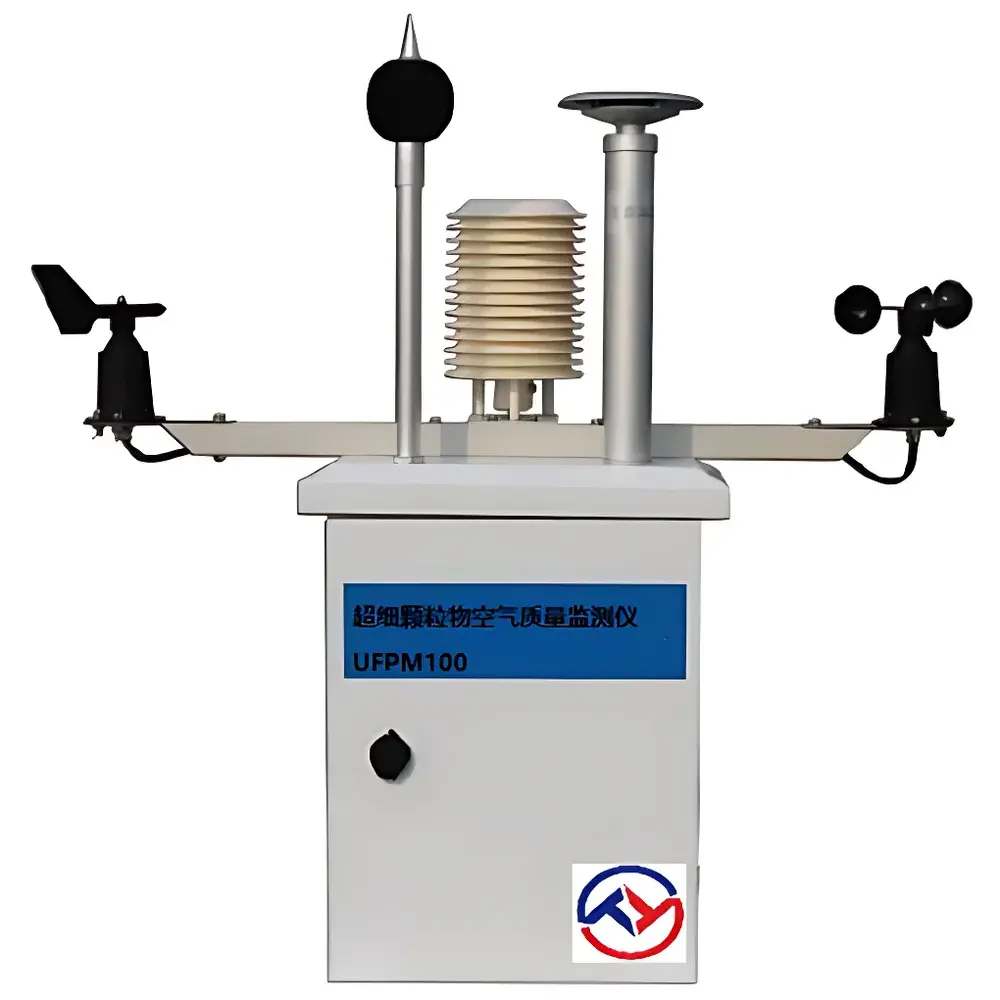
TCT UFPM100 Ultrafine Particulate Matter Air Quality Monitor
| Brand | TCT |
|---|---|
| Origin | Fujian, China |
| Manufacturer Type | Authorized Distributor |
| Origin Category | Domestic (China) |
| Model | UFPM100 |
| Price Range | USD 7,000 – 28,000 |
| Measured Pollutants | PM10, PM2.5, PM1.0, TSP |
| Detection Principle | Diffusion Charging + Electrometric Sensing |
| Particle Size Range | ≥10 nm |
| Number Concentration Range | 1,000 – 50,000,000 #/cm³ |
| Response Time | 200 ms |
| Output Parameters | Particle Number Concentration (PN), Lung Deposited Surface Area (LDSA), Mean Particle Diameter |
| Environmental Inputs (Optional) | Ambient Temperature, Relative Humidity, Atmospheric Pressure, Illuminance, Noise Level, CO₂, Dew Point Temperature |
| Connectivity | 4G (LTE), GPRS, Ethernet, Wi-Fi, 5G-ready |
| Data Platform | AQCP100 Cloud Platform with RESTful API & Mobile App Support |
| Compliance | Designed to align with WHO Air Quality Guidelines (2021), ISO 29463-1:2011 (filter testing reference), ASTM D6245-19 (indoor air particulate measurement practice) |
Overview
The TCT UFPM100 Ultrafine Particulate Matter Air Quality Monitor is an engineered solution for real-time, continuous measurement of ultrafine particles (UFPs) in ambient air—specifically targeting the PM1.0 fraction (aerodynamic diameter ≤1.0 µm) and extending detection down to 10 nm. Unlike conventional optical scattering-based aerosol spectrometers—which suffer from low sensitivity and poor counting efficiency below ~300 nm—the UFPM100 employs a diffusion charging principle coupled with high-fidelity electrometric sensing. This method enables quantitative, calibration-stable particle number concentration (#/cm³) measurements without reliance on volatile working fluids, optical alignment, or consumable filters. The instrument delivers direct metrics including total particle number concentration (PN), lung-deposited surface area (LDSA), and mean particle diameter—parameters increasingly recognized by epidemiological studies as more biologically relevant than mass-based PM2.5 or PM10 alone. Its design addresses a critical gap in regulatory-grade monitoring infrastructure: while WHO has classified UFPs as a priority health concern and emphasized their role in cardiovascular and respiratory morbidity, no globally harmonized ambient concentration limits exist. The UFPM100 provides metrologically traceable, long-term stable data to support exposure assessment, source apportionment, and policy development aligned with WHO AQG 2021 recommendations.
Key Features
- Diffusion charging-based detection with no requirement for butanol, ethanol, or other condensable working fluids—eliminating maintenance cycles associated with CPCs (Condensation Particle Counters)
- Real-time particle number concentration output across a dynamic range of 1,000–50,000,000 #/cm³, with sub-second response time (200 ms)
- Simultaneous derivation of lung-deposited surface area (LDSA) and mean particle diameter—enabling improved toxicological interpretation beyond count-only metrics
- Integrated environmental sensor suite (optional): ambient temperature, relative humidity, barometric pressure, illuminance, noise, CO₂, and dew point temperature
- Multi-protocol connectivity: embedded 4G LTE modem with fallback to GPRS; optional Ethernet, Wi-Fi, and 5G-ready firmware architecture
- Modular expandability: compatible with co-located meteorological stations and additional gas-phase analyzers (e.g., CO, NO₂, SO₂, O₃, atmospheric ions)
- Firmware-upgradable architecture supporting remote diagnostics, over-the-air (OTA) configuration, and secure TLS 1.2 encrypted data transmission
Sample Compatibility & Compliance
The UFPM100 is designed for unattended, year-round operation in outdoor environments—including urban street canyons, industrial perimeters, port zones, airport aprons, and construction sites. Its inlet system incorporates inertial separation and heated sampling lines to minimize volatilization losses and hygroscopic growth artifacts. While not certified to EN 12341 or ISO 7203 for regulatory compliance reporting, the instrument’s measurement methodology follows principles consistent with ISO 27891:2018 (air quality — determination of particle number concentration) and supports data collection frameworks required under EU Directive 2008/50/EC Annex XI (supplementary monitoring). It meets mechanical robustness requirements per IEC 60529 IP55 for dust and water ingress protection. All firmware and cloud platform components are architected to support audit trails, user access control, and data integrity logging—facilitating alignment with GLP-aligned field studies and pre-regulatory exposure research protocols.
Software & Data Management
Data acquisition, visualization, and export are managed via the AQCP100 Air Quality Online Monitoring Cloud Platform—a secure, multi-tenant SaaS environment hosted on ISO 27001-certified infrastructure. The platform provides real-time dashboards, configurable alarm thresholds (email/SMS/webhook), historical trend analysis, and batch download in CSV/NetCDF formats. RESTful APIs enable integration with third-party GIS platforms (e.g., ArcGIS Online, QGIS Server) and national air quality information systems. Mobile access is supported through native iOS and Android applications, offering live telemetry, device status monitoring, and remote parameter reconfiguration. All data transfers comply with TLS 1.2 encryption; platform audit logs record user actions, configuration changes, and firmware updates—supporting traceability requirements for scientific publication and institutional review board (IRB)-approved human exposure studies.
Applications
- Urban roadside and traffic microenvironment monitoring—especially near tunnels, intersections, and bus depots where nucleation-mode particle emissions dominate
- Industrial stack and fence-line monitoring for fugitive UFP emissions from combustion, metal processing, and nanomaterial handling facilities
- Airport and seaport ambient monitoring to assess aircraft auxiliary power unit (APU) and ship auxiliary engine impacts
- Long-term epidemiological cohort studies requiring high-temporal-resolution UFP exposure metrics
- Validation and ground-truthing of satellite-derived aerosol optical depth (AOD) models and dispersion simulations (e.g., CALPUFF, AERMOD)
- Smart city infrastructure deployments integrated with adaptive traffic management and public health alert systems
FAQ
Does the UFPM100 require routine calibration with reference instruments?
Yes—annual verification against a NIST-traceable CPC (e.g., TSI 3776) or electrostatic classifier system is recommended per ISO 27891:2018 guidance. Factory calibration certificates are provided with each unit.
Can the UFPM100 distinguish between combustion-derived soot and secondary organic aerosol (SOA)?
No—it does not perform chemical speciation. However, its high time resolution and LDSA output enable correlation analysis with co-located black carbon (BC) or VOC monitors to infer dominant particle sources.
Is raw voltage output or digital sensor data accessible for custom algorithm development?
Yes—via RS-485 Modbus RTU and MQTT interfaces, full sensor-level analog/digital outputs are exposed for OEM integration and proprietary modeling workflows.
What is the typical power consumption and operating temperature range?
Average power draw is 8 W (12 V DC input); operational range is −20 °C to +50 °C with optional heating/cooling module for extreme climates.
How does the UFPM100 handle high-humidity conditions that may affect charging efficiency?
The sampling line includes a Peltier-cooled dryer stage maintaining relative humidity <40% at the sensor inlet, ensuring stable diffusion charging performance across diverse climatic zones.
Related Products







