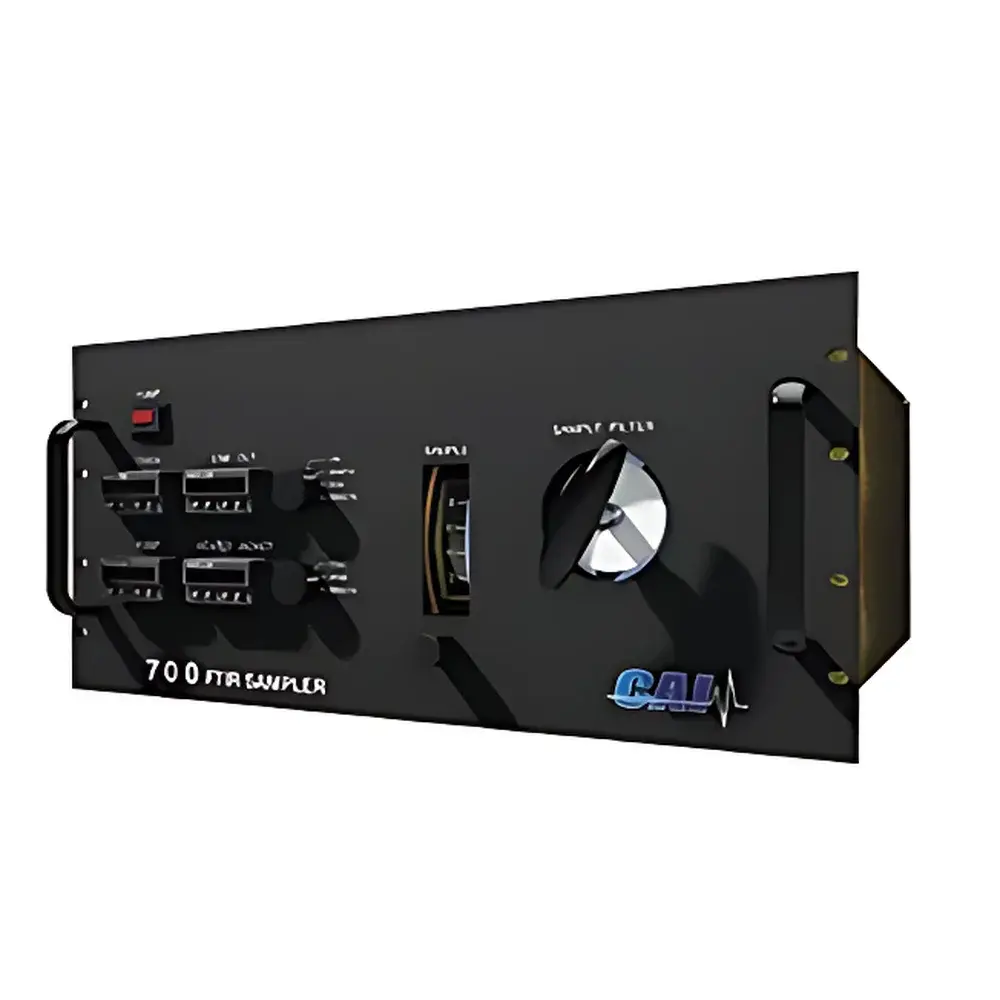
CAI 700FTIR Heated Sample Probe System
| Brand | California Analytical Instruments (CAI) |
|---|---|
| Origin | USA |
| Model | 700FTIR |
| Heating Temperature | 191 °C |
| Pump Flow Rate | 7.0 L/min |
| Power Supply | 230 VAC/4.78 A or 115 VAC/9.3 A |
| Mounting | 19-inch rack-mountable |
| Enclosure Cooling | Fan-cooled |
| Digital I/O | Temperature alarm output included |
| Filter Type | T-shaped high-temperature sintered metal filter |
| Flow Meter | High-temperature rated, durable |
| Valves | Solenoid valves for zero/span gas calibration |
| Tubing | Stainless steel, 1/4-inch SS bulkhead fittings |
| Optional Accessory | 700FTIR Temperature Controller (17″W × 8″D × 3.5″H) for external heated line and filter control |
Overview
The CAI 700FTIR Heated Sample Probe System is an engineered solution designed specifically for high-temperature, condensable-gas sampling in Fourier Transform Infrared (FTIR) spectroscopy applications. It functions as a thermally integrated front-end module for CAI 600/700-series FTIR analyzers, ensuring sample integrity from the point of extraction through transport to the optical cell. The system operates on the principle of maintained thermal homogeneity: by heating all wetted and critical path components—including the probe tip, filter housing, flow meter, internal sample lines, and pump head—to a stable 191 °C, it prevents condensation of volatile organic compounds (VOCs), acid gases (e.g., HCl, HF, SO₂), and semi-volatile species that would otherwise adsorb, react, or fractionate in unheated systems. This thermal management strategy is essential for quantitative accuracy in continuous emissions monitoring (CEM), process gas analysis, and regulatory compliance testing per EPA Methods 320, TO-16, and ASTM D6348.
Key Features
- Uniform 191 °C heating across all sample-contact surfaces—probe tip, T-shaped sintered metal filter, flow meter, and internal 10-ft heated sample line—to eliminate condensation and surface adsorption artifacts.
- Dedicated electrically heated pump head delivering stable 7.0 L/min volumetric flow under elevated temperature conditions, optimized for FTIR pressure and residence time requirements.
- Front-panel accessible T-handle filter housing enabling rapid, tool-free filter replacement without system shutdown or cooling—critical for maintaining uptime in 24/7 CEM applications.
- High-temperature-rated stainless steel flow meter with calibrated linear response up to 191 °C, traceable to NIST standards.
- Integrated solenoid valve manifold for automated zero-air and span-gas introduction, supporting routine calibration per EPA PS-15 and ISO 14956 protocols.
- Motor-driven ball valve for seamless, software-controllable transition between sampling and calibration modes—eliminating manual valve manipulation and reducing operator error.
- Rack-mountable 19-inch chassis with fan-assisted thermal management, digital I/O interface (including configurable temperature alarm output), and dual-voltage power compatibility (115/230 VAC).
Sample Compatibility & Compliance
The 700FTIR is validated for use with corrosive, moisture-laden, and thermally labile gas streams typical of combustion exhaust, chemical reactor off-gases, and semiconductor process tools. Its all-stainless-steel wetted path (316SS) and sintered metal filtration meet ASTM F2251 requirements for particulate removal in heated sampling. The system supports GLP/GMP-aligned operation when paired with CAI’s compliant data acquisition firmware: audit-trail-enabled calibration logs, timestamped temperature validation records, and electronic signature support align with FDA 21 CFR Part 11 and ISO/IEC 17025 documentation expectations. It is routinely deployed in facilities subject to EU Industrial Emissions Directive (IED) and US Clean Air Act Title V permitting.
Software & Data Management
While the 700FTIR operates as a hardware-integrated subsystem, its digital I/O and valve control signals are natively compatible with CAI’s FTIR host software suite (v5.2+), enabling synchronized calibration scheduling, real-time heater status monitoring, and automatic fault logging. Remote calibration initiation—via Modbus TCP or discrete dry-contact inputs—supports integration into plant-wide DCS/SCADA environments. All temperature setpoints, alarm thresholds, and valve actuation events are logged with millisecond timestamps and retained for ≥30 days onboard, satisfying EPA Appendix A recordkeeping mandates. Optional integration with third-party LabVIEW or Python-based control frameworks is supported via documented ASCII command protocol.
Applications
- Continuous emission monitoring of NOₓ, SO₂, CO, CO₂, CH₄, NH₃, and halogenated compounds in stack gas using FTIR spectroscopy.
- High-temperature process stream analysis in petrochemical cracking units, incinerators, and cement kilns.
- Method-compliant sampling for EPA Performance Specification 15 (PS-15) and ASTM D6348 validation studies.
- Complementary use with heated flame ionization detectors (HFID) requiring >190 °C sample conditioning prior to detection.
- Research-grade gas-phase reaction monitoring where thermal stability of reactive intermediates must be preserved during transfer.
FAQ
What is the maximum recommended operating temperature for the 700FTIR’s heated components?
All wetted and critical-path components—including the probe, filter, flow meter, and internal tubing—are rated for continuous operation at 191 °C. Exceeding this temperature may compromise seal integrity and sensor calibration stability.
Can the 700FTIR be used with non-CAI FTIR analyzers?
Yes—the system is functionally agnostic to analyzer brand. Its analog/digital I/O and pneumatic interfaces comply with ISA-76.00.02 and ISO 8573-1 standards, enabling integration with third-party FTIR, GC-FTIR, or multi-gas platforms requiring heated sample delivery.
Is the optional 700FTIR Temperature Controller required for basic operation?
No—the base unit includes full internal temperature regulation. The external controller is only needed when extending heating control to unheated external sample lines or auxiliary heated filters beyond the standard 10-ft internal conduit.
Does the system support automated leak-check routines?
Not natively—the 700FTIR does not include integrated pressure decay measurement. However, its solenoid and ball valves enable external leak-check sequences when coordinated with a master controller or CAI’s FTIR software via programmable I/O triggers.
What maintenance intervals are recommended for the T-shaped filter?
Filter replacement frequency depends on particulate loading; under typical stack gas conditions (≤10 mg/m³), replacement every 3–6 months is typical. Visual inspection via the transparent filter housing window is advised weekly as part of routine QA/QC checks.
Related Products