
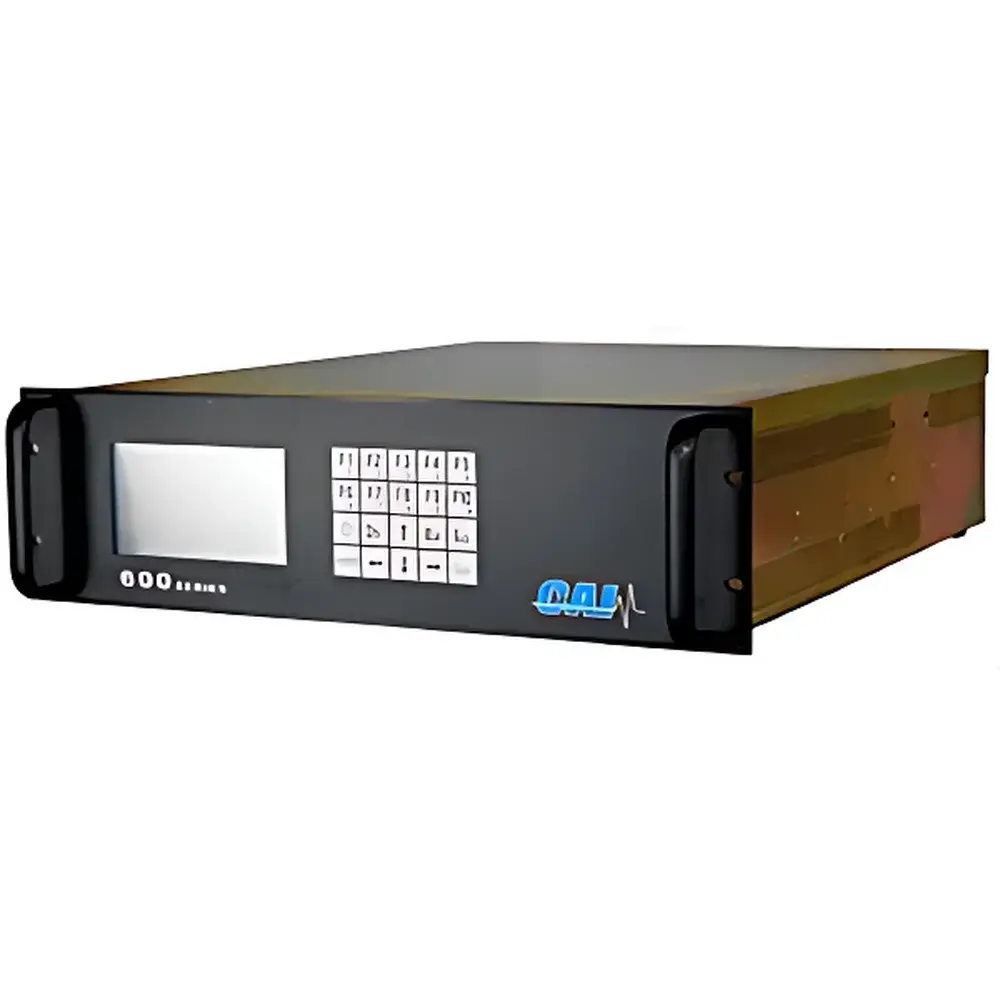
CAI 600HCLD Chemiluminescence Nitrogen Oxides (NO/NOx) Analyzer
| Brand | California Analytical Instruments (CAI) |
|---|---|
| Origin | USA |
| Model | 600HCLD |
| Detection Principle | Chemiluminescence Detection (CLD) with Photodiode Detector (Peltier-cooled) |
| O₃ Generator | UV Lamp |
| NO/NOx Range | 0–3 to 0–3,000 ppm (4 user-selectable ranges) |
| Response Time (T90) | <2 s |
| Zero & Span Drift | <1% of full scale / 24 h |
| Linearity | <0.5% of full scale |
| Repeatability | <0.5% of full scale |
| Sample Flow Rate | 2.0 L/min (standard), optional low-flow 0.6 L/min |
| Reaction Chamber Volume | <3 cc (gold-plated) |
| Converter Material | Glassy carbon @ 205 °C, >95% NO₂ → NO efficiency |
| Oven Temperature | 850 °C (configurable up to 1000 °C) |
| Sample Chamber Temp. | 100 °C (non-condensing) |
| O₂ Measurement | Paramagnetic, 0–25% or 0–100% |
| Ambient Operating Temp. | 5–40 °C |
| Humidity Limit | <90% RH (non-condensing) |
| Power | 115 VAC/60 Hz or 230 VAC/50 Hz |
| Dimensions | 5.5" H × 19" W × 23" D |
| Weight | 65 lbs |
| Compliance | CE-marked, ETL-listed per UL 61010-1 and CAN/CSA C22.2 No. 61010.1 |
| Regulatory Alignment | Designed for EPA Method 7E, ISO 11566, and EN 14792 compliance |
Overview
The CAI 600HCLD is a high-precision, laboratory- and field-deployable chemiluminescence nitrogen oxides (NO/NOx) analyzer engineered for continuous, trace-level gas concentration measurement in demanding environmental and industrial applications. It operates on the well-established chemiluminescence detection (CLD) principle: nitric oxide (NO) reacts quantitatively with ozone (O3) to produce excited nitrogen dioxide (NO2*), which emits photons upon relaxation. This emitted light intensity—measured by a thermoelectrically cooled photodiode—is linearly proportional to the mass flow rate of NO entering the reaction chamber. For total NOx (NO + NO2) analysis, sample gas passes through a high-efficiency glassy carbon thermal converter heated to 205 °C, ensuring >95% conversion of NO2 to NO prior to detection. The reaction chamber is gold-plated and maintained at 100 °C to prevent condensation and minimize wall losses—critical for accurate NO2 quantification in humid or complex matrices. The instrument’s core electronics feature a 16-bit microprocessor-based control architecture with integrated MSR card (16-bit digital I/O, 16-bit analog input, 4-bit analog output), enabling deterministic real-time signal processing and robust system diagnostics.
Key Features
- Four user-configurable measurement ranges (0–3 ppm to 0–3,000 ppm), optimized for both ambient air monitoring and high-concentration stack gas analysis
- Peltier-cooled photodiode detector ensures thermal stability and long-term signal reproducibility, minimizing drift from ambient temperature fluctuations
- Integrated paramagnetic O2 sensor (0–25% or 0–100% range) co-located with NO/NOx measurement for stoichiometric combustion analysis
- Heated sample path (100 °C chamber, 850 °C converter oven) eliminates water vapor interference and prevents NO2 adsorption or hydrolysis
- Electronic proportional pressure regulation enables precise, pumpless sample flow control at 2.0 L/min (standard) or 0.6 L/min (low-flow option)
- Four-tier password protection and audit-trail-capable firmware support GLP/GMP-aligned operational integrity
- Automated zero/span calibration routines scheduled via internal real-time clock; executable locally or remotely via TCP/IP or RS-232
- Comprehensive self-diagnostics—including lamp health monitoring, converter efficiency validation, and flow verification—with event-logged data archiving
Sample Compatibility & Compliance
The CAI 600HCLD is validated for use with flue gases, ambient air, engine exhaust, and process streams containing CO2 (<10%), H2O vapor (<90% RH, non-condensing), and low levels of NH3, SO2, or HCN (<100 ppm). Cross-sensitivity to CO2 is limited to <2.0% per 10% CO2; H2O interference is <1.0% per 1% CO2 equivalent. It meets CE marking requirements and is ETL-listed to UL 61010-1 and CAN/CSA C22.2 No. 61010.1 for electrical safety. Its design aligns with EPA Method 7E for stationary source NOx measurement, ISO 11566 for ambient NO2 monitoring, and EN 14792 for portable emission analyzers. It satisfies key provisions of 40 CFR Part 60 Subparts JJJJ (stationary CI engines) and UU (electric utility steam generating units), as well as 40 CFR Part 1065 for heavy-duty engine certification testing.
Software & Data Management
The analyzer supports native ASCII protocol over RS-232 and Modbus TCP/IP for seamless integration into SCADA, DCS, or CEMS platforms. All configuration, calibration, and diagnostic functions—including polynomial curve fitting for span correction—are accessible via front-panel keypad or remote interface. Data output options include isolated 4–20 mA, 0–1 V, 0–5 V, and 0–10 V analog signals, plus digital outputs (Modbus RTU/TCP, ASCII serial). Internal memory logs operational events, calibration records, and diagnostic flags with timestamps—enabling full traceability for regulatory audits. While CAI does not supply proprietary software, the device’s open communication protocols ensure compatibility with third-party platforms compliant with FDA 21 CFR Part 11 (electronic records/signatures) when deployed in validated environments.
Applications
- Continuous Emission Monitoring Systems (CEMS) for coal-, gas-, and biomass-fired power plants, particularly in SCR/SNCR de-NOx control loops
- Combustion optimization studies in gas turbines, reciprocating engines, and industrial boilers
- R&D of particulate filtration efficiency, where NOx serves as a stable tracer gas
- Vehicle and engine emissions testing per ISO 8178, SAE J1930, and EU Regulation (EC) No 595/2009
- Fuel cell exhaust characterization, especially during start-up/shutdown transients
- Occupational health and safety monitoring in confined spaces or tunnel ventilation systems
- Process gas analysis in nitric acid production, fertilizer synthesis, and semiconductor fabrication scrubber streams
FAQ
What detection principle does the CAI 600HCLD use?
It employs gas-phase chemiluminescence detection (CLD), where NO reacts with ozone to emit measurable photons; NO2 is first catalytically converted to NO using a high-efficiency glassy carbon converter.
Does the analyzer require external vacuum pumping?
No—it uses an internal heated sampling pump and electronic pressure regulation, eliminating dependence on external vacuum sources.
Can it measure NO and NOx simultaneously?
Yes, via sequential or concurrent channel operation: one path measures NO directly; another routes sample through the converter for total NOx, with differential calculation yielding NO2.
How is calibration traceability ensured?
Users may input NIST-traceable calibration curve coefficients (e.g., 2nd- or 3rd-order polynomials) to correct for nonlinearity across wide dynamic ranges.
Is the instrument suitable for unattended operation in remote locations?
Yes—its robust thermal management, low-drift optics, scheduled auto-calibration, and dual-network interface (RS-232 + TCP/IP) support fully autonomous deployment for weeks without intervention.







