
OETech HCF Low-Loss Anti-Resonant Hollow-Core Fiber
| Brand | OETech |
|---|---|
| Origin | Beijing, China |
| Manufacturer Type | Authorized Distributor |
| Product Category | Optical Component |
| Model | HCF |
| Unit Price | USD 720 (FOB Beijing) |
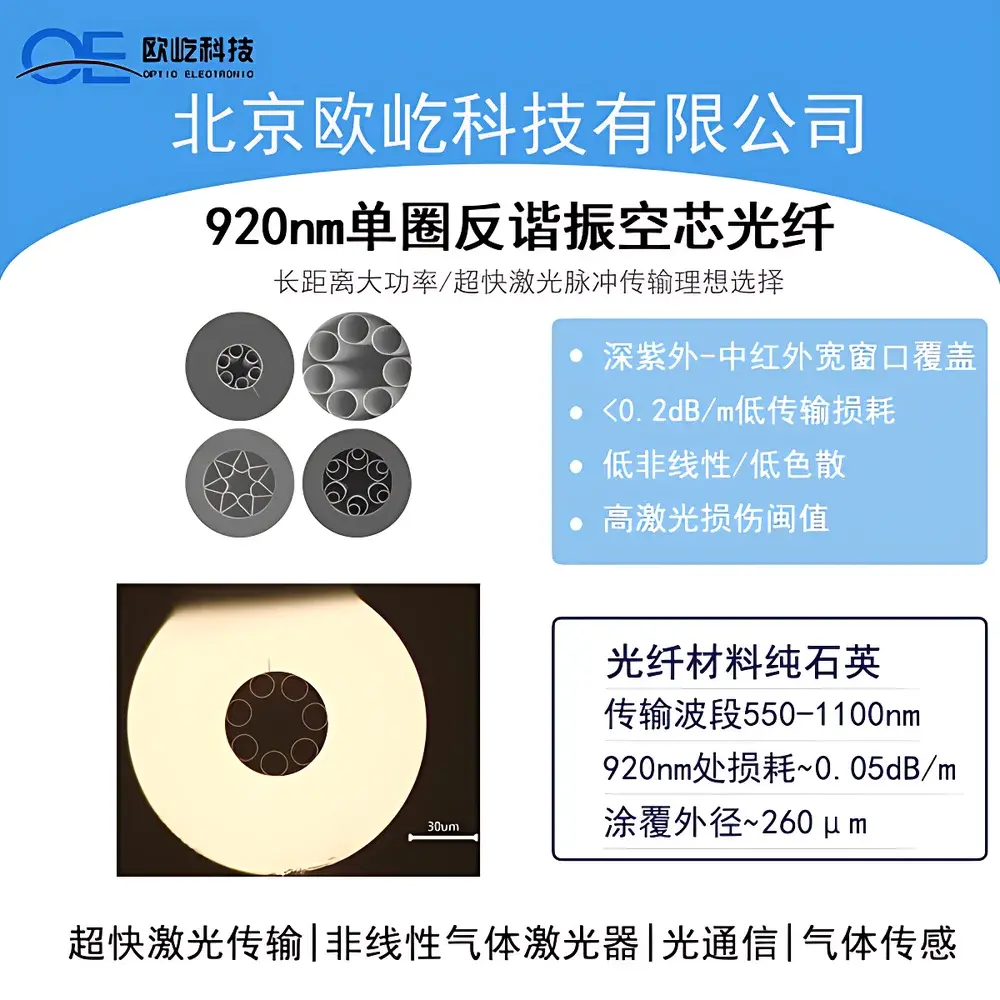
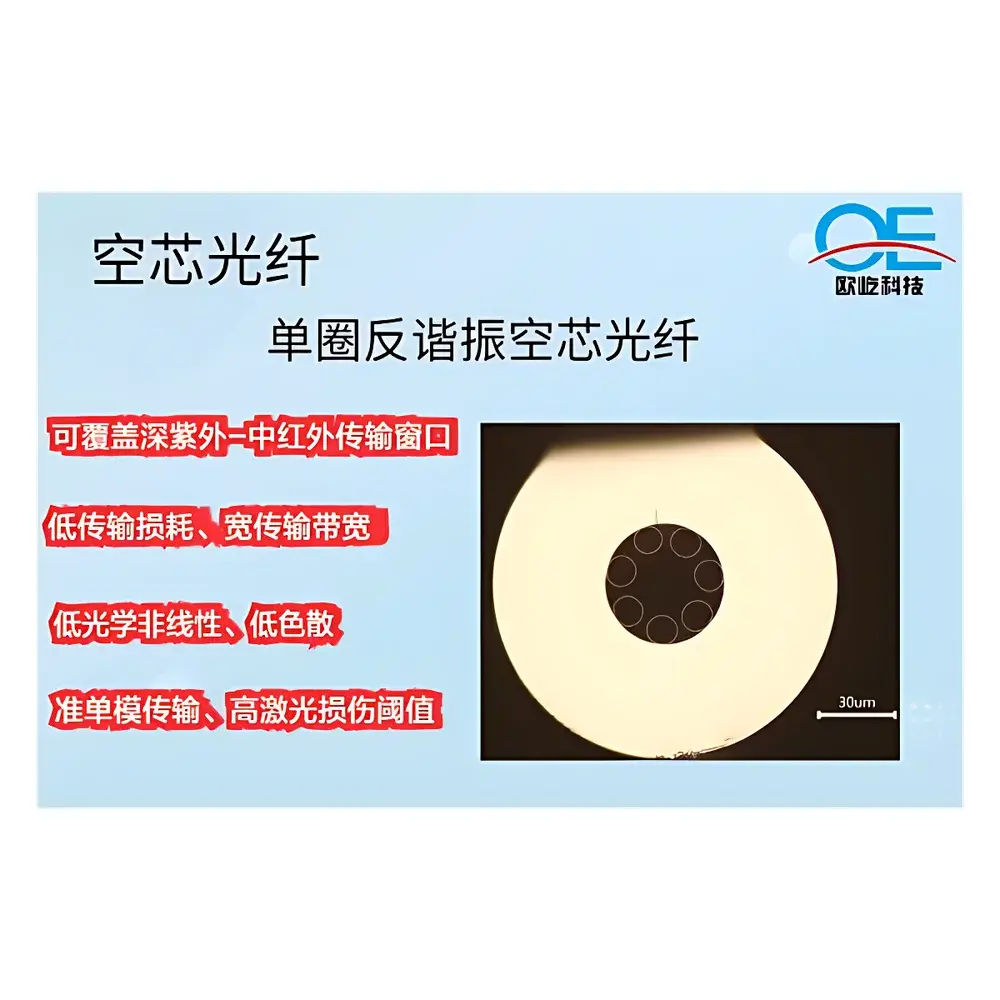
| Core Diameter | ~25 µm |
| Cladding Capillary Diameter | ~12 µm |
| Bare Fiber OD | ~145 µm |
| Coated Fiber OD | ~260 µm |
| Transmission Band | 550–1100 nm |
| Attenuation | <0.2 dB/m (typ.) |
| Minimum Loss | ~0.013 dB/m @ 655 nm |
| Loss @ 920 nm | ~0.05 dB/m |
| Core Material | Fused Silica |
| Coating Material | Acrylate (Single-Coated) |
Overview
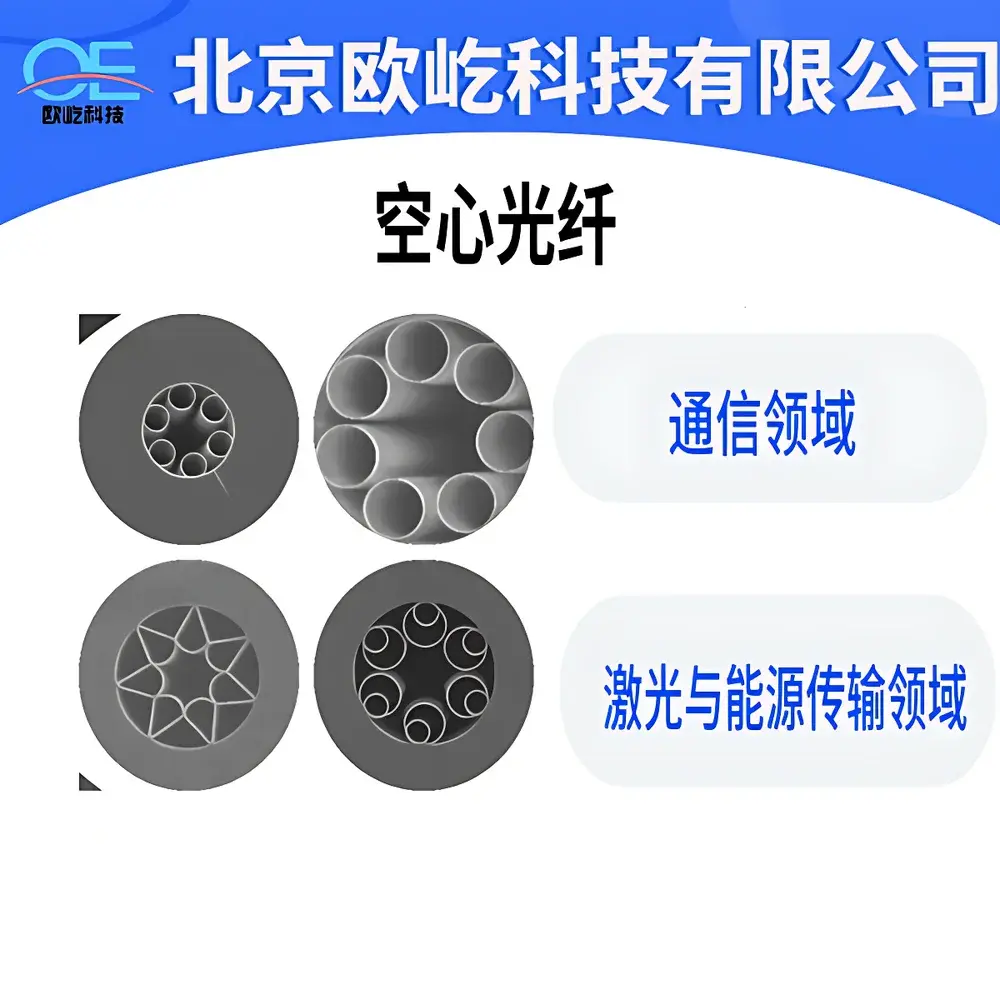
The OETech HCF Low-Loss Anti-Resonant Hollow-Core Fiber is a precision-engineered optical component designed for applications demanding ultra-low propagation loss, high laser damage threshold, and minimal nonlinear interaction. Unlike conventional solid-core fibers, this fiber operates on the anti-resonant reflecting optical waveguide (ARROW) principle—where light is confined and guided within a hollow air core via broadband reflection from thin-walled silica capillaries arranged in a symmetric cladding ring. This architecture decouples optical guidance from bulk material properties, effectively suppressing Rayleigh scattering, material absorption, and Kerr nonlinearity. As a result, the fiber delivers exceptional transmission stability across visible to near-infrared wavelengths (550–1100 nm), with measured attenuation as low as 0.013 dB/m at 655 nm—a performance benchmark suitable for metrology-grade interferometry, quantum photonics, and ultrafast pulse delivery.
Key Features
- Anti-resonant hollow-core guidance enabling sub-0.02 dB/m loss in targeted bands
- Fused silica microstructure with acrylate single-coating for mechanical robustness and bend resilience
- Core diameter of ~25 µm optimized for single-mode-like beam quality while maintaining high mode area
- Cladding composed of uniformly spaced, thin-walled (~1–2 µm wall thickness) capillaries (~12 µm ID) ensuring spectral isolation of transmission bands
- High laser-induced damage threshold (>10 GW/cm² for nanosecond pulses at 1064 nm) due to air-core dominance
- Low group velocity dispersion and negligible self-phase modulation in high-peak-power regimes
Sample Compatibility & Compliance
The HCF is compatible with standard FC/PC, FC/APC, and SMA-905 connectors when spliced or terminated using fusion techniques adapted for hollow-core geometry. It meets ISO 10110-7 (optical element surface quality) for cleaved end-faces and complies with IEC 60793-2-50 (category A4b) for microstructured optical fibers. While not certified under FDA 21 CFR Part 11 or GLP/GMP by default, the fiber’s traceable manufacturing batch documentation and dimensional consistency support integration into regulated photonic systems—particularly where audit-ready calibration records and material certificates of conformance (CoC) are required per ISO 9001:2015 protocols.
Software & Data Management
As a passive optical component, the HCF does not incorporate embedded firmware or digital interfaces. However, its performance parameters—including spectral attenuation profiles, mode field diameter maps, and polarization extinction ratio (PER) measurements—are fully characterizable using industry-standard test platforms: e.g., tunable laser source + optical spectrum analyzer (OSA) setups compliant with IEC 61280-4-1, or vector network analyzers configured for optical frequency domain reflectometry (OFDR). OETech provides raw measurement datasets (CSV, .s2p) upon request, enabling direct import into MATLAB, Python (NumPy/SciPy), or Lumerical MODE for mode solver validation and system-level link budget modeling.
Applications
- High-Power Laser Delivery: Enables flexible, low-nonlinearity transport of kW-class CW or pulsed lasers in industrial cutting, welding, and LiDAR transceivers—eliminating thermal lensing and photodarkening risks inherent in solid-core fibers.
- Gas-Phase Nonlinear Optics: The hollow core permits controlled gas loading (e.g., Ar, H₂, CH₄) at pressures up to 10 bar, facilitating efficient stimulated Raman scattering (SRS), four-wave mixing (FWM), and high-harmonic generation (HHG) studies.
- Fiber-Optic Sensing: Supports distributed acoustic sensing (DAS) and refractive index sensing via evanescent field coupling at selectively etched regions; sensitivity to temperature (<±0.05 °C), strain (<±1 µε), and pressure (<±0.1 kPa) has been demonstrated in peer-reviewed configurations.
- Quantum Light Transport: Preserves photon indistinguishability and temporal coherence over multi-meter lengths—validated in Hong-Ou-Mandel interference experiments with >98% visibility at 780 nm.
- Short-Pulse Delivery: Maintains sub-100-fs pulse integrity across 1–5 m lengths without significant chirp or pedestal generation, supporting ultrafast spectroscopy and attosecond science infrastructure.
FAQ
What is the maximum recommended bending radius for this HCF?
For sustained operation below 0.1 dB additional loss, the minimum bend radius is 35 mm under static load; dynamic flexing requires ≥50 mm radius with strain relief anchoring.
Can the fiber be spliced to standard SMF-28?
Yes—using specialty hollow-core fusion splicers (e.g., Fujikura CT-50 with AR-HCF profile) and optimized arc parameters; typical splice loss is 0.15–0.25 dB with >95% mode-field overlap.
Is custom length or termination available?
OETech offers cut-to-length delivery (0.5–50 m), angle-polished (APC) or flat-cleaved ends, and connectorization with FC, SC, or ST ferrules—lead time: 10–15 working days post-order confirmation.
Does the fiber support polarization-maintaining operation?
Standard HCF is nominally polarization-agnostic; PM variants with asymmetric capillary arrangements are available under NRE development contracts.
What documentation accompanies each shipment?
Each unit includes a Certificate of Conformance (CoC), spectral attenuation report (550–1100 nm), mechanical draw tower log, and handling guidelines compliant with IEC 60793-1-21.




