
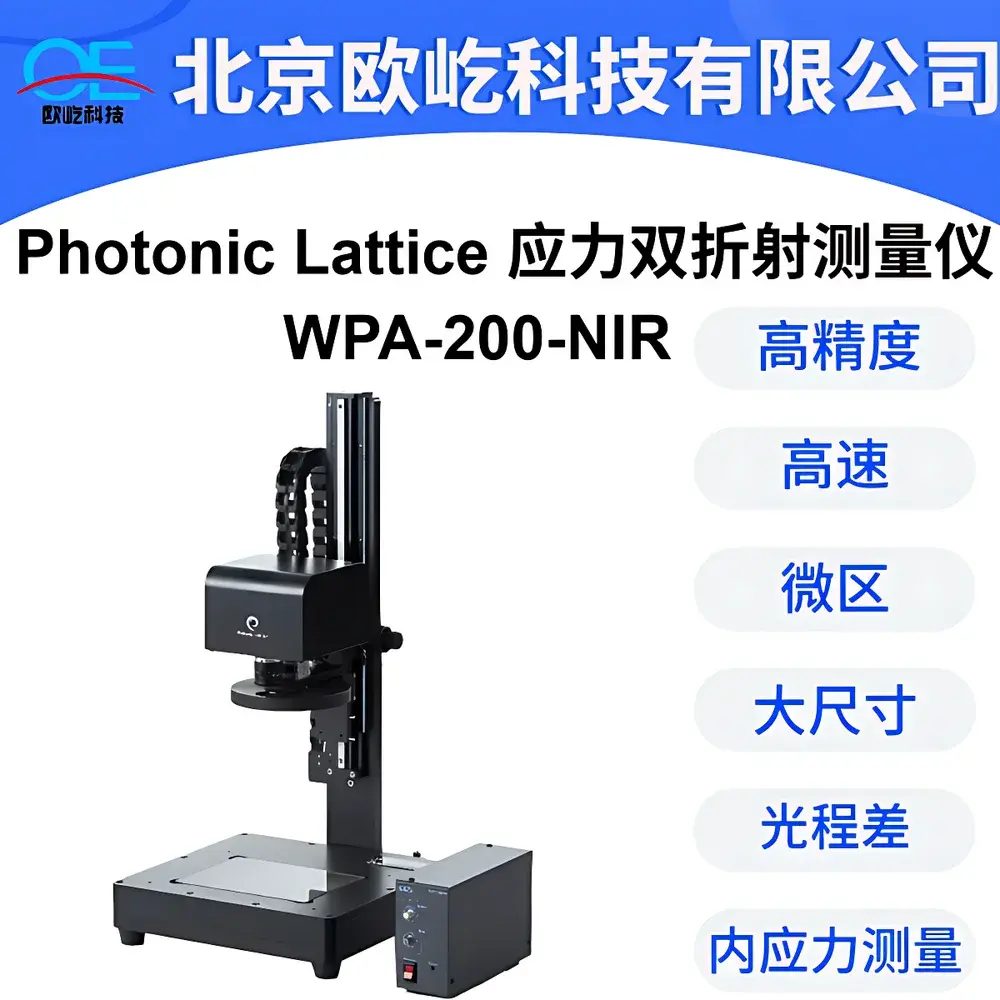
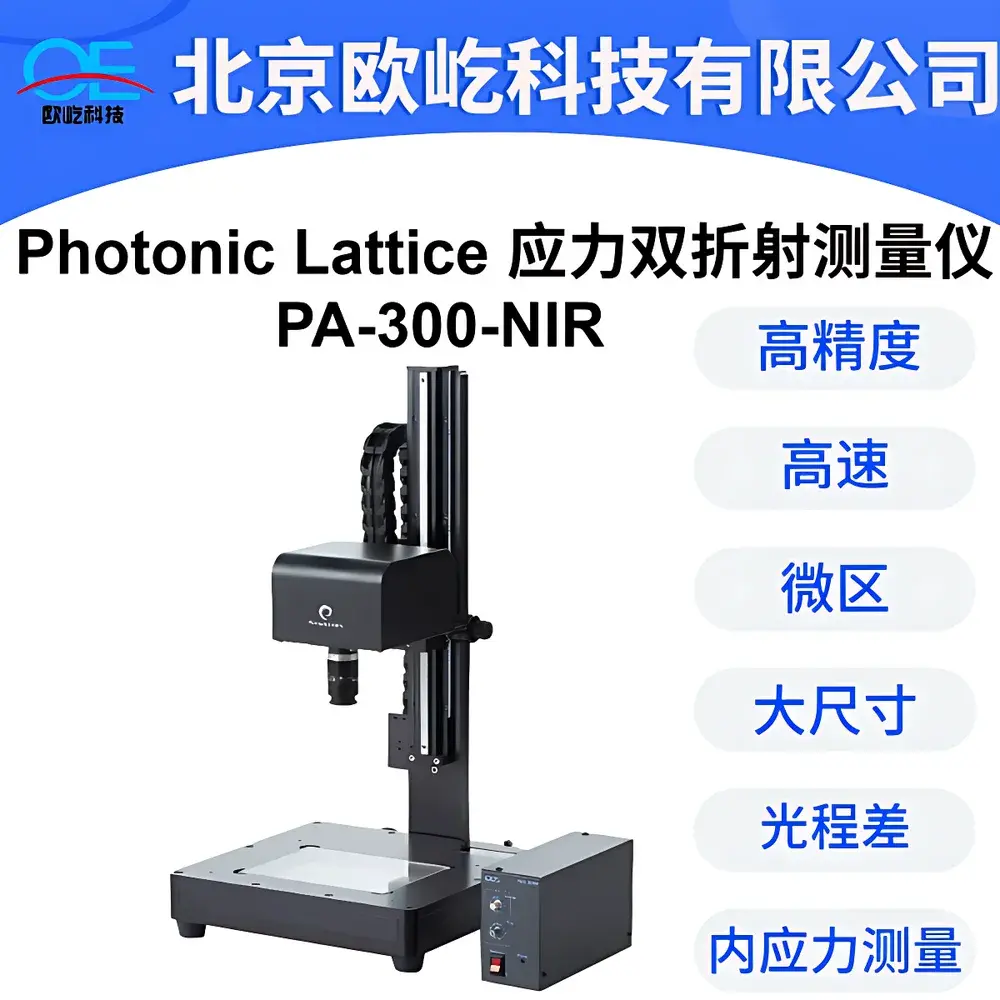
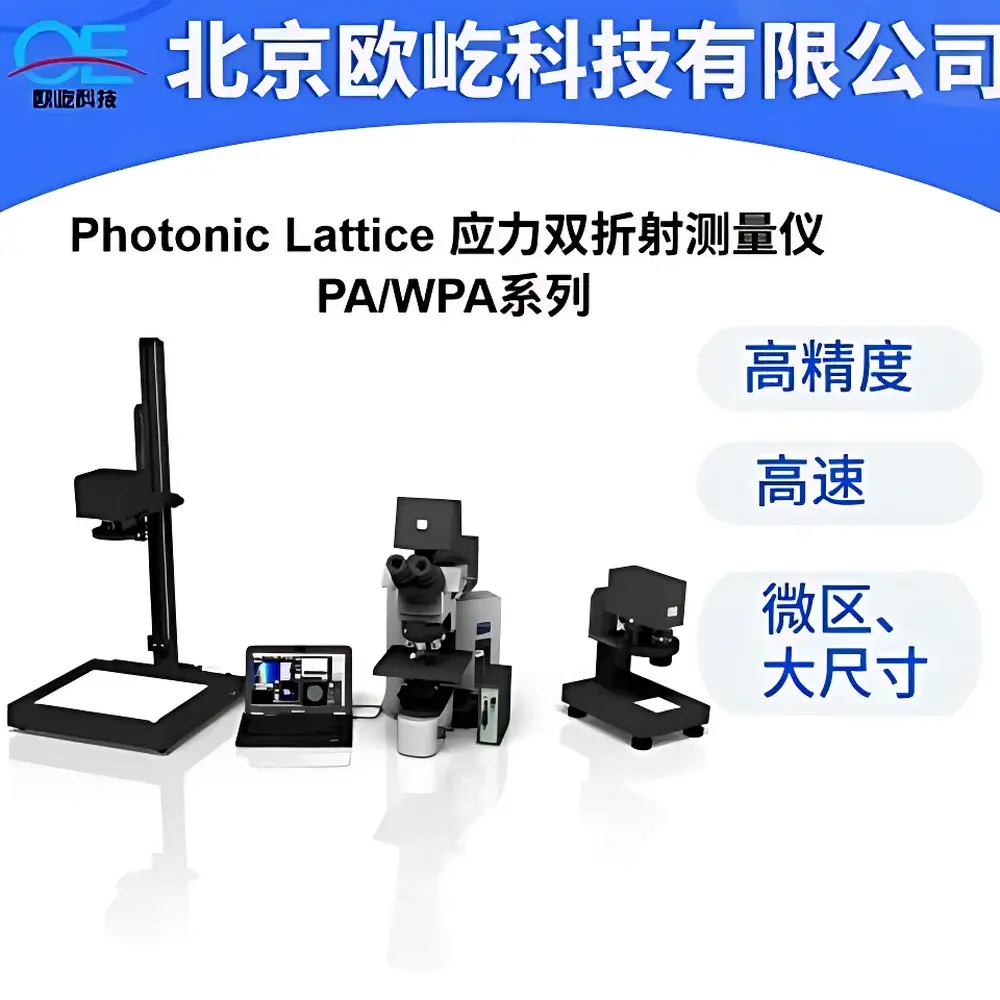
Photonic Lattice PA-300-NIR & WPA-200-NIR Near-Infrared Polarizing Stress Meters
| Brand | Photonic Lattice |
|---|---|
| Origin | Japan |
| Model Series | NIR |
| Measurement Wavelengths | 850 nm (PA-300-NIR) |
| Spatial Resolution | Up to 5 MP imaging module |
| Output Units | Retardation (nm), Azimuth Angle (°), Stress (MPa), Stress Birefringence (nm/mm) |
| Measurement Modes | Point, Line, Area, and 3D Stress Mapping |
| Compliance | Designed for ISO 11475, ASTM F2894, and JIS K 7106-aligned optical stress evaluation |
Overview
The Photonic Lattice PA-300-NIR and WPA-200-NIR are high-precision near-infrared polarizing stress meters engineered for quantitative birefringence characterization of optically opaque or infrared-transmissive materials. These instruments operate on the principle of photoelasticity combined with full-field polarization imaging—measuring phase retardation and azimuthal orientation of the slow axis across a sample’s surface under controlled NIR illumination. Unlike visible-light stress analyzers, the NIR-series systems leverage longer wavelengths (centered at 850 nm for PA-300-NIR; multiple NIR bands for WPA-200-NIR) to penetrate deeply into chalcogenide glasses, germanium optics, ZnS/ZnSe windows, and other IR-grade substrates that exhibit strong absorption in the visible spectrum. This enables non-destructive, contactless mapping of internal residual stress and stress-induced birefringence—critical parameters influencing wavefront fidelity, thermal lensing behavior, and polarization-dependent transmission in infrared optical systems.
Key Features
- Full-field, high-resolution stress mapping: Both models acquire spatially resolved retardation and azimuth data across the entire field of view in a single acquisition—eliminating point-by-point scanning and reducing measurement time by >90% compared to manual polariscope methods.
- Dual-platform architecture: The PA-300-NIR employs a fixed 850 nm LED source optimized for chalcogenide glass (e.g., Ge-As-Se, As-S) stress profiling; the WPA-200-NIR integrates three independently tunable NIR wavelengths (e.g., 940 nm, 1050 nm, 1300 nm) to resolve wavelength-dependent birefringence dispersion—essential for LiDAR lens assemblies and automotive IR transmissive components.
- Quantitative output suite: Direct calculation and export of four primary stress-related metrics: optical path difference (OPD) in nanometers, polarization azimuth angle in degrees, principal stress magnitude in megapascals (via stress-optic coefficient calibration), and stress birefringence gradient (nm/mm).
- Multi-dimensional analysis engine: Built-in software supports point interrogation, linear profile extraction, 2D false-color heatmaps, and reconstructed 3D stress vector fields—enabling correlation between fabrication processes (e.g., molding, annealing, coating) and localized stress anomalies.
- Robust mechanical design: Precision-machined aluminum chassis with motorized rotation stages, temperature-stabilized optics mount, and vibration-damped optical table integration capability ensure long-term measurement repeatability (±0.5 nm OPD stability over 8 h at 23 ± 1 °C).
Sample Compatibility & Compliance
These systems accommodate flat or gently curved IR optics up to Ø200 mm (PA-300-NIR) or Ø150 mm (WPA-200-NIR), including molded chalcogenide lenses, CVD-deposited ZnS domes, diamond-turned germanium substrates, and hybrid polymer-glass composites used in thermal imaging modules. Sample mounting is tool-free via vacuum chuck or kinematic stage options. All measurements adhere to principles outlined in ISO 11475 (optical material stress classification), ASTM F2894 (stress birefringence testing of infrared transmissive materials), and JIS K 7106 (plastic optical stress evaluation). Data logs include timestamp, operator ID, calibration certificate traceability, and instrument configuration metadata—supporting GLP-compliant documentation workflows and FDA 21 CFR Part 11 audit trails when deployed with validated software packages.
Software & Data Management
The proprietary PL-StressView™ software (v4.2+) provides real-time image acquisition, live birefringence visualization, and batch processing of multi-sample datasets. It supports raw data export in HDF5 and TIFF formats with embedded EXIF-like metadata (wavelength, exposure, gain, calibration matrix). Advanced modules include automated defect flagging (retardation thresholding), comparative overlay analysis across process lots, and CSV-based reporting compatible with JMP, MATLAB, and Python (via NumPy/Pandas interfaces). Software validation documentation—including IQ/OQ protocols and electronic signature functionality—is available upon request for regulated environments.
Applications
- Quality control of molded chalcogenide infrared lenses during mass production—detecting mold-induced shear stress and cooling gradient artifacts.
- R&D evaluation of annealing protocols for Ge-based optics, correlating thermal cycle parameters with residual stress relaxation rates.
- Stress uniformity certification of ZnSe output windows for CO₂ laser systems prior to anti-reflection coating.
- Failure root-cause analysis of delamination or fracture in bonded IR sensor stacks, where interfacial stress concentration precedes mechanical breakdown.
- Development of low-stress thin-film coatings for LWIR multispectral filters, using stress birefringence as a proxy for film adhesion and intrinsic stress.
FAQ
What NIR wavelengths are supported on the WPA-200-NIR?
The WPA-200-NIR integrates three discrete, narrowband NIR sources: 940 nm ±10 nm, 1050 nm ±15 nm, and 1300 nm ±20 nm—selected to span key atmospheric transmission windows and match common IR detector responsivity peaks.
Can the system measure curved or aspheric IR optics?
Yes—within limits of depth-of-field and surface normal alignment. Optional motorized tilt/rotation stages enable sequential multi-angle acquisition for curvature-compensated stress reconstruction.
Is calibration traceable to national standards?
All factory calibrations use NIST-traceable retardation standards (e.g., Berek compensators, quartz wedge sets) and are documented per ISO/IEC 17025 requirements.
How is stress magnitude calculated from retardation data?
Stress (MPa) = Retardation (nm) × C / t, where C is the material-specific stress-optic coefficient (provided by user or selected from built-in library), and t is local thickness (mm) measured separately or imported via external profilometry data.
Does the system support automated pass/fail judgment against specification limits?
Yes—customizable acceptance criteria can be defined per region-of-interest (ROI), with color-coded overlays and summary reports generated automatically for SPC charting.




