
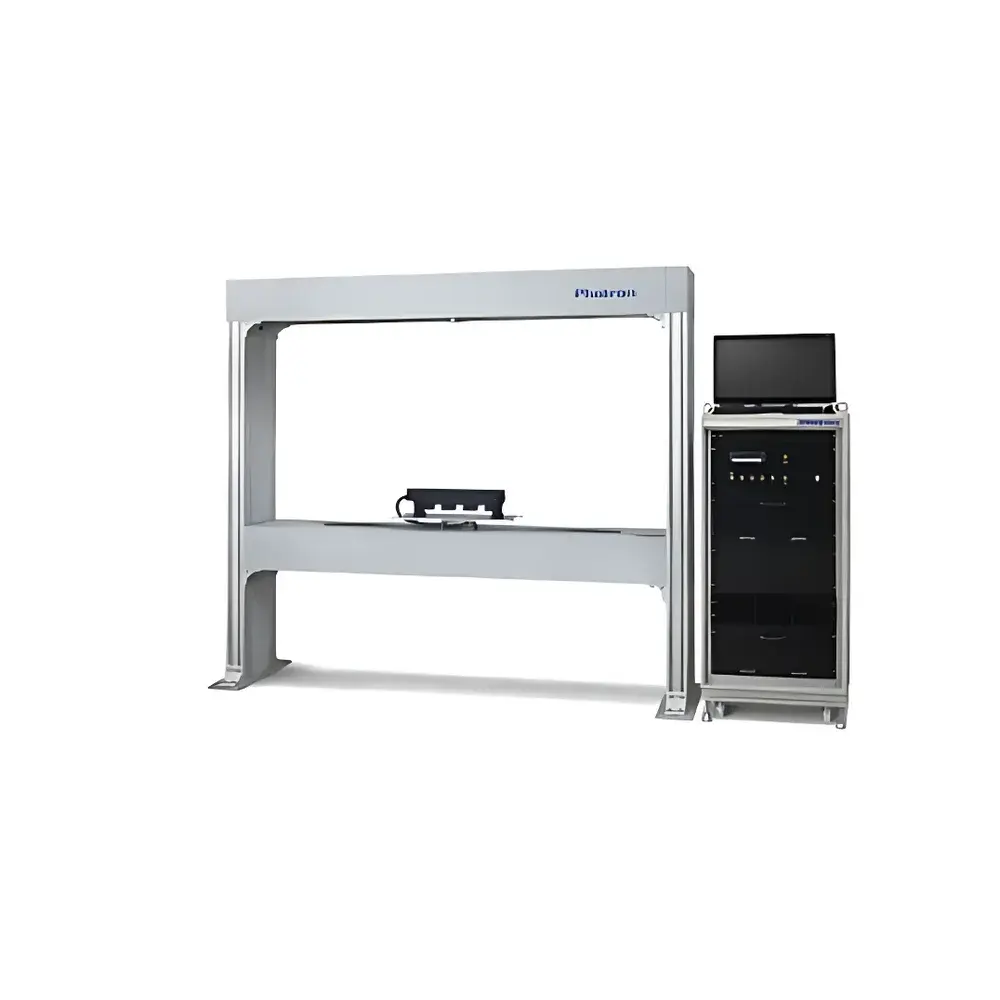
Photonic Lattice KAMAKIRI WM Online Birefringence Measurement System
| Brand | Photonic Lattice |
|---|---|
| Origin | Japan |
| Manufacturer Type | Authorized Distributor |
| Origin Category | Imported |
| Model | KAMAKIRI WM |
| Price | Upon Request |
| Output Parameters | Retardation [nm], Fast Axis Orientation [°] |
| Measurement Wavelength | 520 nm |
| Birefringence Range | 0–130 nm (standard), 0–260 nm (optional) |
| Principal Axis Range | 0–180° |
| Repeatability | <1 nm (σ) |
| Measurement Width | 350 mm |
| Spatial Resolution Points Across Width | 2560 |
Overview
The Photonic Lattice KAMAKIRI WM Online Birefringence Measurement System is an industrial-grade, real-time polarimetric imaging instrument engineered for continuous in-line monitoring of optical anisotropy in transparent and semi-transparent polymer films and substrates. Based on full-field quantitative photoelasticity, the system integrates a high-speed CMOS sensor with a proprietary micropolarizer array developed by Photonic Lattice Co., Ltd., enabling simultaneous acquisition of retardation magnitude and fast-axis orientation at every pixel across the measurement field. Unlike point-scanning or rotating-compensator systems, the KAMAKIRI WM employs snapshot polarimetry—eliminating motion artifacts and ensuring phase-stable measurements under dynamic production conditions. Its core optical architecture is optimized for 520 nm illumination, balancing sensitivity to sub-nanometer retardation shifts with robustness against ambient light interference and thermal drift. Designed for integration into roll-to-roll (R2R) coating lines, injection molding stations, and precision laminating processes, the system delivers traceable, ISO/IEC 17025-aligned birefringence data without requiring sample contact or vacuum environments.
Key Features
- Real-time full-field birefringence mapping at up to 60 Hz frame rate, synchronized with line speed via encoder input.
- Simultaneous pixel-level quantification of retardation (0–130 nm standard; 0–260 nm optional) and fast-axis orientation (0–180°) using calibrated micropolarizer array technology.
- On-the-fly pass/fail classification: configurable threshold-based alarms trigger visual (color-coded overlay) and digital (TTL/Modbus TCP) alerts upon detection of localized retardation anomalies exceeding user-defined limits.
- Intuitive color-mapping interface with adjustable hue-saturation-value (HSV) scaling, enabling rapid spatial interpretation of stress distribution and molecular alignment gradients.
- High spatial fidelity: 2560 discrete measurement points across a 350 mm active width, corresponding to ~137 µm effective sampling pitch.
- Modular expandability: additional polarization sensor modules can be daisy-chained to extend measurement width beyond 350 mm while maintaining temporal synchronization and geometric calibration integrity.
- Factory-calibrated repeatability of <1 nm (σ) under controlled environmental conditions (23 ± 1°C, RH <60%), verified per ASTM E2544-22 Annex A3 protocols.
Sample Compatibility & Compliance
The KAMAKIRI WM is validated for use with optically transparent and isotropic-to-anisotropic transition materials including triacetyl cellulose (TAC), polycarbonate (PC), cycloolefin copolymer (COC), polymethyl methacrylate (PMMA), polyethylene terephthalate (PET), polyethylene naphthalate (PEN), polystyrene (PS), polyimide (PI), and thermoplastic amorphous copolyesters (e.g., COP). It supports thickness ranges from 10 µm to 1.2 mm, provided transmittance exceeds 35% at 520 nm. The system complies with IEC 61000-6-2 (EMC immunity) and IEC 61000-6-4 (EMC emission) standards. Data acquisition and storage meet GLP audit-trail requirements, with timestamped metadata (including environmental sensor readings, calibration ID, operator login, and instrument status flags) embedded in each HDF5-formatted output file. Optional FDA 21 CFR Part 11 compliance package includes electronic signature support, role-based access control, and immutable audit logs.
Software & Data Management
The KAMAKIRI Control Suite (v4.2+) provides native Windows 10/11 support with deterministic real-time processing pipelines implemented in C++ and CUDA-accelerated GPU kernels. Raw polarimetric data undergoes on-board correction for non-uniform illumination, micropolarizer crosstalk, and sensor dark-current drift prior to retardation/axis computation. Export formats include CSV (tabular time-series), TIFF (georeferenced false-color maps), and HDF5 (self-describing binary with embedded calibration matrices and uncertainty estimates). APIs (RESTful HTTP and shared memory) enable integration with MES/SCADA platforms such as Siemens SIMATIC IT, Rockwell FactoryTalk, and Yokogawa CENTUM VP. Historical datasets are indexed via SQLite-backed metadata catalog supporting queries by batch ID, timestamp range, or process parameter setpoint.
Applications
- Roll-to-roll manufacturing of phase-difference compensation films for LCD and OLED displays.
- In-process monitoring of residual stress development during thermal annealing and UV-curing of optical adhesives and hard-coat layers.
- Quality gate verification for TAC and PC substrates used in polarizer assemblies.
- Correlation of birefringence profiles with mechanical draw ratios in oriented polymer extrusion.
- Root-cause analysis of edge curl, warpage, and delamination in multilayer laminates containing birefringent components.
- Validation of stress-relief treatments in glass substrates post-cutting or chemically strengthened surfaces.
FAQ
What is the minimum detectable retardation step size?
The system resolves retardation changes down to 0.3 nm (LSB) with statistical repeatability better than 1 nm (σ) over 100 consecutive measurements under stabilized conditions.
Can the KAMAKIRI WM operate in ambient factory lighting?
Yes—the optical head incorporates narrowband 520 nm LED illumination and spectral rejection filters, achieving >50 dB ambient light suppression without requiring dark enclosures.
Is calibration traceable to national standards?
Factory calibration uses NIST-traceable quarter-wave and half-wave retardation standards (certified by AIST, Japan), with full uncertainty budgets documented per ISO/IEC 17025:2017 clause 7.7.
How is geometric distortion corrected across the 350 mm field?
A two-step calibration procedure captures lens distortion coefficients and micropolarizer array registration errors using a precision grid target; correction is applied in real time via bilinear interpolation with sub-pixel accuracy.
Does the system support multi-layer stack analysis?
While the KAMAKIRI WM measures net surface-integrated retardation, it can be deployed upstream/downstream of lamination stations to isolate layer-specific contributions when combined with reference measurements on individual substrates.





