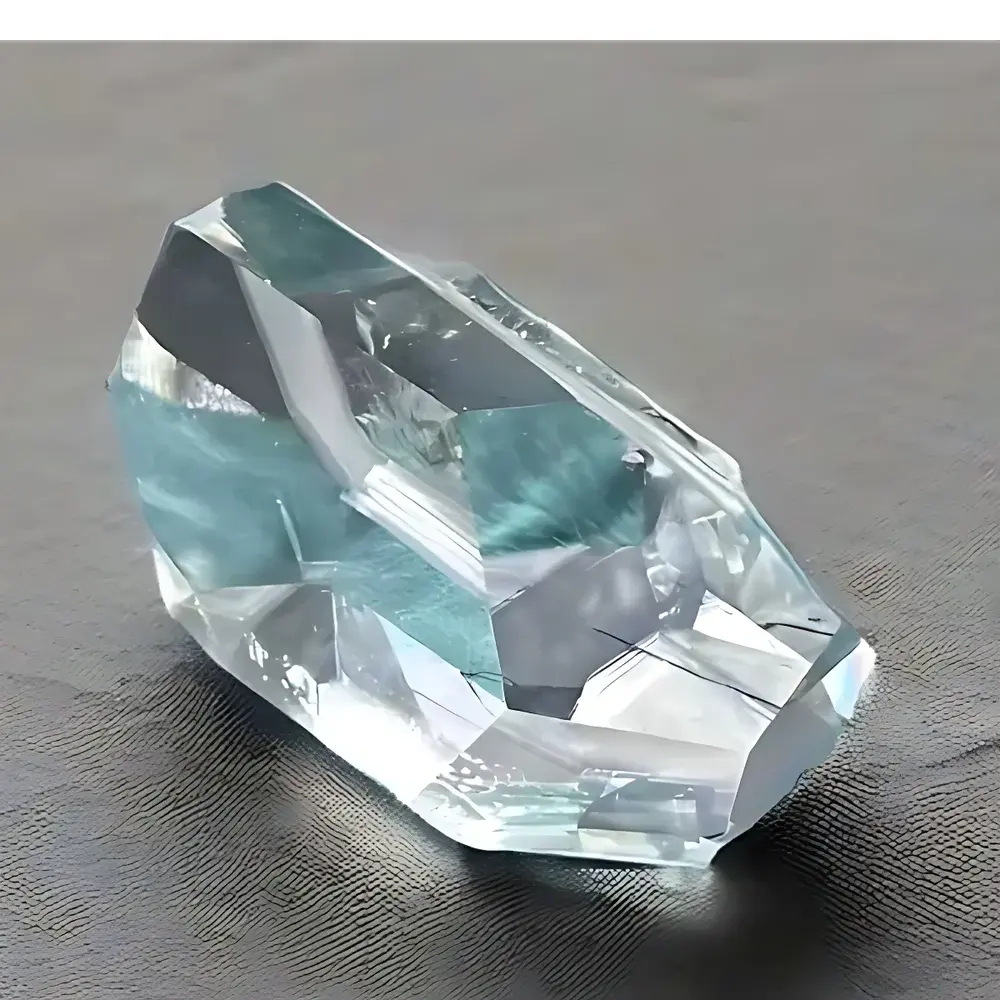
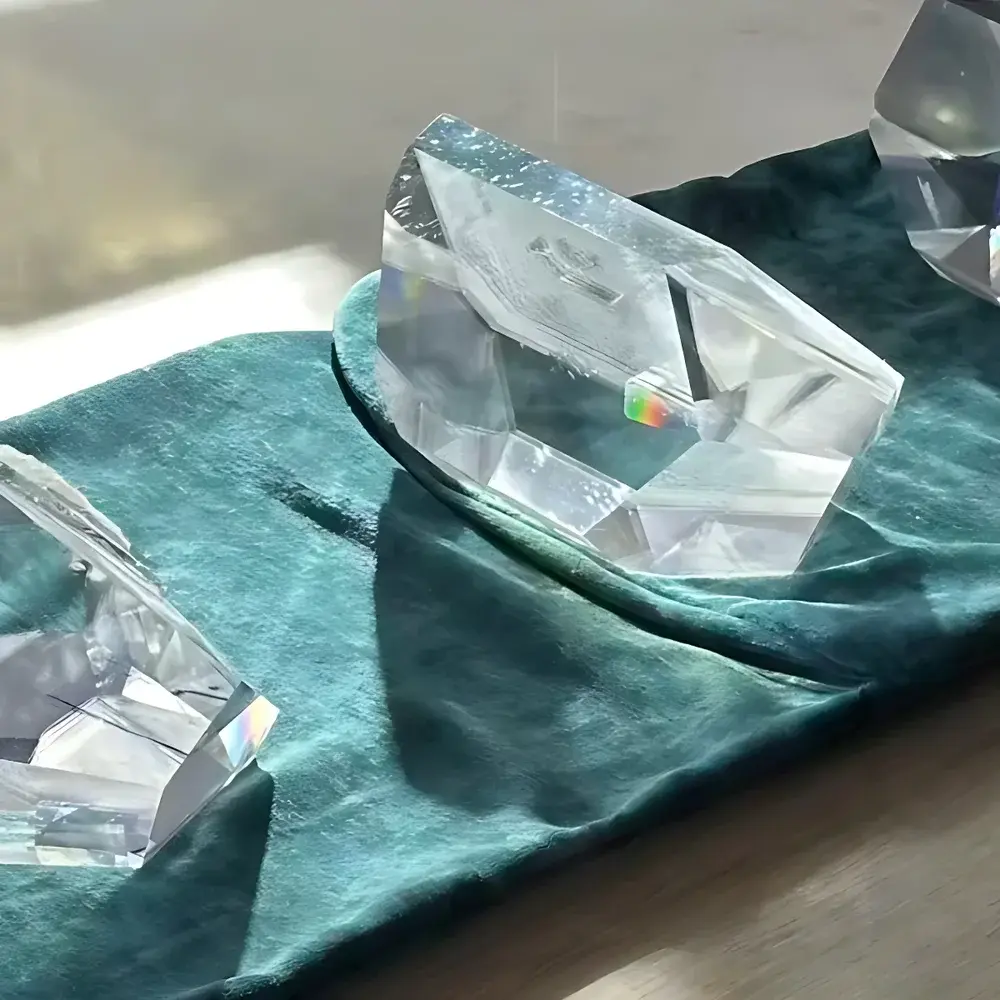
LBO Crystal – Lithium Triborate (LiB₃O₅)
| Brand | OETech |
|---|---|
| Model | OELBO001 |
| Origin | Beijing, China |
| Type | Nonlinear Optical (NLO) Crystal |
| Damage Threshold | >15 GW/cm² (1064 nm, 10 ns, 10 Hz) |
| Transmission Range | 160–2600 nm |
| Phase-Matching Range | 1040–2600 nm (Type I), 550–2600 nm (Type II) |
| Thermal Conductivity | 3.5 W/m·K |
| Hygroscopicity | Non-hygroscopic |
| Refractive Index (532 nm) | nₒ = 1.655, nₑ = 1.647 |
| Acceptance Angle | ~10 mrad·cm |
| Walk-off Angle (1064 nm → 532 nm) | ~1.8° |
Overview
Lithium triborate (LiB₃O₅, commonly abbreviated as LBO) is a widely adopted nonlinear optical (NLO) crystal engineered for high-efficiency frequency conversion in solid-state laser systems. Its crystal structure belongs to the orthorhombic space group Pna2₁, enabling broad phase-matching capability across ultraviolet (UV), visible, and near-infrared (NIR) spectral regions. Unlike hygroscopic alternatives such as KDP or BBO, LBO exhibits exceptional environmental stability—resisting moisture absorption, thermal shock, and mechanical degradation under high-intensity irradiation. It operates on the principle of second-order nonlinear polarization, where incident coherent light (e.g., fundamental wavelength at 1064 nm) interacts with the non-centrosymmetric lattice to generate harmonics (e.g., 532 nm SHG or 355 nm THG) via parametric processes governed by energy and momentum conservation.
Key Features
- High Laser-Induced Damage Threshold (LIDT): Exceeds 15 GW/cm² at 1064 nm (10 ns pulse width, 10 Hz repetition rate), making it suitable for high-average-power Q-switched and mode-locked laser systems.
- Broad Transparency Window: Transmits effectively from 160 nm (deep UV) to 2600 nm (mid-IR), supporting multi-stage harmonic generation and broadband parametric tuning.
- Non-Hygroscopic Nature: Requires no hermetic sealing or climate-controlled storage—reducing operational overhead and long-term maintenance costs in industrial and laboratory environments.
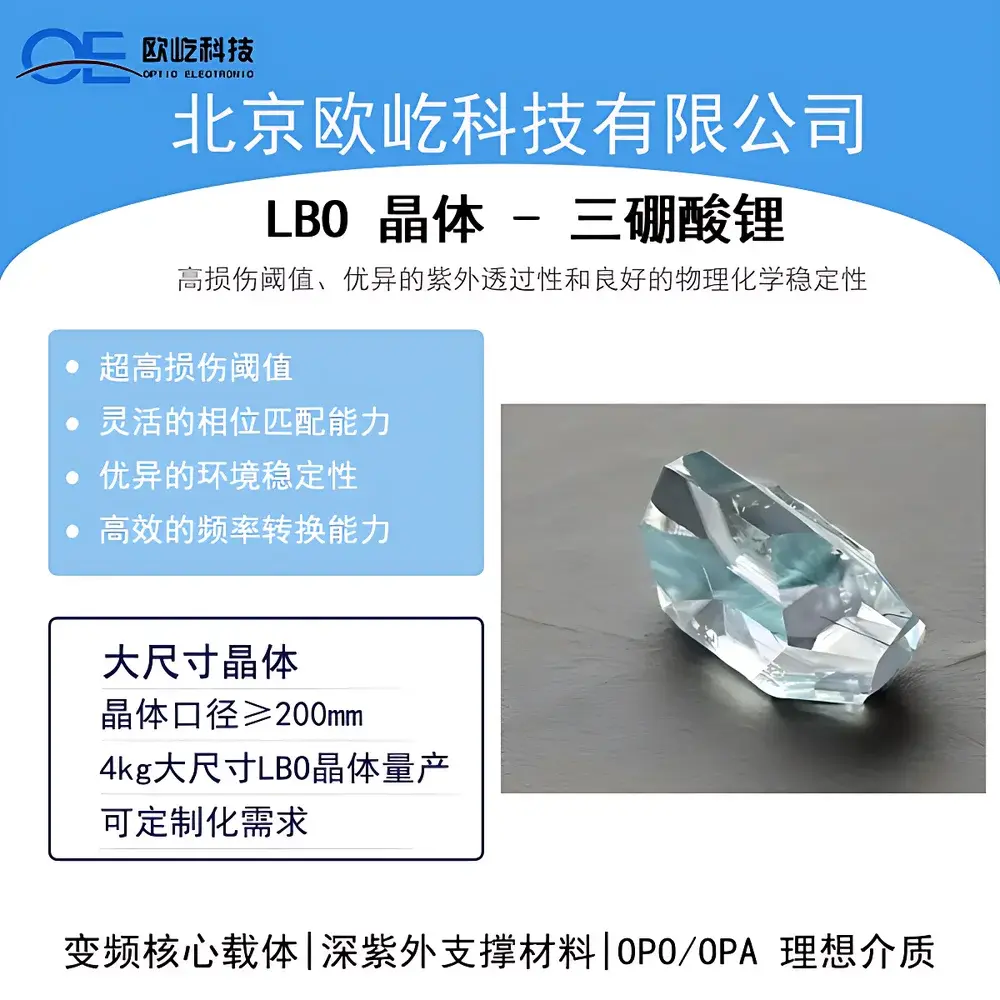
- Large Aperture Availability: OETech routinely supplies LBO crystals with clear apertures ≥200 mm and mass-produced boules up to 4 kg, enabling scalability for high-energy laser amplifier stages and EUV lithography source development.
- Thermal & Mechanical Robustness: Exhibits low thermo-optic coefficient (dn/dT ≈ −16 × 10⁻⁶/°C) and high thermal conductivity (3.5 W/m·K), minimizing thermal lensing effects during continuous-wave or high-repetition-rate operation.
Sample Compatibility & Compliance
LBO crystals are compatible with standard optomechanical mounts (e.g., kinematic rotation stages, Brewster-angle holders, and temperature-controlled ovens for critical phase-matching alignment). All OETech-manufactured LBO wafers undergo full traceability per ISO 9001:2015 quality management protocols. Crystals are polished to λ/10 surface flatness (RMS), scratch-dig ≤ 10–5 per MIL-PRF-13830B, and coated with AR/HR multilayer dielectric films optimized for specific pump/probe wavelengths (e.g., R<0.2% @ 1064/532/355 nm). While LBO itself is not subject to ITAR or EAR restrictions, export documentation complies with Chinese dual-use item regulations and EU REACH Annex XIV substance declarations.
Software & Data Management
OETech provides comprehensive technical support documentation—including phase-matching angle calculators (based on Boyd-Kleinman formalism), Sellmeier equation coefficients (valid from 160–2600 nm), and thermal dephasing models—for integration into system-level simulation tools such as MATLAB, Python (SciPy), or commercial ray-tracing platforms (Zemax OpticStudio, CODE V). No proprietary software is required; all data formats adhere to IEEE Std 1596-2020 for optical material property exchange. Calibration reports include interferometric surface metrology (Zygo Verifire), spectrophotometric transmission curves (PerkinElmer Lambda 950), and LIDT validation test logs—archivable under GLP-compliant electronic lab notebook (ELN) frameworks.
Applications
- UV Laser Generation: Efficient 3rd-harmonic generation (THG) of Nd:YAG (1064 nm → 355 nm) and Ti:sapphire (800 nm → 266 nm) lasers for micromachining, semiconductor inspection, and time-resolved fluorescence spectroscopy.
- Deep-UV Source Development: Cascaded mixing with CLBO or BBO to produce stable 193 nm output for photolithography stepper calibration and wafer defect metrology per SEMI F20 standards.
- Optical Parametric Oscillation (OPO): Pumped by Q-switched 355 nm or 532 nm sources, delivering tunable idler signal outputs from 540 nm to 1030 nm with >30% conversion efficiency—used in standoff chemical detection and quantum entanglement experiments.
- Ultrafast Amplification Stages: Employed in chirped-pulse amplification (CPA) chains for petawatt-class facilities, including inertial confinement fusion (ICF) driver lines and attosecond pulse generation setups.
FAQ
What is the typical acceptance angle for type-I SHG at 1064 nm?
The angular acceptance bandwidth is approximately 10 mrad·cm, ensuring alignment tolerance suitable for industrial OEM integration.
Can LBO be used for fourth-harmonic generation (FHG) directly?
No—direct FHG is inefficient due to weak χ⁽³⁾ contribution; instead, cascaded SHG + SFG (e.g., 1030 nm → 515 nm → 343 nm) or THG + SFG schemes are employed.
Is anti-reflection coating included by default?
Yes—standard AR coatings are applied for specified pump/signal wavelengths; custom HR/AR stacks are available upon request.
How does LBO compare to BBO for UV generation?
LBO offers higher damage threshold and lower walk-off than BBO but narrower phase-matching bandwidth—making it preferable for high-power CW or high-repetition-rate pulsed systems where thermal management dominates.
Do you provide crystal orientation verification reports?
Yes—each crystal is supplied with X-ray Laue diffraction pattern analysis confirming cut angle accuracy within ±0.1° of nominal phase-matching orientation.