
Photonic Lattice WPA Ultra-Large-Area Birefringence and Residual Stress Measurement System
| Brand | Photonic Lattice |
|---|---|
| Origin | Japan |
| Manufacturer Status | Authorized Distributor |
| Origin Category | Imported |
| Model | WPA |
| Pricing | Upon Request |
| Wavelengths | 523 nm, 543 nm, 575 nm |
| Phase Difference Range | Up to 3000 nm |
| Optical Configuration | Custom-Engineered Large-Aperture Circular Polarization Illumination System |
| Detection | Wide-Angle Polarimetric CMOS Area Sensor |
| Application Scope | Automotive Glazing, Architectural Laminated Glass, Display Cover Glass |
Overview
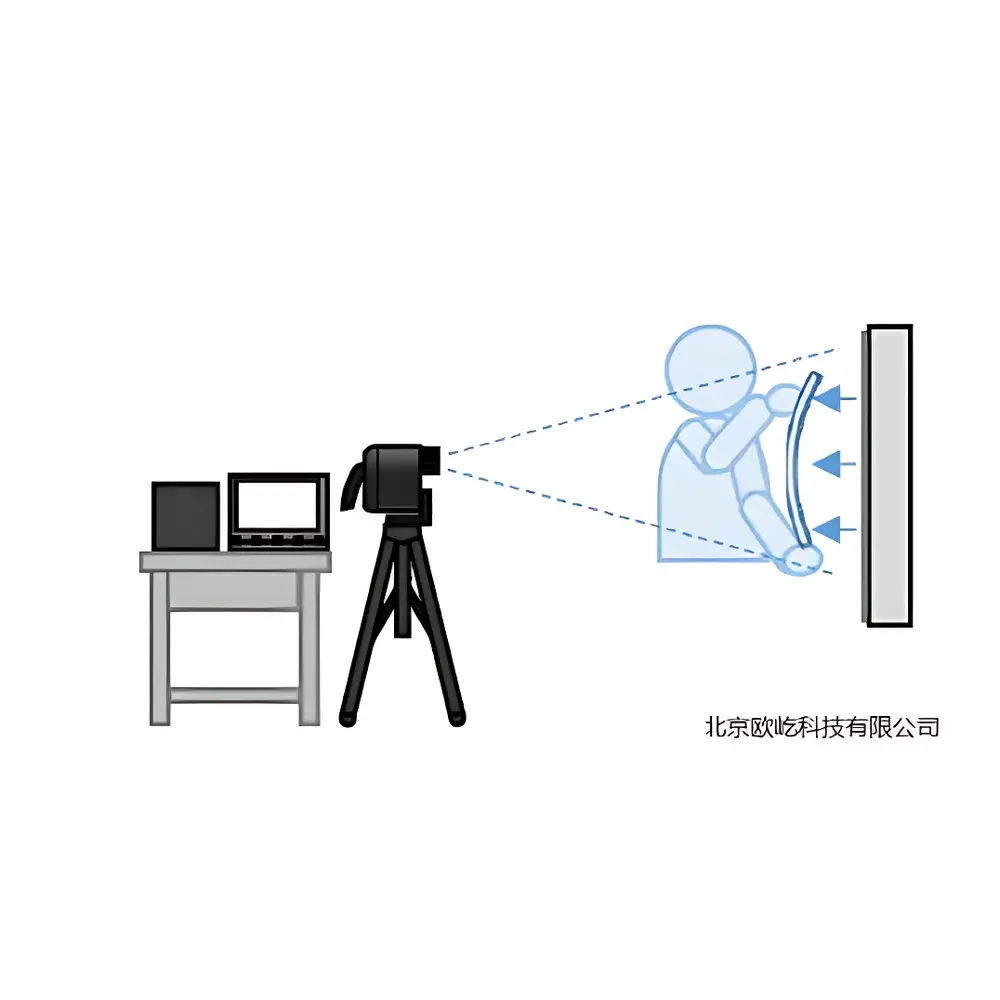
The Photonic Lattice WPA Ultra-Large-Area Birefringence and Residual Stress Measurement System is an industrial-grade polarimetric imaging platform engineered for quantitative, non-contact evaluation of optical anisotropy in large-format transparent components. Unlike conventional tabletop photoelastic or retardation mapping instruments—whose field-of-view limitations and point-scanning architectures impose prohibitive throughput constraints—the WPA system employs a full-field, wide-angle polarimetric imaging architecture based on synchronous multi-wavelength circular polarization illumination and high-dynamic-range birefringence detection. Its core measurement principle relies on the quantitative analysis of phase retardation (δ) and fast-axis orientation (θ) across the entire sample surface using Mueller matrix-derived polarimetric reconstruction. This enables direct, spatially resolved mapping of residual stress-induced birefringence in materials such as tempered automotive glazing, laminated safety glass, and chemically strengthened cover substrates—without mechanical scanning or sample translation.
Key Features
- Ultra-large measurement area support: Configurable optical path and custom-built circular polarization illumination systems accommodate samples up to 2,500 mm × 1,800 mm (typical for automotive windshields), with scalable design for larger architectural or display applications.
- Multi-wavelength polarimetric acquisition: Simultaneous operation at 523 nm (green), 543 nm (yellow-green), and 575 nm (orange) enables wavelength-dependent retardation analysis, critical for distinguishing intrinsic birefringence from stress-induced contributions and mitigating dispersion-related artifacts.
- Full-field, single-shot measurement: A wide-angle, high-resolution polarimetric CMOS area sensor captures complete retardation and axis orientation maps in one exposure—eliminating raster scanning and reducing measurement time per windshield from >30 minutes to <90 seconds.
- High dynamic range phase resolution: Capable of resolving retardation values from 0.1 nm up to 3000 nm with sub-nanometer repeatability under controlled environmental conditions (temperature stability ±0.2°C, vibration isolation class ISO 230-2 Class 3).
- Robust thermal and mechanical architecture: Designed for integration into production-line environments; includes active thermal stabilization of optical components and vibration-damped optical bench construction compliant with ISO 10110-7 for precision optical instrumentation.
Sample Compatibility & Compliance
The WPA system is validated for use with flat and mildly curved transparent dielectrics exhibiting linear or weakly circular birefringence, including soda-lime silicate glass, borosilicate glass, polycarbonate laminates, and alkali-aluminosilicate cover glass. It supports thicknesses from 2 mm to 25 mm and surface curvature radii down to 1,200 mm (RMS deviation < 5 µm over 100 mm aperture). Measurement traceability aligns with ISO 11146-1 (laser beam parameters) and ASTM E1725 (standard practice for photoelastic stress analysis), while system calibration protocols follow NIST-traceable reference retarders and certified stress standards. The instrument’s data handling architecture supports audit-ready documentation required under GLP and GMP frameworks, including electronic signatures, change control logs, and FDA 21 CFR Part 11–compliant user access management when deployed with optional validation packages.
Software & Data Management
The proprietary WPA Control & Analysis Suite (v4.2+) provides integrated instrument control, real-time polarimetric visualization, and metrological post-processing. Key modules include: (1) Multi-wavelength retardation fusion engine for dispersion-corrected δ-maps; (2) Stress tensor inversion module calibrated for common automotive glass compositions (e.g., float glass, heat-strengthened laminates); (3) Statistical process control dashboard with SPC charting (X-bar/R, Cpk), defect clustering algorithms, and automated pass/fail classification against user-defined spatial thresholds; (4) Export interfaces for CSV, HDF5, and industry-standard Metrology XML (MTLX) formats compatible with MES and QMS platforms such as Siemens Opcenter Quality and ETQ Reliance. All software operations maintain full audit trail functionality—including parameter changes, user logins, and report generation—with timestamped digital signatures.
Applications
- Automotive Tier-1 supplier R&D: Quantitative correlation of tempering parameters (quench pressure, cooling asymmetry) with residual stress distribution in laminated windshields and side windows.
- In-line quality assurance: High-throughput screening of optical distortion and edge compression anomalies in mass-produced glazing prior to final assembly.
- Display manufacturing: Evaluation of birefringence uniformity in large-area OLED cover glass and touch sensor laminates where polarization-dependent viewing angle shifts impact contrast ratio.
- Architectural glass certification: Mapping of stress gradients in thermally bent façade panels to verify compliance with EN 1863-1 (heat-treated soda-lime-silica glass) and ASTM C1048 (standard specification for heat-strengthened and fully tempered flat glass).
- Optical component validation: Characterization of wavefront distortion and polarization crosstalk in large-format beam splitters, polarizing cubes, and AR-coated substrates used in lithography tools and laser systems.
FAQ
What is the maximum sample size supported by the WPA system?
Standard configurations accommodate up to 2,500 mm × 1,800 mm; custom optical layouts are available for widths exceeding 3,200 mm upon engineering review.
Can the WPA measure curved or laminated glass?
Yes—it supports gently curved surfaces (radius ≥ 1,200 mm) and multi-layer laminates (e.g., PVB/EVA interlayers), provided total optical path difference remains within the 3000 nm dynamic range.
Is calibration traceable to national standards?
All factory calibrations utilize NIST-traceable quarter-wave and half-wave reference retarders, with certificate of calibration issued per ISO/IEC 17025 requirements.
Does the system comply with FDA 21 CFR Part 11 for regulated environments?
Yes—when configured with the Validation Support Package (VSP), it delivers full electronic record and signature functionality, including role-based access control, audit trail export, and system validation documentation.
How is thermal drift managed during extended measurements?
The illumination source and sensor subsystems incorporate active temperature regulation (±0.1°C setpoint stability), and the software applies real-time thermal compensation using embedded thermistor arrays and empirical drift models.




