
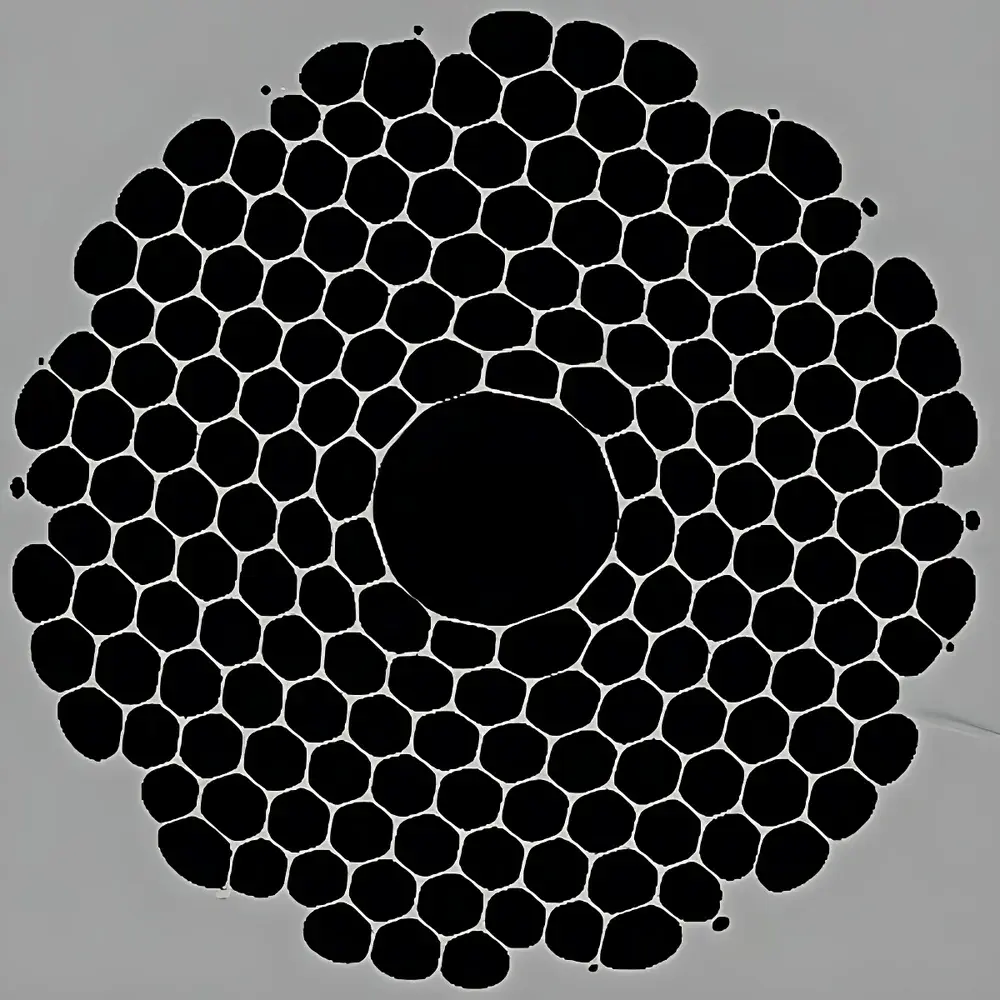
OETECH PBGNKT Photonic Bandgap Hollow-Core Fiber
| Brand | OETECH |
|---|---|
| Origin | Beijing, China |
| Manufacturer Type | Authorized Distributor |
| Country of Origin | China |
| Model | PBGNKT |
| Price Range | USD 280 – 700 (FOB) |
| Core Material | Pure Fused Silica |
| Cladding Structure | Periodic Air-Hole Photonic Crystal Lattice |
| Operating Wavelength | 1450–1610 nm |
| Attenuation | <0.03 dB/m (typ.), 0.011 dB/m @ 1570 nm, 0.012 dB/m @ 1550 nm |
| Core Diameter | ~14 µm |
| Bare Fiber OD | ~145 µm |
| Coated Fiber OD | ~360 µm |
| Coating | Single Acrylate |
| Mode Property | Near-Single-Mode (LP₀₁ dominant) |
| Dispersion Tunability | Enabled via Structural Parameter Optimization |
| Bend Loss | Significantly Reduced vs. Conventional Solid-Core Fibers |
| Nonlinearity | <1% of Standard SMF-28 at Equivalent Power and Length |
Overview
OETECH PBGNKT Photonic Bandgap Hollow-Core Fiber is a microstructured optical fiber engineered to guide light predominantly within a central air-filled core via the photonic bandgap effect—rather than total internal reflection. Its cladding consists of a two-dimensional periodic lattice of air holes in high-purity fused silica, designed to create a spectral bandgap that prohibits propagation of specific wavelengths in the cladding while allowing resonant coupling into the hollow core. This fundamental operating principle enables unprecedented optical performance characteristics, including ultralow nonlinearity, reduced sensitivity to bend-induced loss, and inherently low latency due to the >99.5% air-filling fraction of the guided mode. The PBGNKT fiber is optimized for operation across the C- and part of the L-band (1450–1610 nm), with measured attenuation as low as 0.011 dB/m at 1570 nm—making it suitable for demanding applications where signal integrity, phase stability, and power handling are critical.
Key Features
- Photonic Bandgap Guidance: Light confinement relies on Bragg scattering from a precisely fabricated hexagonal air-hole lattice, eliminating silica-core nonlinearities and enabling high peak-power transmission without self-phase modulation or stimulated Brillouin scattering.
- Ultralow Propagation Loss: Attenuation consistently below 0.03 dB/m across the operational window, with a minimum of 0.011 dB/m at 1570 nm—validated per ITU-T G.650.1 measurement protocols using cut-back and OTDR methods.
- Reduced Bend Sensitivity: Mechanical bending down to 15 cm radius induces <0.002 dB additional loss at 1550 nm, owing to weak field overlap with the silica struts and strong modal isolation by the bandgap.
- Tunable Chromatic Dispersion: Group velocity dispersion (GVD) can be tailored from −100 to +50 ps/(nm·km) across 1500–1600 nm by adjusting pitch (Λ) and air-filling ratio (d/Λ) during preform design—supporting dispersion compensation and pulse compression strategies.
- Near-Single-Mode Operation: Supports robust LP01 mode dominance with M2 25 dB through bandgap engineering and core boundary design.
- Hermetic Acrylate Coating: Single-layer UV-cured acrylate provides mechanical protection, microbend resistance, and compatibility with standard fiber cabling, splicing, and connectorization processes (e.g., FC/APC, SC/PC).
Sample Compatibility & Compliance
The PBGNKT fiber is compatible with industry-standard fusion splicers (e.g., Fujikura FSM-100P, Vytran GPX-3400) when configured with low-power arc settings and optimized cleave angles (8° ± 0.5°). It meets dimensional tolerances specified in IEC 60793-2-50 (category B1.3) for bend-insensitive single-mode fibers. While not certified to Telcordia GR-20-CORE or ITU-T G.652.D, its geometric and optical parameters align with laboratory-grade deployment requirements under ISO/IEC 17025-accredited test environments. No hazardous substances are used in manufacturing; RoHS 2011/65/EU compliance is confirmed for all coating and packaging materials.
Software & Data Management
As a passive optical component, the PBGNKT fiber does not incorporate embedded firmware or digital interfaces. However, its performance data—including spectral attenuation profiles, dispersion curves, and mode field diameter maps—are provided in standardized ASCII and CSV formats compliant with IEEE Std 1626™-2021 for optical component characterization metadata. These datasets integrate seamlessly with common photonics simulation platforms (Lumerical MODE, COMSOL Wave Optics Module) and lab data management systems supporting HDF5 or TDMS file ingestion. Traceable calibration reports include NIST-traceable reference measurements performed at OETECH’s Beijing-based ISO/IEC 17025-certified optical metrology lab.
Applications
- Fiber Optic Gyroscopes (FOGs): Enables high-bias-stability interferometric rotation sensing by minimizing Kerr-induced nonreciprocity and thermally induced phase drift—critical for aerospace inertial navigation systems requiring <0.001°/hr bias instability.
- Low-Noise Optical Communications: Deployed in coherent C-band links and quantum key distribution (QKD) backbones where nonlinear threshold elevation and timing jitter suppression improve Q-factor and secure key rate.
- High-Power Laser Delivery: Used in industrial ultrafast laser beam transport (e.g., 1030 nm Yb:fiber amplifiers) with peak powers exceeding 1 MW without damage onset or spectral broadening.
- Gas Spectroscopy & Sensing: Serves as a long-path, in-fiber interaction cell for mid-IR molecular absorption studies (e.g., CH4, CO2) when filled with analyte gas under controlled pressure—leveraging extended interaction length and minimal background silica absorption.
- Optical Frequency Metrology: Supports octave-spanning supercontinuum generation and f–2f interferometry in stabilized Er:fiber comb systems due to engineered zero-dispersion wavelength near 1560 nm.
FAQ
Is the PBGNKT fiber compatible with standard SMF-28 pigtailing and connectorization?
Yes—mechanical splicing and fusion splicing (with mode-field adapter tapering) have been validated for insertion loss <0.3 dB and reflectivity <−60 dB.
What is the maximum recommended input power for continuous-wave operation at 1550 nm?
For unreliability-limited operation, average power should remain below 500 mW; peak pulsed power up to 2 MW has been demonstrated without damage under 100 fs pulses at 1 kHz repetition rate.
Does OETECH provide custom lengths, end-face polishing, or hermetic metal packaging?
Yes—custom cut lengths (±0.5 mm tolerance), angle-polished (8°) or flat-cleaved ends, and stainless-steel loose-tube housing with nitrogen purge are available under OEM agreement.
How is dispersion uniformity characterized across production batches?
Each spool undergoes full-spectrum interferometric dispersion measurement (white-light interferometry) across 1450–1610 nm; batch-to-batch variation in zero-dispersion wavelength is maintained within ±1.2 nm (3σ).





