
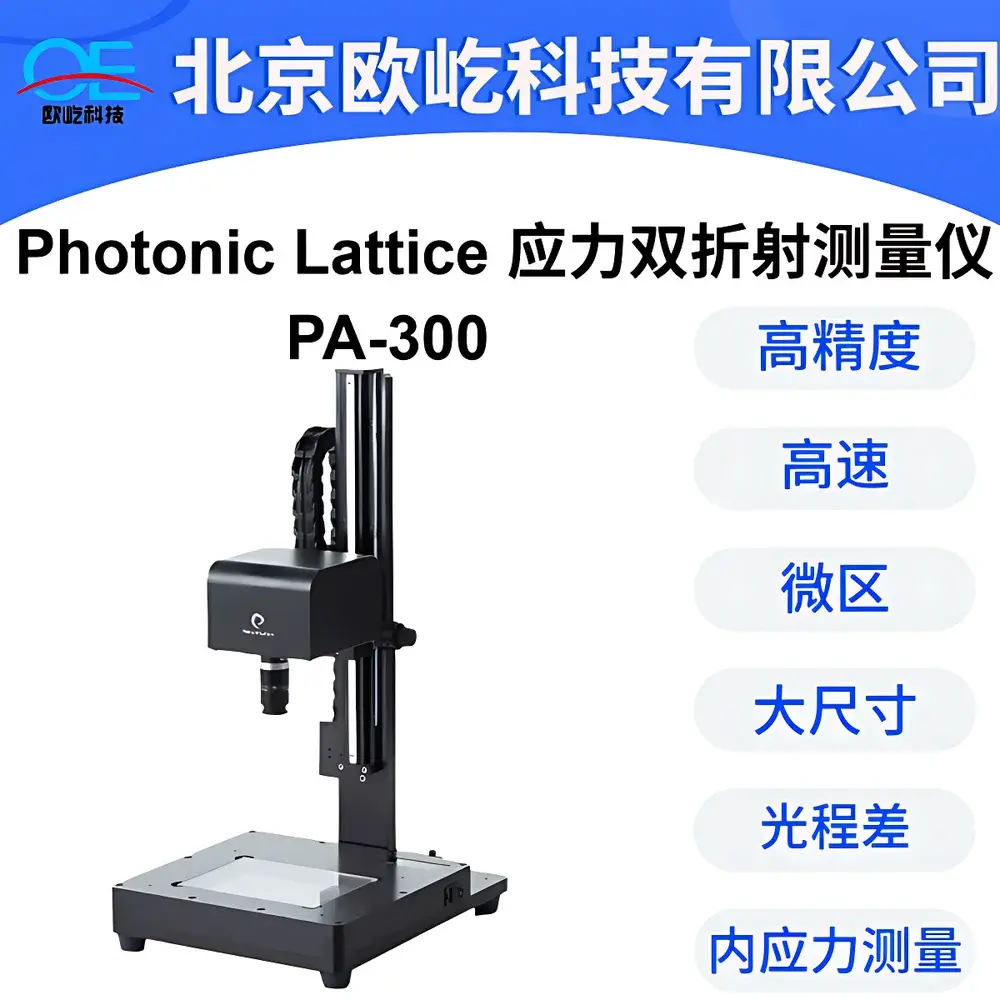
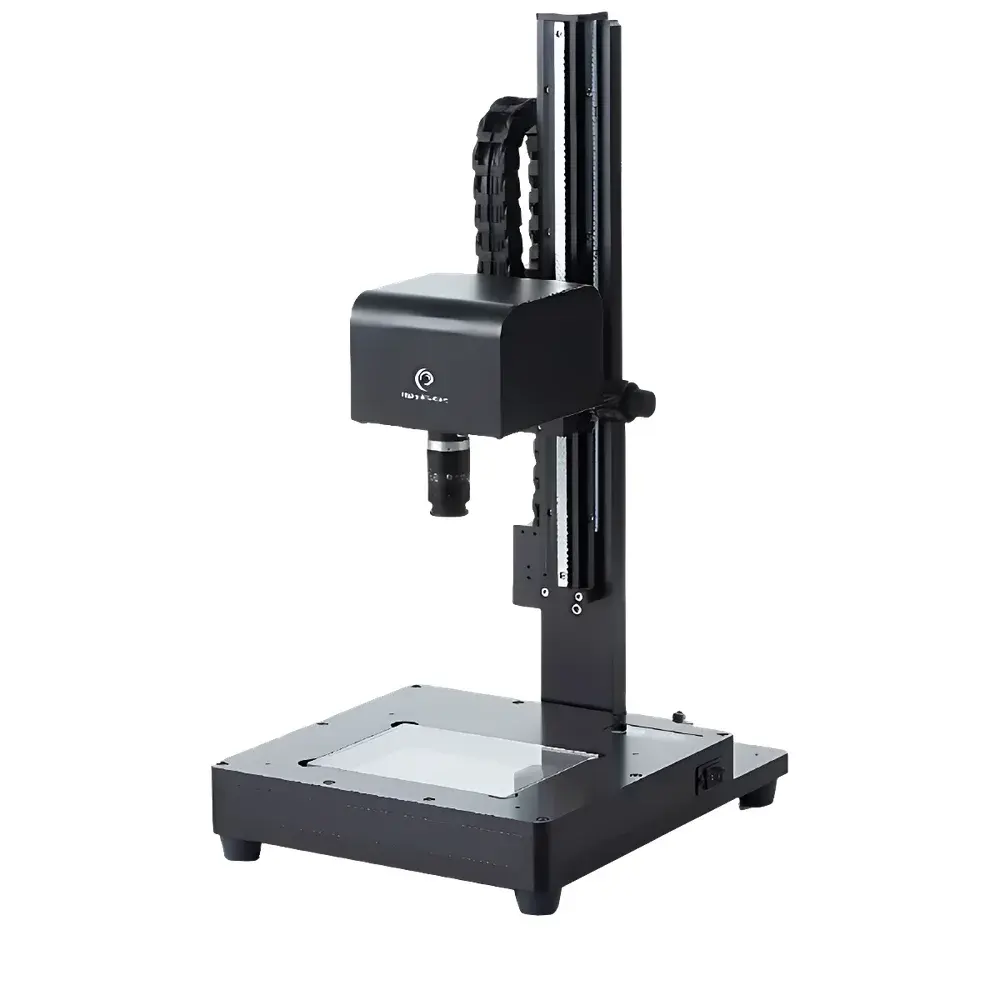
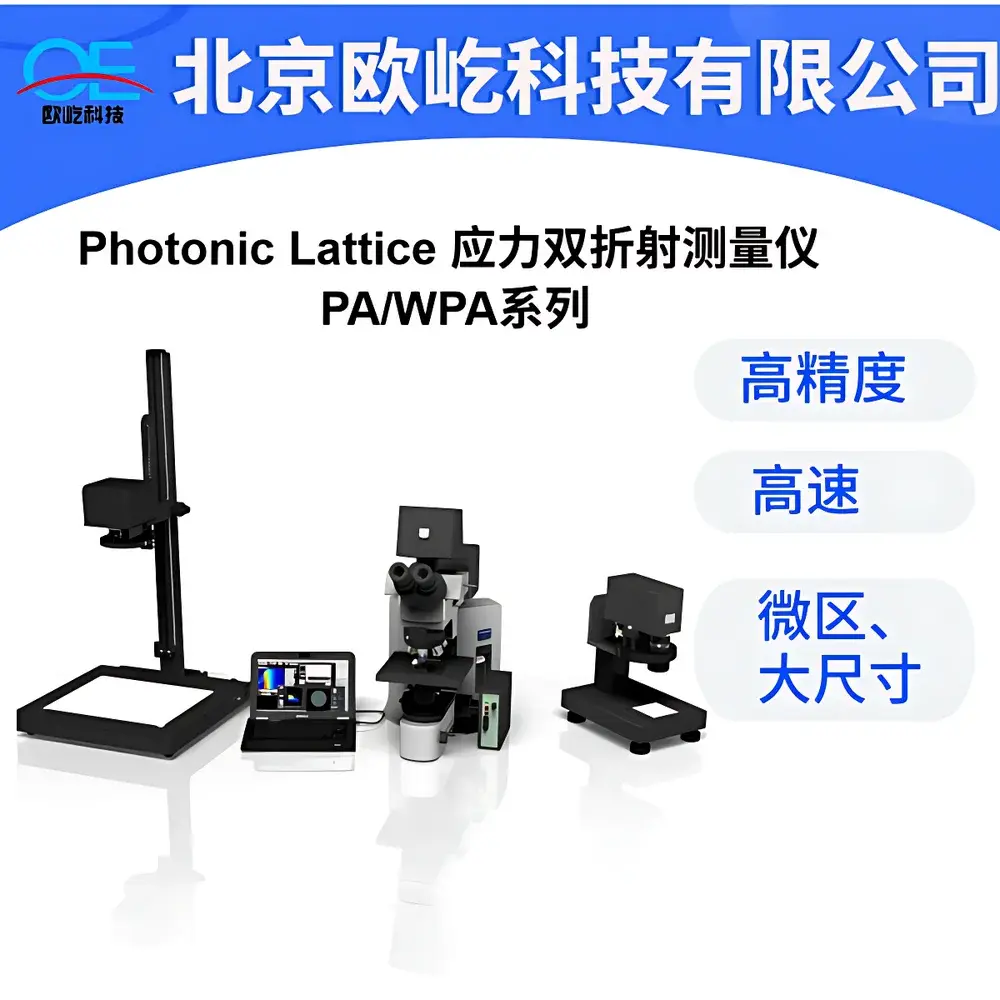
Photonic Lattice PA-300 and PA-300-L Photoelastic Stress Analyzer
| Brand | Photonic Lattice |
|---|---|
| Origin | Japan |
| Model | PA-300 / PA-300-L |
| Measurement Wavelength | 520 nm |
| Birefringence Range | 0–130 nm |
| Minimum Resolution | 0.001 nm |
| Repeatability | <0.1 nm (σ) |
| Field of View (Standard) | 30×36 mm to 100×132 mm |
| Optional FOV (with Expansion Lenses) | 5.5×6.6 mm to 25×30 mm |
| Output Parameters | Retardation (nm), Fast-Axis Orientation (°), Stress Conversion (MPa, optional) |
| Camera Resolution | 2056×2464 pixels |
Overview
The Photonic Lattice PA-300 and PA-300-L Photoelastic Stress Analyzers are high-precision, full-field birefringence measurement systems engineered for quantitative residual stress evaluation in transparent and semi-transparent optical materials. Based on the principle of polarization interferometry and calibrated photoelastic response, these instruments quantify optical retardation—induced by internal mechanical stress—by analyzing the phase shift between orthogonal polarization components transmitted through a sample under controlled illumination at 520 nm. Unlike conventional mechanical or point-scanning stress meters, the PA-300 series employs a proprietary photonic crystal polarizer array coupled with real-time dual-polarization image acquisition, enabling simultaneous pixel-level retardation and fast-axis orientation mapping across the entire field of view. This full-field approach eliminates spatial interpolation artifacts and supports traceable, non-contact assessment of stress distribution in flat or gently curved substrates—including optical lenses, display cover glass, polymer films, and precision injection-molded optics—without surface preparation or contact loading.
Key Features
- Patented photonic crystal polarizer array delivering uniform, stable polarization contrast without moving parts or motorized filter wheels—ensuring long-term calibration stability and minimal maintenance.
- High-resolution polarization camera (2056 × 2464 pixels) with 12-bit dynamic range and hardware-synchronized exposure control for low-noise, high-fidelity retardation imaging.
- Measurement speed of ≤3 seconds per full-field acquisition—optimized for inline QA/QC environments and high-throughput R&D screening.
- Configurable field-of-view options: standard lens (30×36 mm to 100×132 mm), plus optional expansion lenses supporting magnified analysis down to 5.5×6.6 mm for micro-optic components.
- Sub-nanometer resolution (0.001 nm) and repeatability better than ±0.1 nm (σ), validated per ISO 11146-1 for beam characterization metrology practices.
- No mechanical rotation or alignment-sensitive optics—reducing sensitivity to vibration, thermal drift, and operator-dependent setup errors.
Sample Compatibility & Compliance
The PA-300 series accommodates samples ranging from 2 mm diameter micro-lenses to large-area substrates up to 500 mm in dimension (with appropriate staging). It supports transmission-mode measurement of isotropic and anisotropic dielectrics—including borosilicate glass, fused silica, polycarbonate, PMMA, and sapphire—with thicknesses from 0.1 mm to >25 mm. The system is compatible with cleanroom-class handling protocols and integrates seamlessly into ISO/IEC 17025-accredited laboratories. All measurement algorithms adhere to ASTM E1788-21 (Standard Guide for Photoelastic Stress Analysis) and support traceable reporting aligned with GLP documentation requirements. Optional stress conversion modules apply material-specific stress-optic coefficients (e.g., C = 2.95 × 10⁻¹² Pa−1 for BK7 glass), enabling direct MPa output per ASTM C148-20 Annex A1.
Software & Data Management
Bundled with Photonic Lattice’s PL-Analyze Suite v4.x, the system provides comprehensive data acquisition, visualization, and export functionality. The software supports real-time false-color retardation mapping, vector field overlay for axis orientation, region-of-interest (ROI) statistics, cross-sectional line profiles, and batch comparison across multiple measurements. Export formats include TIFF (with embedded metadata), CSV (per-pixel retardation/angle), and HDF5 for integration with MATLAB, Python (NumPy/H5Py), or LabVIEW-based automation frameworks. Audit-trail logging, user-access controls, and electronic signature capability comply with FDA 21 CFR Part 11 requirements when configured with optional validation packages. Remote operation via TCP/IP interface enables integration into factory MES or LIMS platforms.
Applications
- Residual stress mapping in precision optical components during polishing, coating, and bonding processes.
- Quality assurance of tempered glass used in smartphone displays, automotive HUDs, and AR waveguides.
- Process development and failure analysis of injection-molded plastic optics exhibiting flow-induced birefringence.
- Verification of stress homogeneity in UV-fused silica blanks prior to lithographic patterning.
- Research into stress relaxation kinetics in polymer-based photonic devices under thermal or humidity cycling.
- Calibration reference for interferometric stress sensors in semiconductor wafer handling systems.
FAQ
What is the difference between the PA-300 and PA-300-L models?
The PA-300-L includes an integrated LED light engine with stabilized 520 nm output and optimized collimation optics, whereas the PA-300 requires external illumination alignment. The “L” variant offers improved intensity uniformity and reduced setup dependency.
Can the system measure curved or aspheric surfaces?
Yes—within limits of paraxial approximation. For moderate curvature (radius > 100 mm), the standard configuration yields reliable results; highly aspheric samples require optional telecentric lens adapters and custom calibration.
Is stress conversion to MPa traceable to national standards?
Yes. When paired with certified reference materials (e.g., NIST SRM 2800) and validated stress-optic coefficients, the system supports uncertainty budgets compliant with ISO/IEC 17025 Clause 7.6.
Does the software support automated pass/fail thresholding?
Yes. Users can define spatially resolved retardation limits (e.g., <5 nm over central 80% area) with configurable alerts, report generation, and SPC charting via optional Statistical Process Control module.
What maintenance is required beyond routine cleaning?
None. The solid-state polarizer array and fixed-optics architecture eliminate scheduled recalibration; annual verification using a NIST-traceable retardation standard is recommended for accredited use.



