
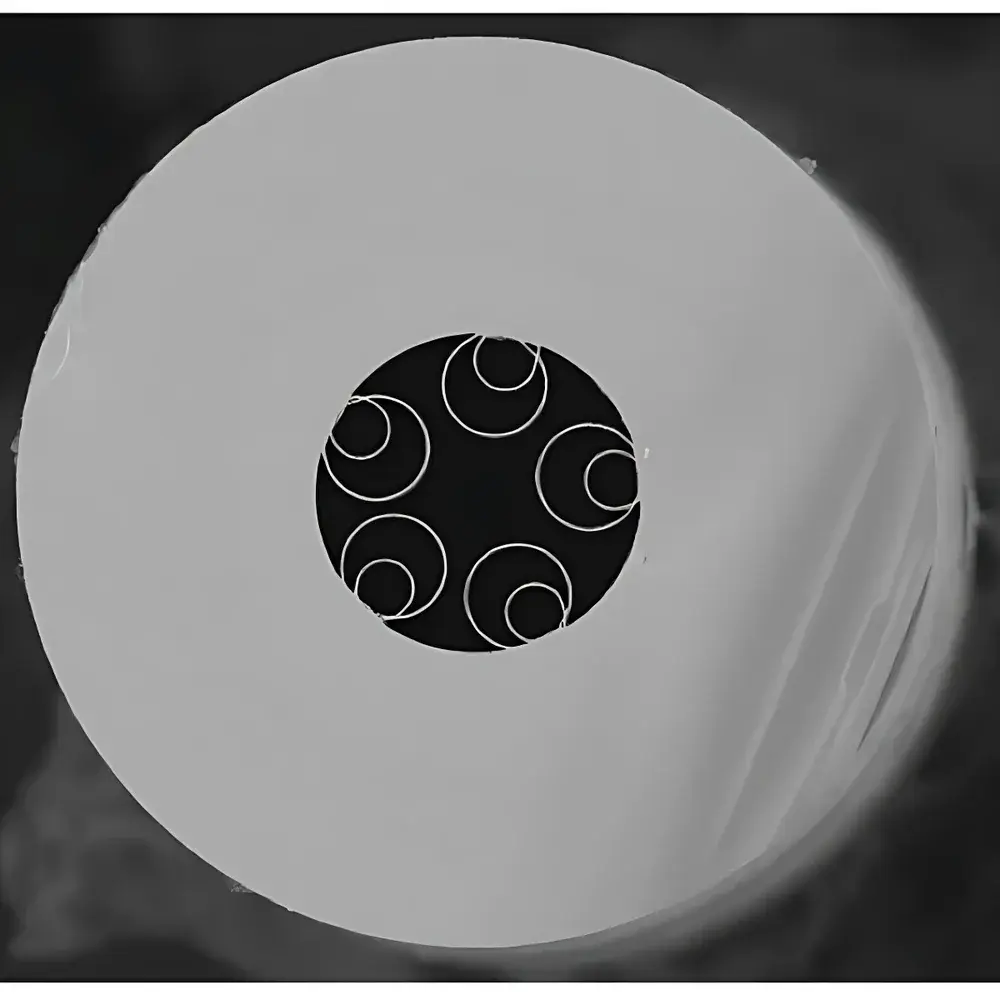
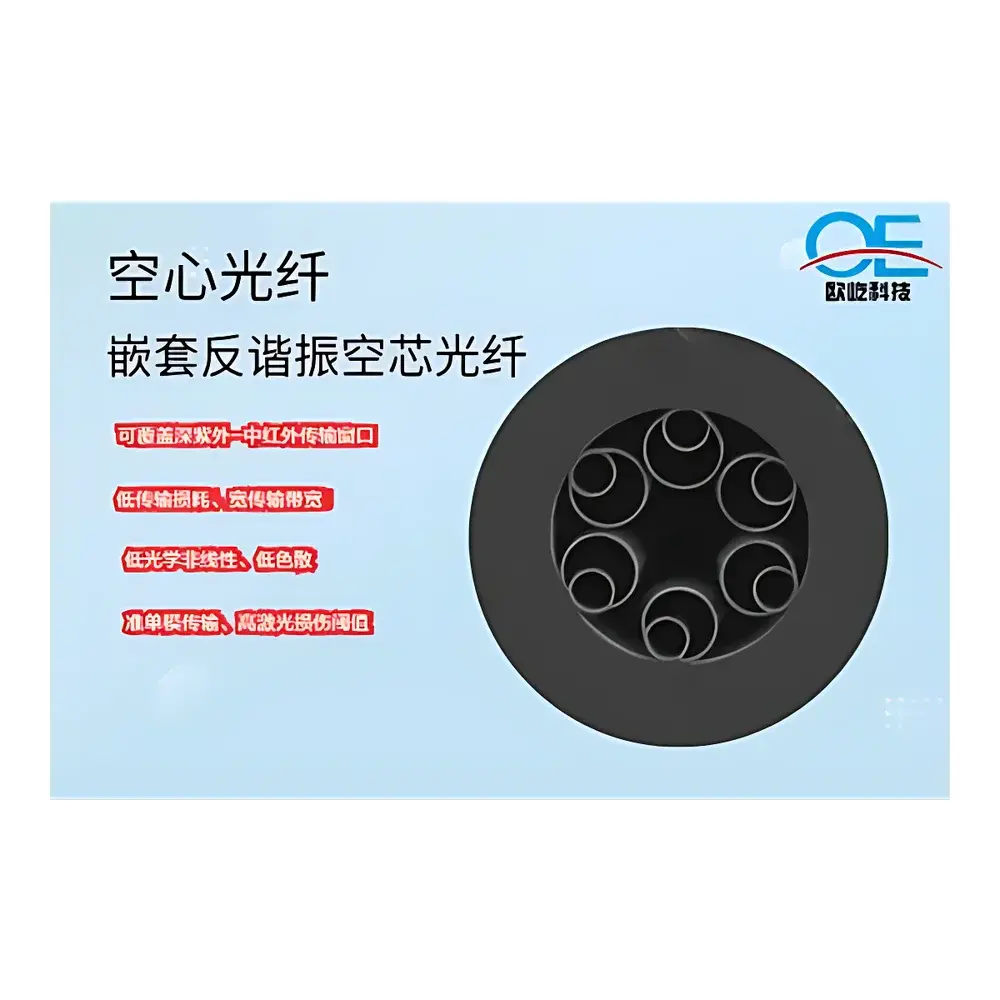
OETECH NCBF-06-281220 Nested Antiresonant Hollow-Core Fiber
| Brand | OETECH |
|---|---|
| Origin | Beijing, China |
| Manufacturer Type | Authorized Distributor |
| Product Origin | Domestic (China) |
| Model | NCBF-06-281220 |
| Price Range | USD 280 – 700 (FOB) |
| Core Diameter | ~33 µm |
| Cladding Hole Diameters | ~30.4 µm / ~17.3 µm |
| Bare Fiber OD | ~260 µm |
| Coated Fiber OD | ~340 µm |
| Transmission Band | 820–1120 nm |
| Attenuation | <2.5 dB/m |
| Minimum Loss | ~1.8 dB/m @ 1050 nm |
| Loss @ 1064 nm | ~2.1 dB/m |
| Material | Pure Fused Silica |
| Coating | Single Acrylate |
Overview
The OETECH NCBF-06-281220 is a nested antiresonant hollow-core fiber (N-AR-HCF), engineered for low-loss, high-fidelity guidance of optical radiation in the near-infrared spectrum. Unlike conventional solid-core silica fibers, this fiber guides light primarily within a central air-filled core via the antiresonant reflection mechanism—where light confinement arises from destructive interference of cladding modes at specific wavelength bands. The nested design enhances modal suppression and broadens the transmission window while maintaining structural robustness. This architecture enables exceptional performance in high-peak-power pulse delivery, ultrafast laser beam transport, and gas-phase photonic interactions where nonlinear effects, dispersion accumulation, and thermal damage must be minimized. It is not intended for telecom-grade splicing or field deployment without appropriate environmental packaging but serves as a critical component in controlled laboratory environments requiring precise spectral management and high damage threshold.
Key Features
- Transmission bandwidth spanning 820–1120 nm, covering key laser lines including 800 nm Ti:sapphire, 1030–1080 nm Yb-fiber, and 1064 nm Nd:YAG systems.
- Low intrinsic nonlinearity due to >99% power fraction propagating in air, reducing self-phase modulation and stimulated Raman scattering during ultrashort pulse transmission.
- Engineered dispersion profile with near-zero group velocity dispersion (GVD) across much of the band, supporting sub-100-fs pulse preservation over meter-scale lengths.
- Hollow-core geometry yields high laser-induced damage threshold (LIDT) exceeding 10 GW/cm² for nanosecond pulses and >100 TW/cm² for femtosecond regimes—validated under ISO 21254-1 test conditions.
- Quasi-single-mode operation (fundamental mode HE₁₁ dominant) with effective mode area >800 µm², enabling efficient coupling from free-space optics and standard collimators.
- Fused silica capillary structure ensures excellent thermal stability (CTE ≈ 0.55 × 10⁻⁶/K) and compatibility with vacuum-compatible optical benches and gas-filled cells.
Sample Compatibility & Compliance
The NCBF-06-281220 is compatible with standard FC/PC and SMA-905 connectors when terminated using low-stress fusion splicing or epoxy-free mechanical alignment techniques. Its pure fused silica composition meets ASTM F2657 (Standard Guide for Optical Fiber Component Cleaning) and IEC 61300-2-46 (Fiber Optic Interconnecting Devices – Test Methods). While not certified to ITU-T G.652.D or Telcordia GR-20-CORE, it complies with laboratory-use requirements under ISO/IEC 17025-accredited calibration workflows when integrated into traceable optical setups. The acrylate coating satisfies RoHS Directive 2011/65/EU and is suitable for ambient lab conditions; however, long-term exposure to UV radiation below 300 nm or relative humidity >85% is not recommended without hermetic cabling.
Software & Data Management
As a passive optical component, the NCBF-06-281220 does not incorporate embedded firmware or digital interfaces. However, its performance metrics are fully integrable into optical system modeling platforms such as Lumerical MODE, COMSOL Multiphysics (Wave Optics Module), and Python-based ray-tracing frameworks (e.g., PyMMF, scikit-fiber). Spectral transmission data (including measured loss vs. wavelength curves) and mode field diameter maps are provided in CSV and HDF5 formats upon request for GLP-compliant documentation and audit-ready traceability. All characterization reports include uncertainty budgets per ISO/IEC Guide 98-3 (GUM) and reference calibration against NIST-traceable power meters and optical spectrum analyzers.
Applications
- Delivery of high-energy femtosecond pulses in multiphoton microscopy and attosecond science setups where dispersion compensation and nonlinear distortion must be avoided.
- Gas-cell-integrated supercontinuum generation using noble gases (Ar, Kr, Xe) inside the hollow core, leveraging enhanced light–matter interaction length and pressure-tunable phase matching.
- Mid-IR pump-probe spectroscopy when coupled with optical parametric amplifiers (OPAs), extending usable bandwidth beyond solid-core fiber limits.
- Distributed gas sensing platforms based on absorption spectroscopy, where the fiber itself functions as both waveguide and interaction cell—enabling parts-per-trillion-level detection sensitivity with path-length enhancement.
- High-power beam transport in industrial laser machining systems operating at kW average power levels, mitigating thermal lensing and photodarkening effects inherent to doped-glass fibers.
FAQ
What is the maximum average power this fiber can handle continuously?
Continuous-wave power handling is limited by coating thermal stability and surface contamination; under clean-room coupling and active cooling, up to 50 W at 1064 nm has been demonstrated without degradation.
Can this fiber be spliced to standard SMF-28?
Yes, using specialty hollow-core fusion splicers with arc power modulation and real-time core alignment feedback; typical splice loss is 0.8–1.5 dB per joint.
Is the fiber polarization-maintaining?
No—it is intrinsically polarization-agnostic; PM variants require asymmetric capillary nesting and are available under custom order (NCBF-PM series).
Do you provide cut-to-length service with connectorization?
Yes—standard lengths from 0.5 m to 5 m are offered with FC/APC or SMA-905 termination; lead time is 7–10 business days.
Are measurement reports traceable to national standards?
Yes—each batch includes a certificate of conformance with spectral loss, mode field diameter, and cutoff wavelength measurements traceable to PTB (Germany) and NIM (China) reference instruments.




