
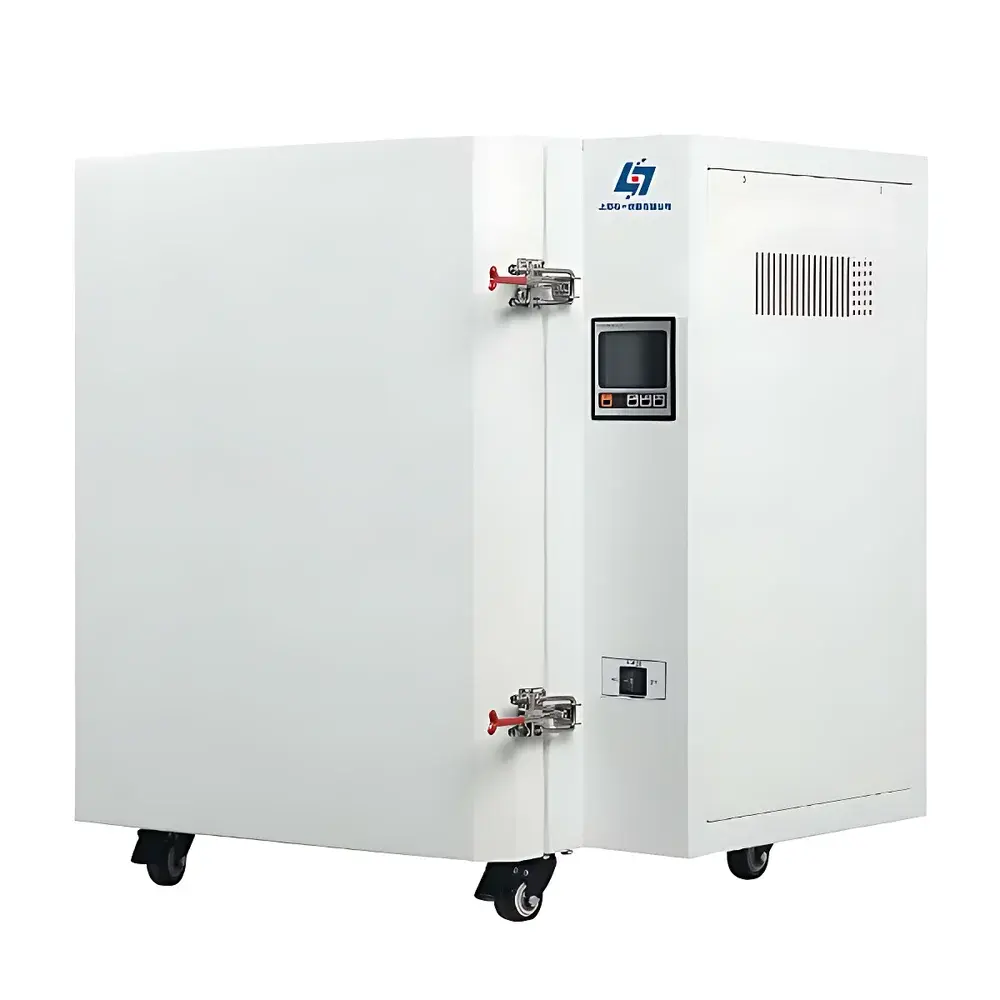
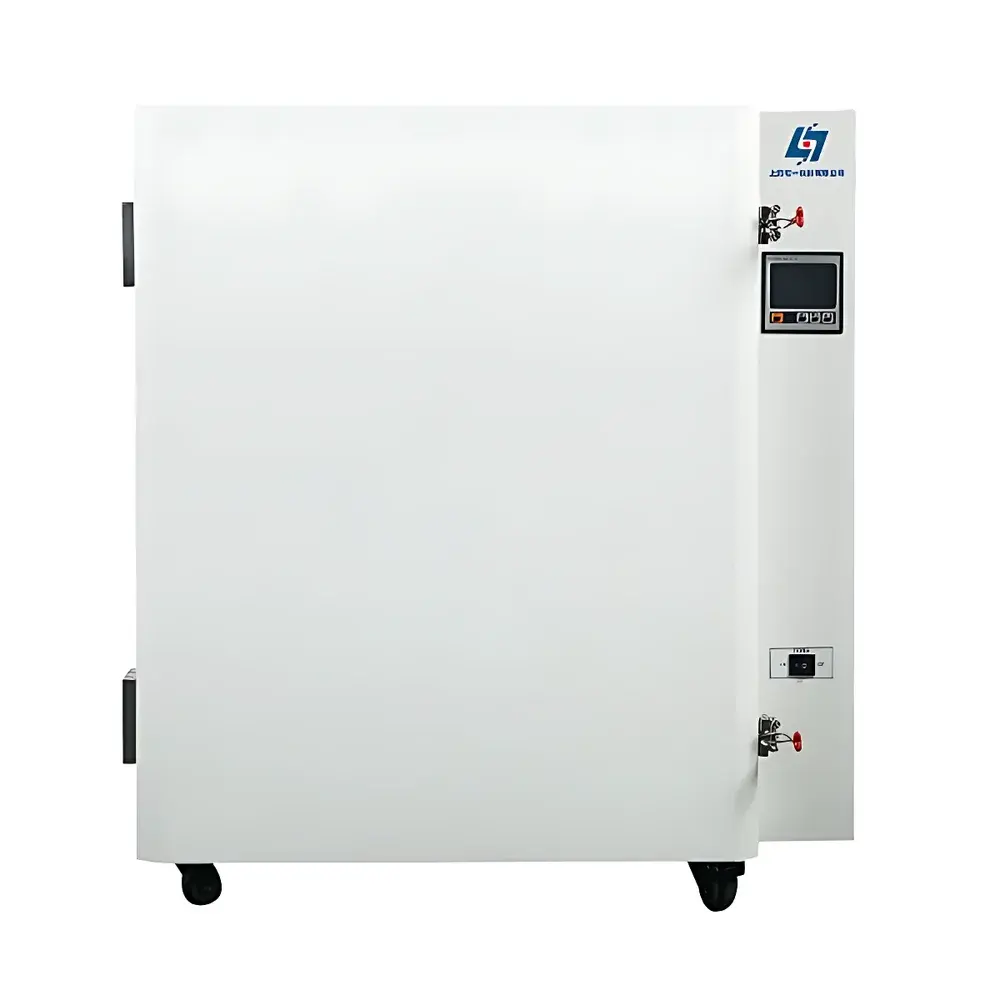
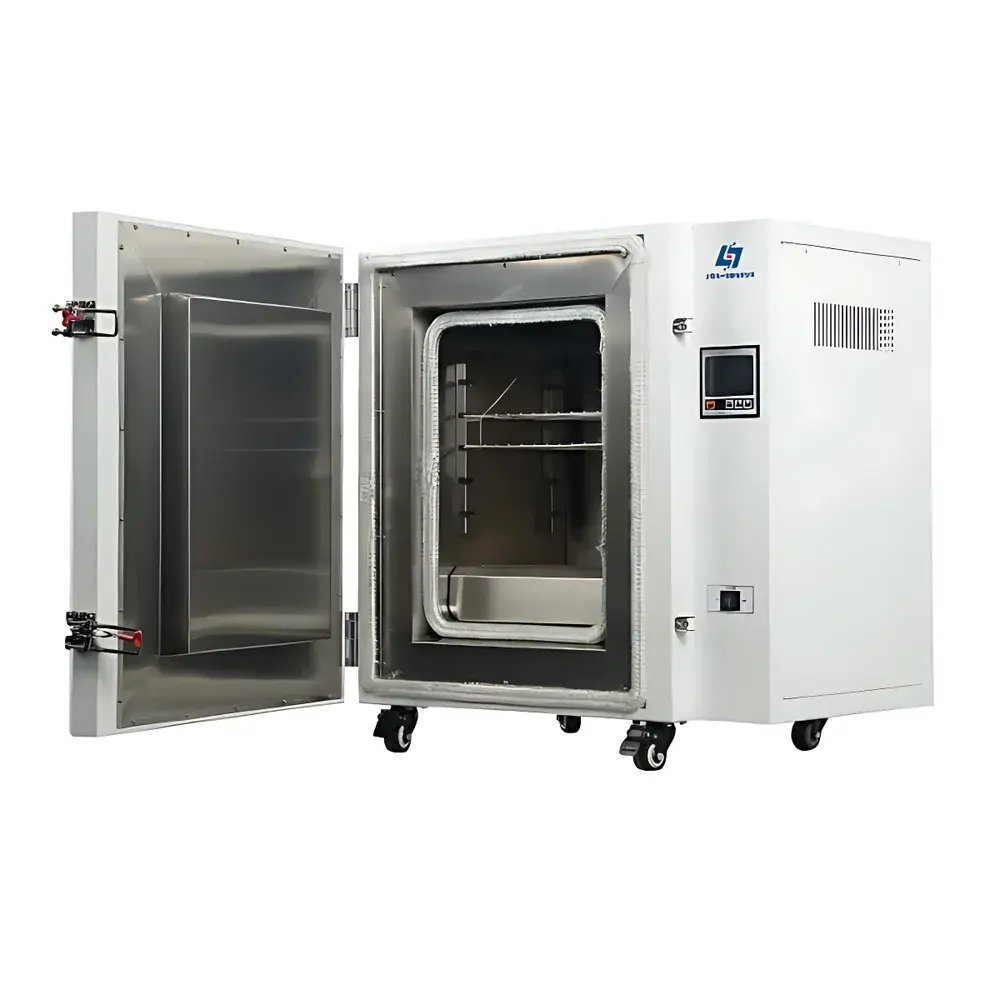
Yoyi DGG-39 Programmable High-Temperature Oven (500 °C)
| Brand | Yoyi |
|---|---|
| Origin | Shanghai, China |
| Manufacturer | Yes |
| Type | High-Temperature Forced-Air Drying Oven |
| Model | DGG-39 |
| Temperature Range | RT+20 °C to 500 °C |
| Temperature Uniformity | ±2.5 % (at 100 °C) |
| Temperature Fluctuation | ±2.0 °C |
| Temperature Resolution | 1 °C |
| Internal Dimensions (W×D×H) | 450×550×550 mm |
| External Dimensions (W×D×H) | 820×730×900 mm |
| Chamber Material | Mirror-Finish Stainless Steel (SUS304) |
| Power Supply | AC 220 V, 50 Hz |
| Input Power | 2400 W |
| Net Volume | 136 L |
| Standard Shelves | 2 pcs |
| Timer Range | 1–9999 min |
Overview
The Yoyi DGG-39 is a benchtop programmable high-temperature forced-air oven engineered for precision thermal processing in research laboratories and industrial quality control environments. It operates on the principle of convective heat transfer via a multi-blade centrifugal fan and optimized airflow architecture—featuring a preheating chamber that mixes heated air prior to entering the working chamber. This design ensures rapid thermal response and improved spatial temperature uniformity across the stainless-steel interior (SUS304), critical for applications requiring reproducible thermal profiles up to 500 °C. The unit complies with fundamental safety and performance expectations for Class II laboratory ovens under IEC 61010-1 and meets structural requirements for continuous operation at elevated temperatures. Its microprocessor-based controller supports multi-segment programming, enabling complex thermal ramps, holds, and cooling cycles essential for annealing, curing, aging, and residual moisture analysis.
Key Features
- Intelligent microcomputer temperature controller with 4.3-inch LCD interface, supporting programmable multi-step heating profiles, auto-tuning PID algorithm, and power suppression logic for stable setpoint maintenance.
- Preheated air mixing chamber upstream of the work area ensures faster ramp rates and minimizes thermal gradients; validated uniformity of ±2.5 % at 100 °C per ISO 14644-3 methodology.
- Dual-layer ceramic fiber door gasket and glass wool insulation between chamber and outer casing reduce thermal loss and maintain external surface temperatures below 45 °C during 500 °C operation.
- Robust mechanical construction: cold-rolled steel exterior with electrostatic epoxy coating; mirror-finish SUS304 interior; adjustable stainless-steel shelves secured by spring-loaded clamps.
- Self-diagnostic startup sequence detects hardware faults; automatic parameter recovery after power interruption preserves user-defined programs and setpoints.
- Independent over-temperature cut-off system (optional) interrupts heating if chamber temperature exceeds user-defined safety limit—critical for unattended operation and GLP-compliant workflows.
Sample Compatibility & Compliance
The DGG-39 accommodates standard laboratory sample containers—including porcelain crucibles, aluminum trays, glass Petri dishes, and metal test fixtures—within its 136 L working volume. Its inert stainless-steel chamber resists oxidation and corrosion during prolonged exposure to dry air or mildly reactive atmospheres. While not rated for inert gas purging as standard, an optional inert gas inlet port (with integrated flowmeter) enables controlled nitrogen or argon environments for oxidation-sensitive materials. The device adheres to general electrical safety standards (IEC 61010-1) and thermal stability benchmarks referenced in ASTM E145 and ISO 17025 clause 5.4.1 for equipment used in accredited testing laboratories. It supports documentation traceability when equipped with RS485 communication and compliant data logging software.
Software & Data Management
The embedded controller stores up to 16 programmable segments per profile, each with defined ramp rate (°C/min), target temperature, dwell time, and output power modulation. Optional RS485 interface enables bidirectional communication with external PCs running Windows-based configuration software—supporting real-time monitoring, remote parameter adjustment, and export of timestamped temperature logs (.csv). An optional embedded thermal printer provides hard-copy records suitable for audit trails in GMP or ISO 9001 environments. All digital outputs include UTC timestamps and instrument ID, satisfying basic FDA 21 CFR Part 11 requirements for electronic records when paired with appropriate access controls and audit-log configurations.
Applications
- Thermal aging studies of polymers, composites, and elastomers per ASTM D573 and ISO 188.
- Moisture content determination in pharmaceutical excipients and raw materials (USP <921>).
- Curing of powder coatings, adhesives, and printed circuit board laminates.
- Heat treatment of metallurgical specimens prior to tensile or hardness testing.
- Pre-drying of analytical samples before gravimetric or chromatographic analysis.
- Calibration verification of thermocouples and RTDs using fixed-point reference blocks.
FAQ
What is the maximum continuous operating temperature?
The DGG-39 is rated for continuous operation at 500 °C, verified per manufacturer thermal stress testing protocols.
Does the oven support inert atmosphere operation?
Standard configuration uses ambient air; optional inert gas inlet (with mass flow meter) allows nitrogen or argon purging—contact technical support for compatibility validation.
Is the temperature uniformity validated at all setpoints?
Uniformity is specified at 100 °C (±2.5 %); users performing critical processes above 300 °C are advised to conduct in-house mapping per ISO/IEC 17025 Annex B.
Can the timer function be used for automatic shutdown?
Yes—the built-in timer triggers end-of-cycle alarm and halts heating; power remains supplied to controller for data retention.
Are calibration certificates available?
Factory calibration report (NIST-traceable reference sensor) is provided; UKAS-accredited calibration services are available upon request.



