
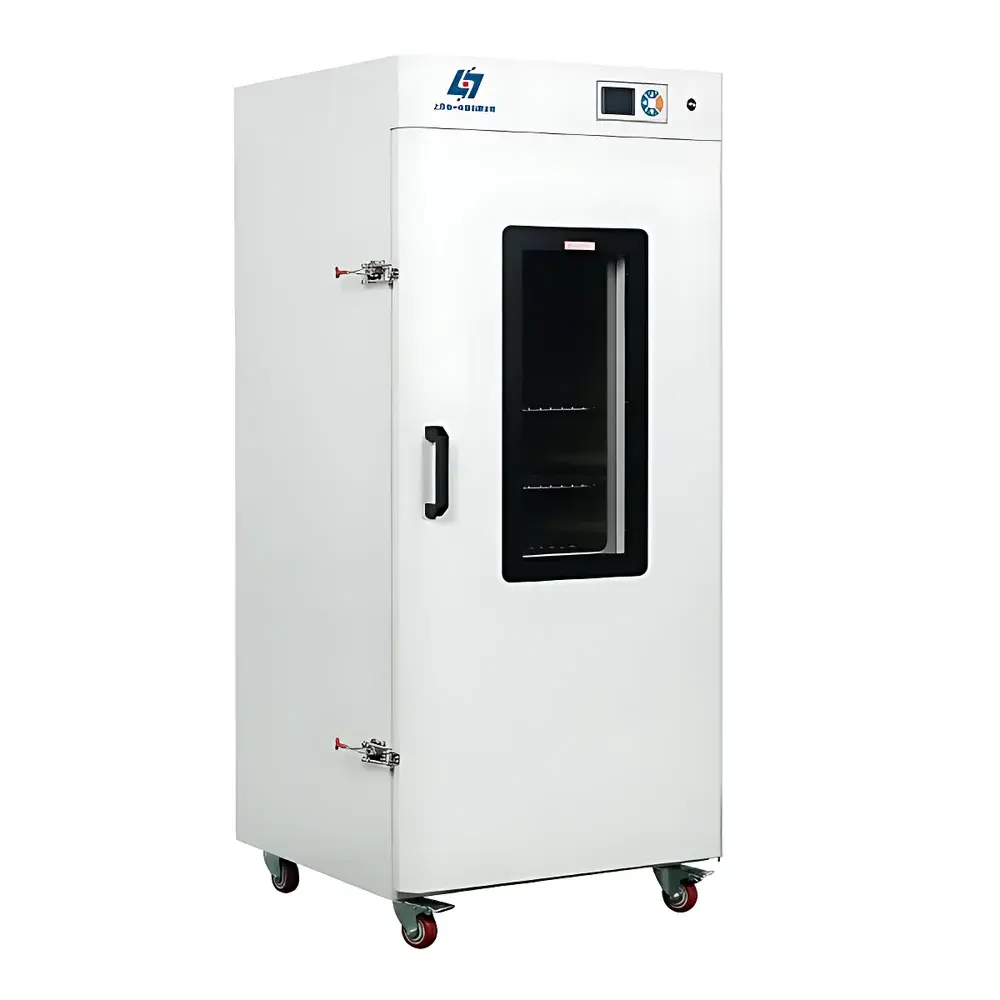
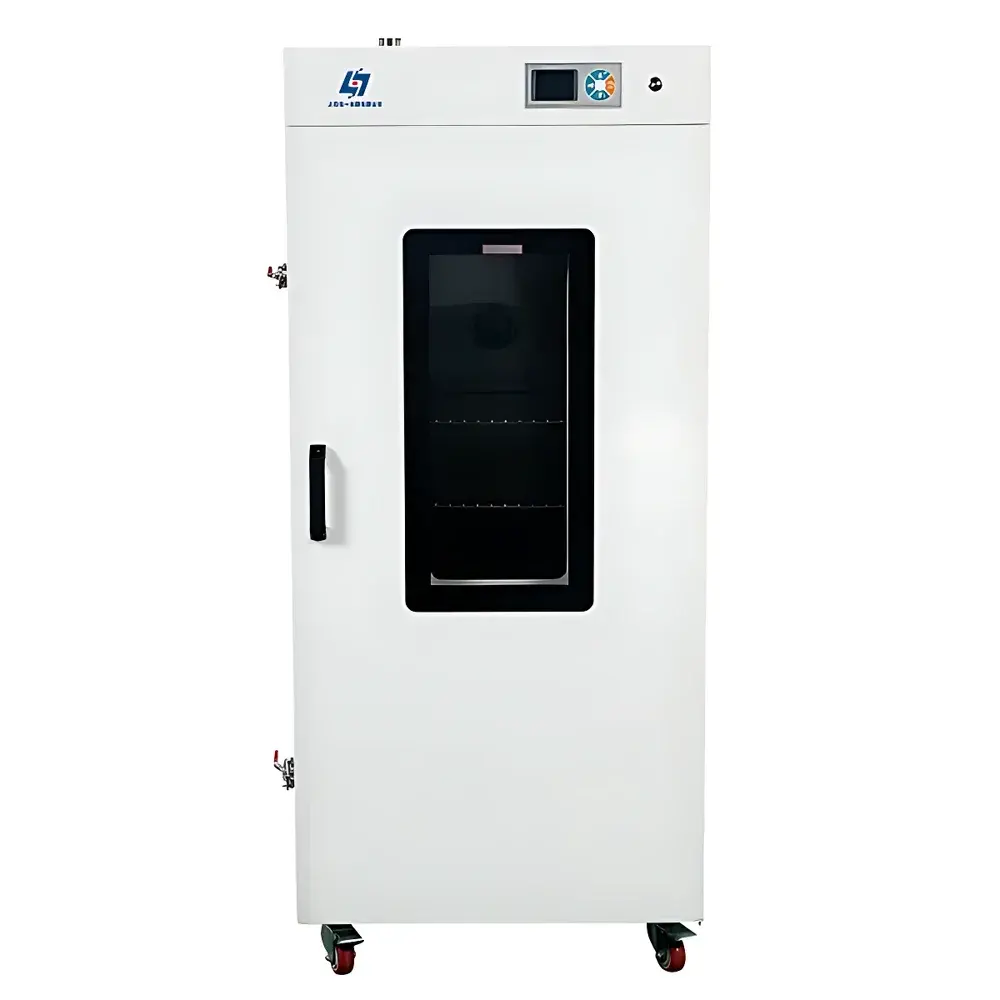
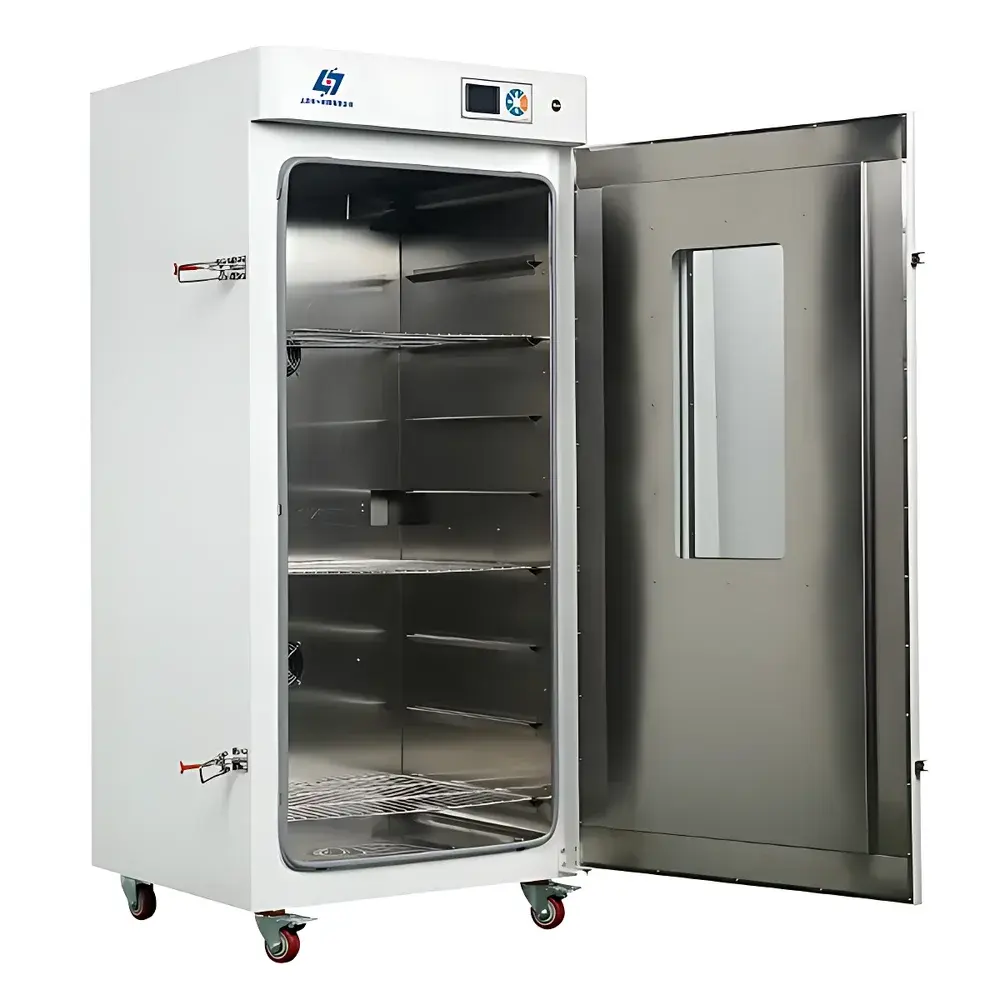
Yoyilab DHG-9925A Vertical Forced-Air High-Temperature Drying Oven
| Brand | Yoyilab |
|---|---|
| Origin | Shanghai, China |
| Manufacturer | Yes |
| Country of Origin | China |
| Model | DHG-9925A |
| Temperature Range | RT+10°C to 300°C |
| Temperature Uniformity | ±2.5% (at 100°C) |
| Temperature Fluctuation | ±1°C |
| Temperature Resolution | 0.1°C |
| Internal Chamber Dimensions (W×D×H) | 1000×600×1600 mm |
| External Dimensions (W×D×H) | 1180×800×2150 mm |
| Chamber Volume | 1000 L |
| Chamber Material | Mirror-Finish Stainless Steel |
| Construction | Cold-Rolled Steel with Electrostatic Powder Coating |
| Power Supply | AC 380 V, 50 Hz |
| Input Power | 6500 W |
| Compliance | GB/T 30435–2013 |
Overview
The Yoyilab DHG-9925A is a vertically oriented, forced-air high-temperature drying oven engineered for precision thermal processing in demanding laboratory and industrial R&D environments. Designed in accordance with GB/T 30435–2013 (the Chinese national standard for electrically heated drying ovens), this 1000 L capacity instrument employs a robust convection-based heating architecture to deliver stable, uniform thermal conditions across its large stainless-steel chamber. Its operational range spans from ambient +10°C to 300°C — making it suitable for applications requiring sustained high-temperature exposure, including polymer curing, ceramic sintering pre-treatment, moisture removal from hygroscopic materials, thermal aging studies, and dry-heat sterilization protocols where steam-free environments are mandated.
Key Features
- Microprocessor-controlled temperature regulation with PID algorithm, offering setpoint accuracy within ±0.1°C and long-term stability under load
- Forced-air circulation system utilizing rear-mounted axial fans and optimized duct geometry to ensure ≥90% airflow efficiency and ≤±2.5% temperature uniformity (measured per GB/T 30435 at 100°C)
- Double-layer tempered glass observation window with silicone-sealed frame, enabling real-time visual monitoring without thermal interruption or condensation buildup
- Independent over-temperature cut-off circuit (optional) compliant with IEC 61000-4-2 ESD immunity standards, automatically de-energizing heaters if the primary controller fails
- Intelligent power recovery function preserving user-defined parameters (set temperature, timer duration, ramp rates) after unexpected power loss or system reset
- Front-panel LCD interface supporting multi-parameter display: current chamber temperature, setpoint, elapsed time, remaining hold time, and status indicators for fan/heater operation
- Dual-stage door sealing using high-purity silicone rubber gaskets rated for continuous use up to 350°C, minimizing heat leakage and extending service life
- Modular interior with three adjustable stainless-steel shelves (standard), accommodating irregularly shaped samples or stacked trays without obstructing airflow pathways
Sample Compatibility & Compliance
The DHG-9925A accommodates a broad spectrum of sample types and container formats, including Petri dishes, crucibles, aluminum weighing pans, glass desiccators, metal sample racks, and custom fixtures up to 600 mm deep. Its inert stainless-steel chamber resists oxidation and corrosion during repeated exposure to acidic vapors, solvents, and saline residues — critical for pharmaceutical residual solvent analysis and electrochemical material preparation. The unit meets essential safety and performance benchmarks outlined in GB/T 30435–2013 and aligns with general-purpose requirements referenced in ISO 17025-accredited laboratories for thermal validation activities. While not certified to UL/CSA or EN 61010-1 out-of-the-box, its electrical architecture supports third-party certification readiness upon request (e.g., CE marking with Notified Body assessment).
Software & Data Management
Optional RS485 serial interface enables integration into centralized lab data management systems via Modbus RTU protocol. When paired with supplied configuration software, users can log temperature profiles at configurable intervals (1–60 sec), export CSV-formatted datasets, and generate traceable calibration reports compliant with GLP and internal QA documentation policies. An optional embedded thermal printer provides hard-copy records of cycle start/end timestamps, peak temperatures, and deviation alerts — satisfying audit requirements under FDA 21 CFR Part 11 when used with appropriate electronic signature controls. All firmware updates are delivered via secure USB flash drive, eliminating network exposure risks associated with cloud-connected instruments.
Applications
- Dry-heat sterilization of glassware and stainless-steel tools in microbiology and cell culture facilities
- Moisture content determination per AOAC 950.46 and ASTM D2298 for polymers, composites, and agricultural feedstocks
- Pre-drying of filter papers, membranes, and chromatographic media prior to gravimetric analysis
- Thermal conditioning of lithium-ion battery electrode coatings and solid-state electrolyte precursors
- Baking and post-curing of epoxy encapsulants, conformal coatings, and PCB assemblies
- Accelerated aging tests for automotive seals, aerospace gaskets, and medical device packaging materials
- Residual solvent removal from API intermediates under nitrogen purge (when equipped with inert gas inlet kit)
FAQ
What is the maximum recommended continuous operating temperature?
The DHG-9925A is rated for continuous operation at 300°C. Sustained use above this threshold may compromise sensor longevity and insulation integrity.
Can the oven be validated for IQ/OQ/PQ protocols?
Yes — the unit’s stable thermal profile, digital logging capability (with optional accessories), and documented compliance with GB/T 30435 support formal qualification under ISO/IEC 17025 and GMP frameworks.
Is nitrogen purging supported as standard equipment?
No — inert gas introduction requires the optional inert gas inlet kit, which includes a calibrated rotameter (0–10 L/min range) and quick-connect fittings compatible with standard nitrogen supply lines.
How is temperature uniformity verified during factory testing?
Each unit undergoes 3-hour stabilization at 100°C under no-load conditions, followed by nine-point mapping using NIST-traceable Class A PT100 probes positioned per GB/T 30435 Annex B.
Are custom chamber configurations available?
Yes — Yoyilab offers non-standard modifications including reinforced shelving, additional access ports, explosion-proof variants (for Class I Div 2 environments), and dual-zone temperature zoning upon engineering review.



