
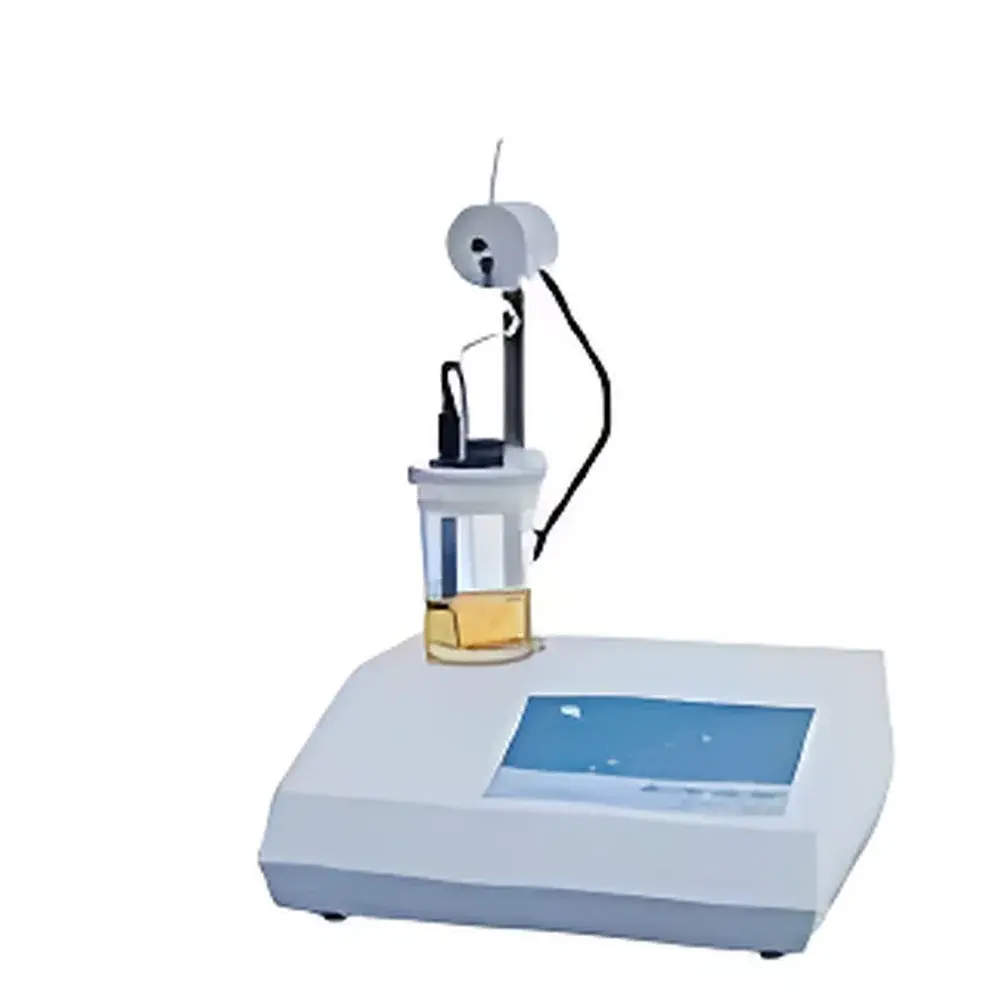
AnTing ZSD-1 Karl Fischer Volumetric Moisture Titrator
| Brand | AnTing |
|---|---|
| Origin | Shanghai, China |
| Model | ZSD-1 |
| Titration Method | Manual Volumetric Karl Fischer |
| Moisture Range | 0.02% – 100% |
| Resolution | 0.05 mL |
| Minimum Dispensing Increment | 0.1 mL |
| Polarization Voltage | −20 mV |
| Sensitivity | 1 × 10⁻⁶ A |
| Endpoint Delay | 10 ± 2 s |
| Titration Flow Rate | 0.1 mL/s |
| Power Supply | 220 V, 50 Hz |
| Power Consumption | 18 W |
| Display | LED digital (mL) |
| Endpoint Indication | Visual LED + audible buzzer |
| Stirring | Continuously variable speed motor |
Overview
The AnTing ZSD-1 Karl Fischer Volumetric Moisture Titrator is a precision laboratory instrument engineered for quantitative determination of water content in solid, liquid, and gaseous samples using the classical volumetric Karl Fischer (KF) titration principle. Based on the stoichiometric reaction between iodine, sulfur dioxide, methanol, and water—governed by the equation: I₂ + SO₂ + CH₃OH + H₂O → 2HI + CH₃OSO₃H—the ZSD-1 detects the electrochemical endpoint via bipotentiometric (dual-platinum-electrode) polarization at −20 mV. This method delivers high reproducibility and trace-level accuracy across diverse matrices, including pharmaceutical excipients, active pharmaceutical ingredients (APIs), agrochemical formulations, polymer resins, food-grade oils, and fine chemical intermediates. Designed for routine QC laboratories operating under GLP-compliant workflows, the ZSD-1 supports manual titration execution with real-time analog signal monitoring and endpoint confirmation through dual-mode detection (visual LED and audible buzzer), ensuring operator confidence without reliance on proprietary software or complex calibration routines.
Key Features
- Manual volumetric KF titration mode with fully adjustable stirrer speed for optimal homogenization of heterogeneous or viscous samples
- Bipotentiometric endpoint detection using dual platinum electrodes with fixed polarization voltage (−20 mV) and sensitivity threshold of 1 × 10⁻⁶ A
- Digital LED display showing real-time titrant volume (in mL) with 0.05 mL resolution and 0.1 mL minimum dispensing increment
- Configurable endpoint delay (10 ± 2 s) to accommodate slow-reacting or diffusion-limited samples, minimizing false endpoints
- Integrated endpoint lock mechanism that halts titrant delivery upon confirmed equivalence point, preventing over-titration
- Robust benchtop architecture with 18 W power consumption, 220 V / 50 Hz input, and EMI-resistant analog circuitry for stable operation in shared lab environments
Sample Compatibility & Compliance
The ZSD-1 accommodates a broad spectrum of sample types—including hygroscopic powders (e.g., lithium salts, silica gels), low-water organic solvents (acetone, chloroform), semi-solids (creams, ointments), and thermally sensitive compounds—when paired with appropriate KF reagents (e.g., single-component anhydrous methanol-based reagents or two-component systems with separate iodine and base solutions). It complies with core principles outlined in ASTM E203–22 (“Standard Test Method for Water Using Volumetric Karl Fischer Titration”) and aligns with general requirements of USP “Water Determination” and EP 2.5.12. While the instrument itself does not embed audit trail or electronic signature functionality, its manual operation mode supports full traceability when used within documented SOPs, including handwritten log entries for sample ID, reagent batch, titrant volume, and environmental conditions—meeting foundational GLP documentation expectations for non-automated analytical systems.
Software & Data Management
The ZSD-1 operates as a standalone hardware system with no embedded microprocessor or data logging capability. All measurements are recorded manually by the analyst using standardized laboratory notebooks or LIMS-integrated paper forms. The absence of onboard memory or USB/RS-232 interfaces ensures electromagnetic compatibility in regulated facilities where unvalidated firmware poses validation risks. For labs requiring digital data capture, external recording devices (e.g., calibrated burette readers or third-party analog-to-digital converters) may be interfaced via the instrument’s analog endpoint signal output (if available per configuration), subject to IQ/OQ validation per ISO/IEC 17025 guidelines. Reagent consumption tracking, moisture calculation (wt% = (V × T × 18.015) / (m × 1000)), and uncertainty estimation must be performed externally using validated spreadsheets or certified calculation tools.
Applications
- Pharmaceutical quality control: Water content verification in lyophilized proteins, tablet granulations, and sterile APIs per ICH Q5C stability guidance
- Fertilizer manufacturing: Quantification of residual moisture in urea, ammonium nitrate, and NPK blends to prevent caking and ensure flowability
- Food safety testing: Validation of dehydration efficacy in milk powder, starch derivatives, and dried fruits per Codex Alimentarius standards
- Polymer processing: Monitoring moisture in PET, PA6, and PC resins prior to extrusion or injection molding to avoid hydrolytic degradation
- Electrolyte formulation: Verification of water limits (<10 ppm) in Li-ion battery cathode precursors and conductive salt solutions
FAQ
Is the ZSD-1 compliant with 21 CFR Part 11?
No—the ZSD-1 is a manually operated analog titrator without electronic records, audit trails, or user authentication features required for Part 11 compliance.
Can it perform coulometric KF analysis?
No—this model is strictly volumetric; coulometric functionality requires dedicated generator electrodes and current-controlled electrolysis cells not present in the ZSD-1 design.
What is the recommended maintenance interval for electrode cleaning?
Platinum electrodes should be cleaned with ethanol and polished with alumina slurry after every 10–15 titrations involving high-salt or proteinaceous samples to maintain polarization stability.
Does the instrument support automatic reagent standardization?
No—standardization against certified water standards (e.g., sodium tartrate dihydrate) must be performed manually using gravimetric or volumetric protocols per ASTM E203.
Is temperature compensation available?
No—temperature effects on KF reaction kinetics and reagent stability must be controlled externally via ambient lab regulation (20–25 °C) and pre-equilibration of samples and reagents.
Related Products




