
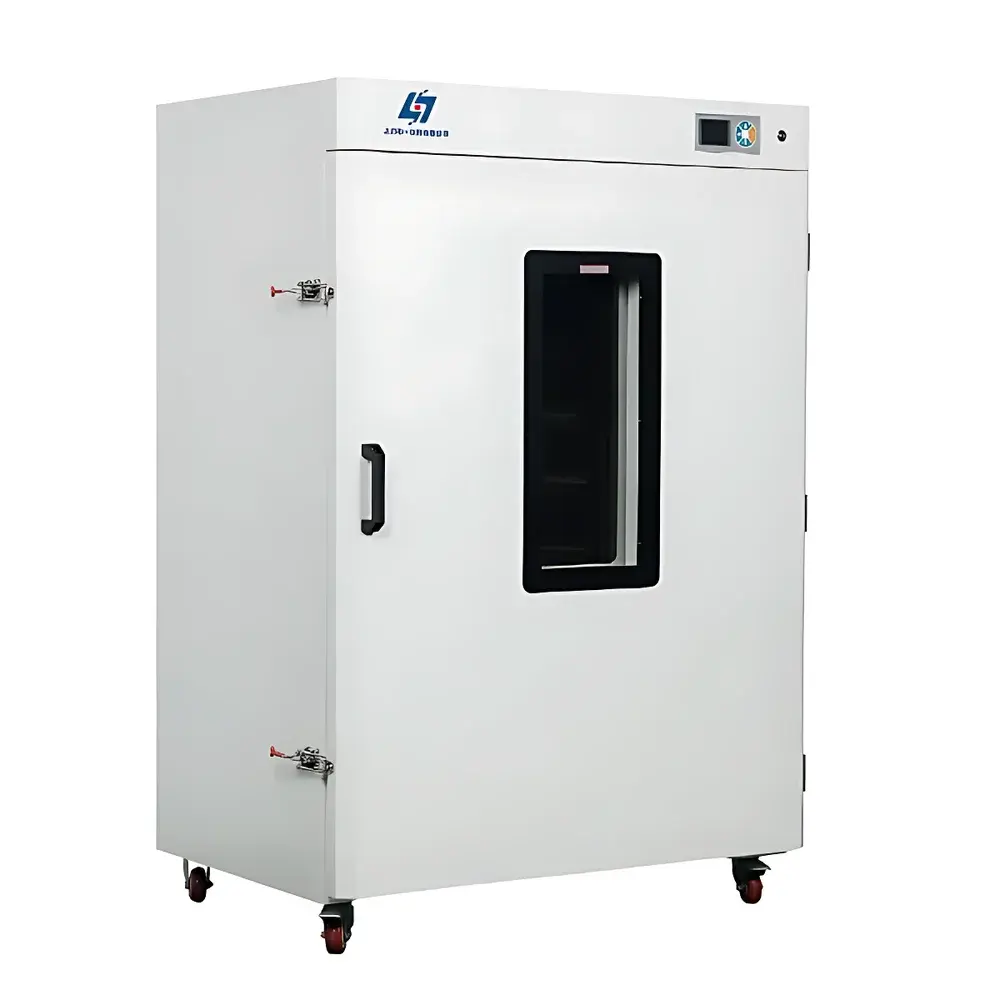
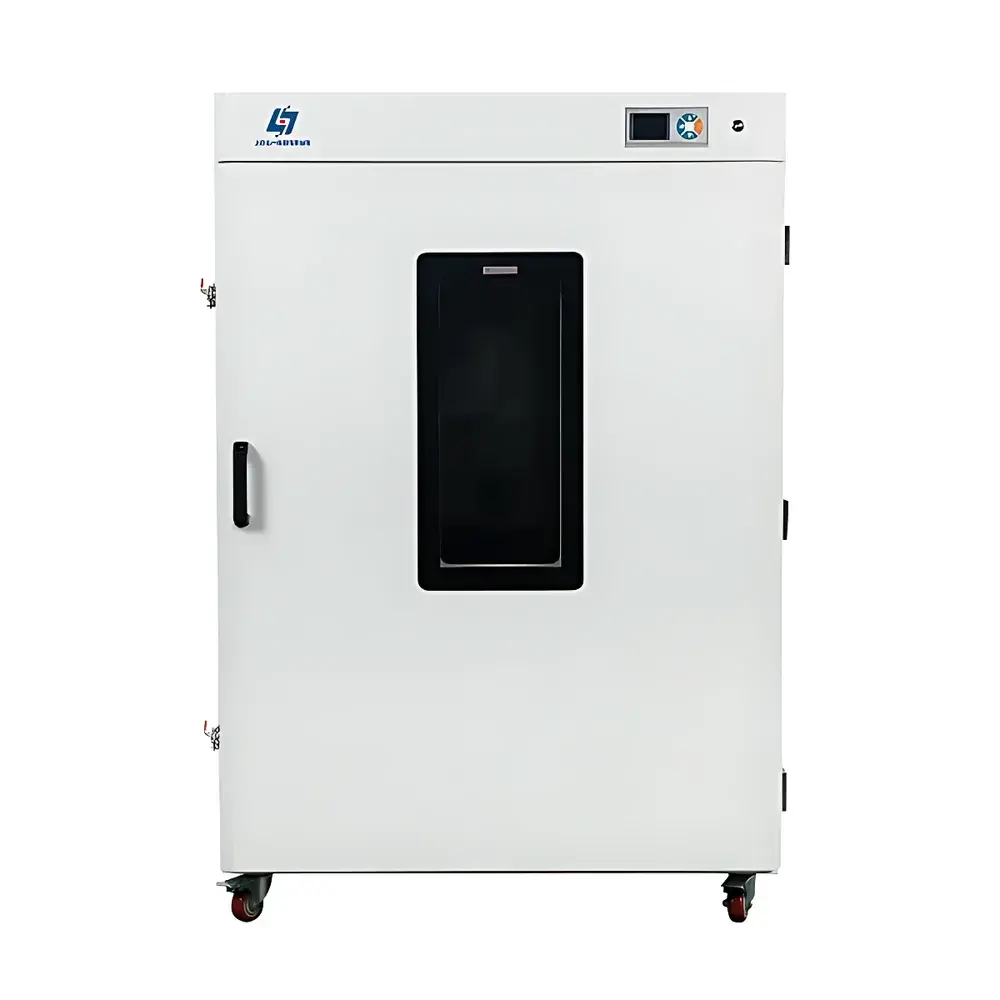
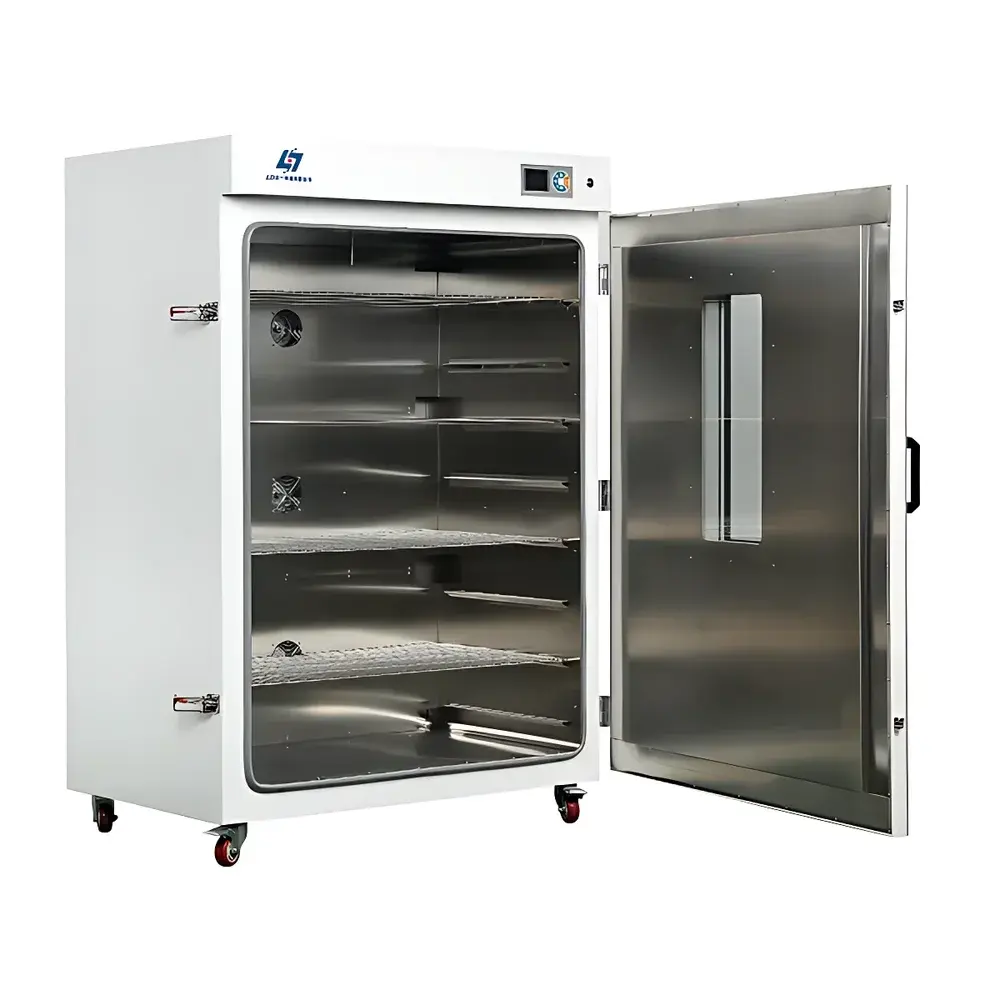
Yoyilab DHG-9645A Vertical Forced-Air High-Temperature Drying Oven
| Brand | Yoyilab |
|---|---|
| Origin | Shanghai, China |
| Manufacturer Type | Direct Manufacturer |
| Model | DHG-9645A |
| Temperature Range | RT+10°C to 300°C |
| Temperature Uniformity | ±2.5% (at 100°C) |
| Temperature Fluctuation | ±1°C |
| Temperature Resolution | 0.1°C |
| Internal Chamber Dimensions | 800 × 800 × 1000 mm (W×D×H) |
| External Dimensions | 980 × 910 × 1450 mm (W×D×H) |
| Chamber Material | Mirror-Finish Stainless Steel (SUS304) |
| Power Supply | AC 380 V, 50 Hz |
| Input Power | 4.5 kW |
| Standard Compliance | GB/T 30435–2013 |
Overview
The Yoyilab DHG-9645A is a vertical forced-air high-temperature drying oven engineered for precision thermal processing in demanding laboratory and industrial R&D environments. Operating on the principle of convection-driven heat transfer, it utilizes a rear-mounted centrifugal blower and optimized ducted airflow architecture to ensure uniform thermal distribution across its 640 L stainless-steel chamber. Designed to meet the requirements of GB/T 30435–2013 (General Technical Conditions for Electrically Heated Drying Ovens), this model supports applications requiring stable, repeatable heating up to 300°C — including polymer curing, moisture loss analysis, pre-conditioning of electrical components, sterilization validation, and thermal stability testing of pharmaceutical excipients and active ingredients.
Key Features
- Microprocessor-based PID temperature controller with intuitive LCD menu interface; displays setpoint, real-time chamber temperature, and remaining hold time simultaneously
- Robust thermal architecture: double-layer tempered glass observation window with silicone gasket seal; cold-rolled steel exterior with electrostatic epoxy coating; mirror-finish SUS304 stainless-steel interior
- High-efficiency air circulation system featuring rear-mounted blower, multi-directional adjustable vents, and automatically regulated intake/exhaust ports to eliminate manual humidity venting
- Comprehensive safety design: independent mechanical over-temperature cutoff (optional), power-loss parameter retention with auto-restart function, and audible/visual alarm for deviation exceeding ±1°C
- Modular expandability: standardized RS485 port (Modbus RTU protocol), optional embedded thermal printer, programmable multi-segment temperature profile module, and inert gas purging interface with calibrated rotameter (0–10 L/min range)
- Adjustable stainless-steel shelving (4 standard trays included); maximum load capacity: 80 kg distributed evenly across shelves
Sample Compatibility & Compliance
The DHG-9645A accommodates a broad spectrum of sample types — from bulk powder batches and coated wafers to assembled PCBs, ceramic green bodies, and biological tissue specimens in sealed containers. Its chamber geometry and airflow dynamics support ISO 17025-aligned validation protocols for temperature mapping (per ICH Q5C and ASTM E2297). The unit complies with GB/T 30435–2013 for performance verification under no-load conditions at 20°C ambient and 50% RH. Optional accessories enable alignment with GMP/GLP workflows: audit-trail-capable data logging (via RS485 + PC software), 21 CFR Part 11–compliant electronic records (with user authentication and signature modules), and traceable calibration certificates per ISO/IEC 17025.
Software & Data Management
When equipped with the optional RS485 interface and配套 software, the DHG-9645A supports real-time temperature logging at user-defined intervals (1 s to 60 min), trend visualization, export to CSV/PDF, and automated report generation compliant with FDA 21 CFR Part 11 Annex 11 requirements. The embedded printer option provides hard-copy time-stamped thermal profiles with operator ID, batch number, and calibration status. All configuration parameters — including ramp rates, dwell times, alarm thresholds, and sensor offsets — are stored in non-volatile memory and survive power interruption without corruption.
Applications
- Thermal aging studies of elastomers, composites, and aerospace-grade adhesives (per ASTM D573, ISO 188)
- Drying and conditioning of reference standards prior to gravimetric analysis (USP <1251>)
- Baking of semiconductor substrates and printed circuit boards prior to solder paste application
- Residual solvent removal from coated films and battery electrode slurries
- Pre-sterilization drying of glassware and stainless-steel instruments in microbiological labs
- Moisture content determination via loss-on-drying (LOD) per AOAC 950.46 and ISO 1183-1
- Accelerated stability testing of pharmaceutical dosage forms (ICH Q1A)
FAQ
What is the maximum recommended operating temperature for continuous use?
The DHG-9645A is rated for continuous operation at 300°C. For extended service life (>5,000 h), sustained operation above 250°C should be limited to validated processes with documented thermal stress assessment.
Does the oven support nitrogen or argon purging for oxygen-sensitive materials?
Yes — the optional inert gas inlet includes a calibrated float-type flowmeter (0–10 L/min) and quick-connect fitting compatible with standard lab gas manifolds. Purge rate and duration are programmable via the controller when paired with the multi-segment timer module.
Can temperature uniformity be verified and documented per ISO/IEC 17025?
Absolutely. The chamber’s geometry and airflow design facilitate 9-point or 15-point mapping per ISO 17025 Annex A.3. Calibration services include NIST-traceable probe certification and uncertainty budgeting.
Is remote monitoring possible via Ethernet or Wi-Fi?
The base model supports only RS485 serial communication. Ethernet or Wi-Fi connectivity requires integration via third-party industrial gateways (e.g., Moxa EDS-G205A) using Modbus TCP translation — a solution commonly deployed in centralized lab infrastructure networks.
Are custom chamber configurations available for non-standard sample geometries?
Yes. Yoyilab offers OEM and non-standard modifications including extended depth chambers, reinforced shelving, explosion-proof variants (ATEX Zone 2), and integrated vacuum ports — all subject to engineering review and compliance validation.



