
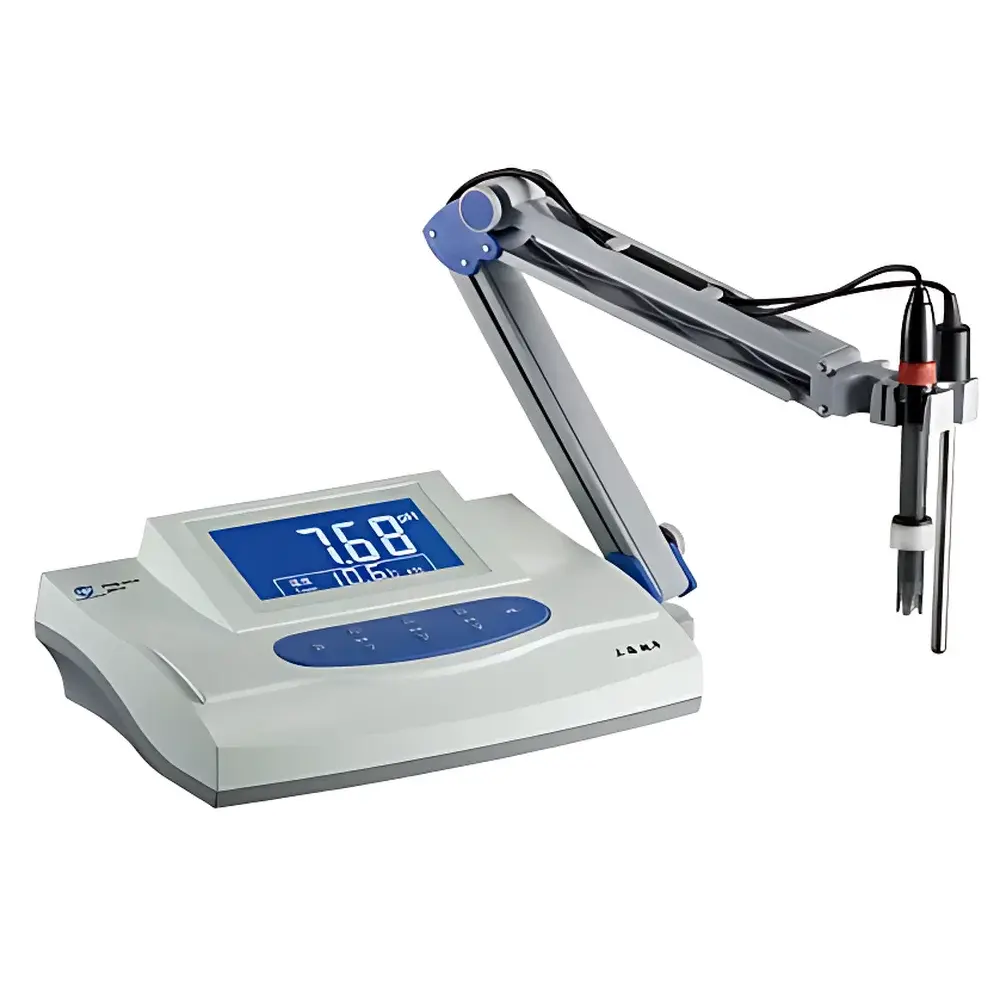
SHYP PHS-3CU Benchtop High-Precision pH Meter, 0.01-Class Laboratory pH Analyzer
| Brand | SHYP |
|---|---|
| Origin | Shanghai, China |
| Model | PHS-3CU |
| Instrument Type | Benchtop |
| Measurement Accuracy | ±0.01 pH |
| pH Range | –2.00 to 19.99 pH |
| Resolution | 0.01 pH |
| Temperature Compensation | Manual/Automatic (0.0–80.0 °C) |
| Input Impedance | ≥1 × 10¹² Ω |
| Input Current | ≤1 × 10⁻¹² A |
| Stability | ±0.01 pH ±1 digit / 3 h |
| mV Range | 0 to ±1999 mV |
| mV Resolution | ±1 mV |
| Temperature Range | 0.0–80.0 °C |
| Temperature Resolution | 0.1 °C |
| Calibration Buffers | pH 4.00, 6.86, and 9.18 |
| Power Supply | DC 12 V, 1.0 A |
| Dimensions | 290 × 210 × 95 mm |
| Weight | 1.5 kg |
Overview
The SHYP PHS-3CU is a benchtop high-precision pH meter engineered for routine and quality-critical pH, mV (ORP), and temperature measurements in academic laboratories, QC/QA environments, and industrial process support settings. It operates on the fundamental principle of potentiometric measurement: the potential difference between a pH-sensitive glass electrode and a stable reference electrode is converted into a logarithmic pH value via the Nernst equation. Designed to meet Class 0.01 accuracy requirements per GB/T 11165–2022 (equivalent to IEC 62261 and ISO 7888 for pH instrumentation), the PHS-3CU delivers traceable, reproducible results across an extended pH range from –2.00 to 19.99 — enabling characterization of strongly acidic, neutral, and highly alkaline aqueous solutions, including those encountered in electroplating baths, semiconductor cleaning chemistries, and alkaline battery electrolytes.
Key Features
- Benchtop architecture with compact footprint (290 × 210 × 95 mm) and lightweight design (1.5 kg), optimized for space-constrained lab benches and shared instrumentation workstations.
- Large LCD display with simultaneous real-time readouts of pH, mV, and temperature — eliminating manual mode switching during multi-parameter workflows.
- Three-point calibration protocol with automatic recognition of standard buffer solutions at pH 4.00, 6.86, and 9.18 — reducing operator error and improving inter-laboratory comparability.
- Dual-mode temperature compensation: both manual entry and automatic sensing via integrated Pt1000 thermistor (0.0–80.0 °C), ensuring accurate pH correction across common laboratory ambient and sample temperature conditions.
- High-input-impedance circuitry (≥1 × 10¹² Ω) and ultra-low input current (≤1 × 10⁻¹² A) minimize loading effects on high-resistance electrodes — critical for reliable measurement with aged or low-ionic-strength samples.
- Stability performance verified at ±0.01 pH ±1 digit over 3 hours, supporting GLP-aligned documentation practices where drift monitoring is required.
Sample Compatibility & Compliance
The PHS-3CU is intended for aqueous and water-miscible liquid samples within standard electrochemical operating limits. It is compatible with SHYP E-201-C combination pH electrodes (included or optional), as well as third-party BNC-compatible electrodes meeting ISO 8655-4 mechanical and electrical interface specifications. The instrument complies with electromagnetic compatibility (EMC) requirements per GB/T 18268.1–2010 (IEC 61326-1), and its measurement uncertainty profile aligns with national metrological verification regulation JJG 119–2018 for laboratory pH meters. While not FDA 21 CFR Part 11–certified out-of-the-box, audit-ready calibration logs (when manually recorded) support basic GMP/GLP documentation needs in non-regulated or internally audited environments.
Software & Data Management
The PHS-3CU operates as a standalone, embedded-system instrument without proprietary PC software or USB connectivity. All calibration, measurement, and configuration data are retained in volatile memory only during active use; no internal data logging or export capability is provided. Users are expected to record readings manually or integrate the meter into external data acquisition systems via analog output (if equipped on custom variants) or visual transcription. This architecture prioritizes operational simplicity, long-term reliability, and minimal maintenance — making it suitable for educational labs, field-deployed QA stations, and facilities with strict IT security policies restricting peripheral device connections.
Applications
- Academic teaching labs: Demonstrating acid-base equilibria, titration endpoints, and buffer capacity under controlled conditions.
- Water treatment facilities: Monitoring influent/effluent pH in municipal and industrial wastewater streams per ASTM D1293 and ISO 10523 protocols.
- Pharmaceutical manufacturing: Performing in-process checks of dissolution media, cleaning validation rinsates, and excipient slurry pH per USP .
- Food & beverage R&D: Verifying pH stability in fermented products, dairy formulations, and acidic preservative systems.
- Electrochemistry research: Supporting ORP (oxidation-reduction potential) measurements in redox titrations and corrosion studies.
FAQ
Does the PHS-3CU support automatic electrode diagnosis or slope calculation?
No. Slope and offset values must be calculated manually post-calibration using recorded buffer potentials and theoretical Nernstian values.
Is the instrument supplied with calibration buffers or electrodes?
The base configuration includes the meter and power adapter only. E-201-C pH electrodes and certified pH 4.00/6.86/9.18 buffer solutions are available as optional accessories.
Can the PHS-3CU measure non-aqueous or low-ionic-strength samples reliably?
It is calibrated and validated for aqueous solutions. Measurements in organic solvents or deionized water require specialized electrodes and procedural adaptations beyond the scope of standard operation.
What is the recommended recalibration frequency?
Per ISO/IEC 17025 guidance, recalibration is advised before each analytical batch, after electrode replacement, or following exposure to extreme pH, high temperature, or proteinaceous matrices.
Is firmware upgrade capability available?
No. The device uses fixed-function embedded firmware with no field-upgrade path; functionality is defined at time of manufacture.





