
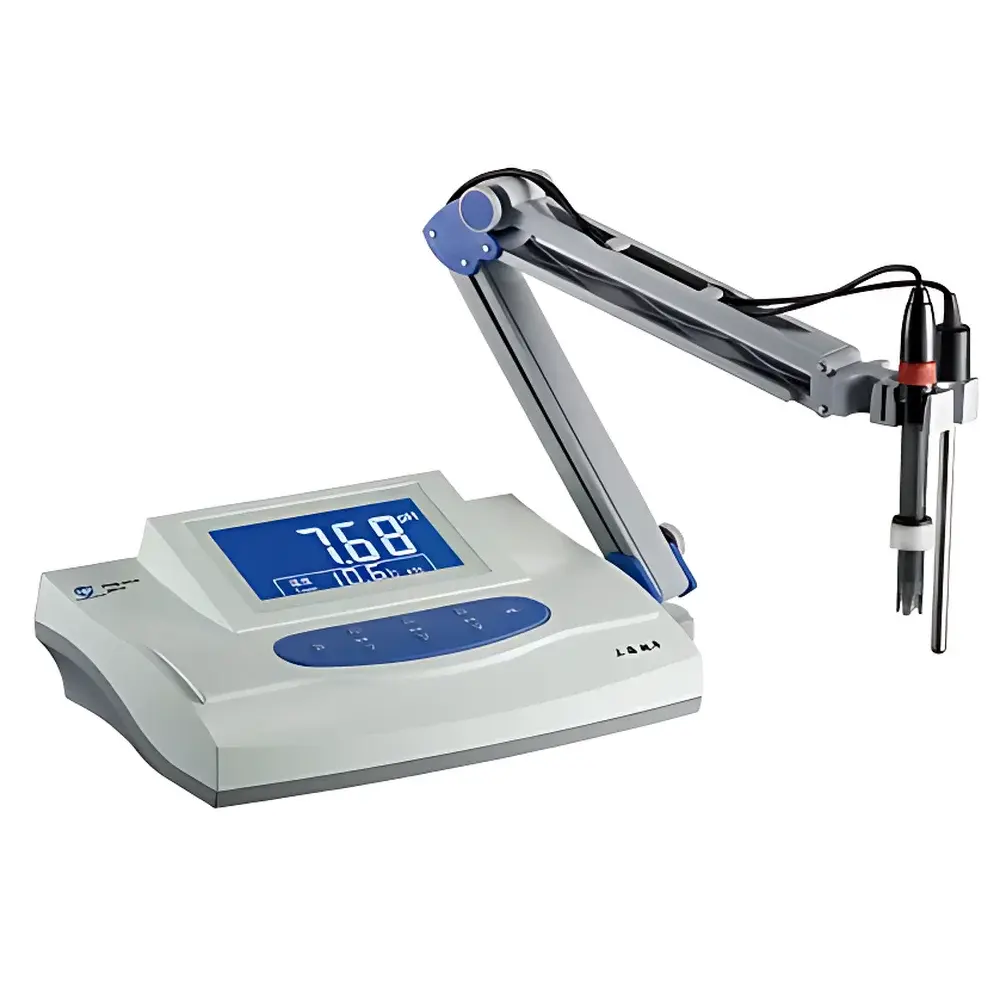
SHYP PHS-3CB Benchtop pH Meter with Automatic Temperature Compensation
| Brand | SHYP |
|---|---|
| Origin | Shanghai, China |
| Model | PHS-3CB |
| Instrument Type | Benchtop pH Meter |
| Measurement Parameters | pH, mV (ORP), Temperature |
| Accuracy | ±0.01 pH |
| pH Range | –2.00 to 19.99 pH |
| Resolution | 0.01 pH |
| Temperature Compensation | Manual & Automatic (0.0–80.0 °C) |
| Input Impedance | ≥1 × 10¹² Ω |
| Input Current | ≤1 × 10⁻¹² A |
| Stability | ±0.01 pH ±1 digit / 3 h |
| Calibration Buffers | pH 4.00, 6.86, and 9.18 |
| Compatible Electrode | SHYP E-201-C pH Composite Electrode |
| Power Supply | DC 12 V / 1.0 A |
| Dimensions (W × D × H) | 290 × 210 × 95 mm |
| Weight | 1.5 kg |
Overview
The SHYP PHS-3CB is a precision benchtop pH meter engineered for routine laboratory pH, redox potential (mV/ORP), and temperature measurements in quality control, academic research, environmental monitoring, and industrial process support. Based on potentiometric measurement principles, the instrument determines hydrogen ion activity via a glass pH electrode and reference junction—generating a Nernstian voltage response proportional to pH across aqueous and low-ionic-strength non-aqueous media. Its dual-mode temperature compensation (manual or automatic) corrects for thermal drift in electrode response using either built-in thermistor input or user-entered values, ensuring traceable accuracy per ISO 7027 and ASTM D1293 guidelines. Designed to meet Class 0.01 pH meter specifications per GB/T 11165–2005 (equivalent to IEC 62261), the PHS-3CB delivers stable, reproducible readings under standard laboratory conditions without requiring external data loggers or PC integration.
Key Features
- Large LCD display with simultaneous three-parameter readout (pH/mV/°C) and intuitive icon-based status indicators
- Three-point calibration with automatic recognition of standard buffers at pH 4.00, 6.86, and 9.18—reducing operator error and supporting ISO 8655-compliant calibration workflows
- Switchable manual or automatic temperature compensation (0.0–80.0 °C), compatible with integrated Pt1000 or thermistor probes
- Dual measurement modes: pH (–2.00 to 19.99) and mV (±1999 mV) with ±1 mV resolution for oxidation-reduction potential analysis
- High-input-impedance circuitry (≥1 × 10¹² Ω) minimizes loading effects on high-resistance electrodes such as double-junction or gel-filled sensors
- Stability performance verified at ±0.01 pH ±1 digit over 3 hours—suitable for GLP-regulated environments where intermediate precision must be documented
- Compact benchtop form factor (290 × 210 × 95 mm) with robust ABS housing and low-power DC 12 V operation for stable performance in shared lab spaces
Sample Compatibility & Compliance
The PHS-3CB supports a broad range of aqueous samples including buffer solutions, biological fluids, wastewater, food extracts, and pharmaceutical formulations. It is optimized for use with the SHYP E-201-C pH composite electrode—a low-maintenance, refillable liquid-junction sensor with Ag/AgCl reference system and asymmetric glass membrane. The instrument complies with national metrological verification regulations JJG 119–2018 (pH meters) and aligns with functional requirements outlined in USP and EP 2.2.3 for pH measurement in pharmacopeial testing. While not certified for FDA 21 CFR Part 11 compliance out-of-the-box, its calibration history, stability metrics, and manual audit trail support documentation required for GMP and ISO/IEC 17025 accreditation when used with controlled SOPs.
Software & Data Management
The PHS-3CB operates as a standalone instrument with no embedded software or USB connectivity. All calibration events, measurement timestamps, and temperature inputs are retained only in volatile memory during active use; no internal storage or export functionality is provided. Users are expected to manually record calibration logs—including date, buffer IDs, slope (%), offset (mV), and temperature—for regulatory traceability. For laboratories requiring electronic records, integration with external LIMS or ELN systems must be achieved via manual transcription or third-party analog-to-digital interface hardware. The absence of firmware-upgradable components ensures long-term operational consistency but limits adaptability to evolving digital compliance frameworks.
Applications
- Quality assurance of raw materials and finished products in food & beverage manufacturing (e.g., dairy acidity, juice titratable acidity verification)
- pH monitoring in municipal and industrial wastewater treatment processes per EPA Method 150.1
- Academic teaching labs for fundamental electrochemistry experiments, including Nernst equation validation and buffer capacity studies
- Environmental field screening (when paired with portable power supply) for soil extract and surface water analysis
- Pharmaceutical formulation development where pH-dependent solubility and stability profiles are assessed under ICH Q5C guidelines
- Calibration verification of inline pH sensors used in bioreactor and fermentation control systems
FAQ
What calibration buffers are supported by the PHS-3CB?
The instrument automatically recognizes and applies calibration coefficients for pH 4.00, 6.86, and 9.18 standard buffer solutions—covering acidic, neutral, and alkaline ranges per ISO 3696 and NIST SRM traceability recommendations.
Does the PHS-3CB support automatic electrode diagnostics or slope calculation?
Yes—during three-point calibration, the meter calculates and displays electrode slope (expressed as % of theoretical Nernst response) and asymmetry potential, enabling real-time assessment of electrode health and readiness for regulated use.
Can the PHS-3CB measure non-aqueous or high-ethanol samples?
It is calibrated for aqueous systems; direct measurement of organic solvents or mixed-phase solutions requires specialized electrodes and empirical correction factors—not provided by default firmware.
Is the E-201-C electrode included with the PHS-3CB?
The E-201-C pH composite electrode is specified as the recommended sensor but is sold separately unless explicitly bundled by distributor; verify configuration at time of order.
What maintenance is required to ensure long-term accuracy?
Daily rinsing with deionized water, proper storage in 3 M KCl solution, periodic cleaning of the reference junction with dilute nitric acid (for sulfide fouling), and annual verification against certified reference materials are essential for sustained metrological integrity.
Related Products



