
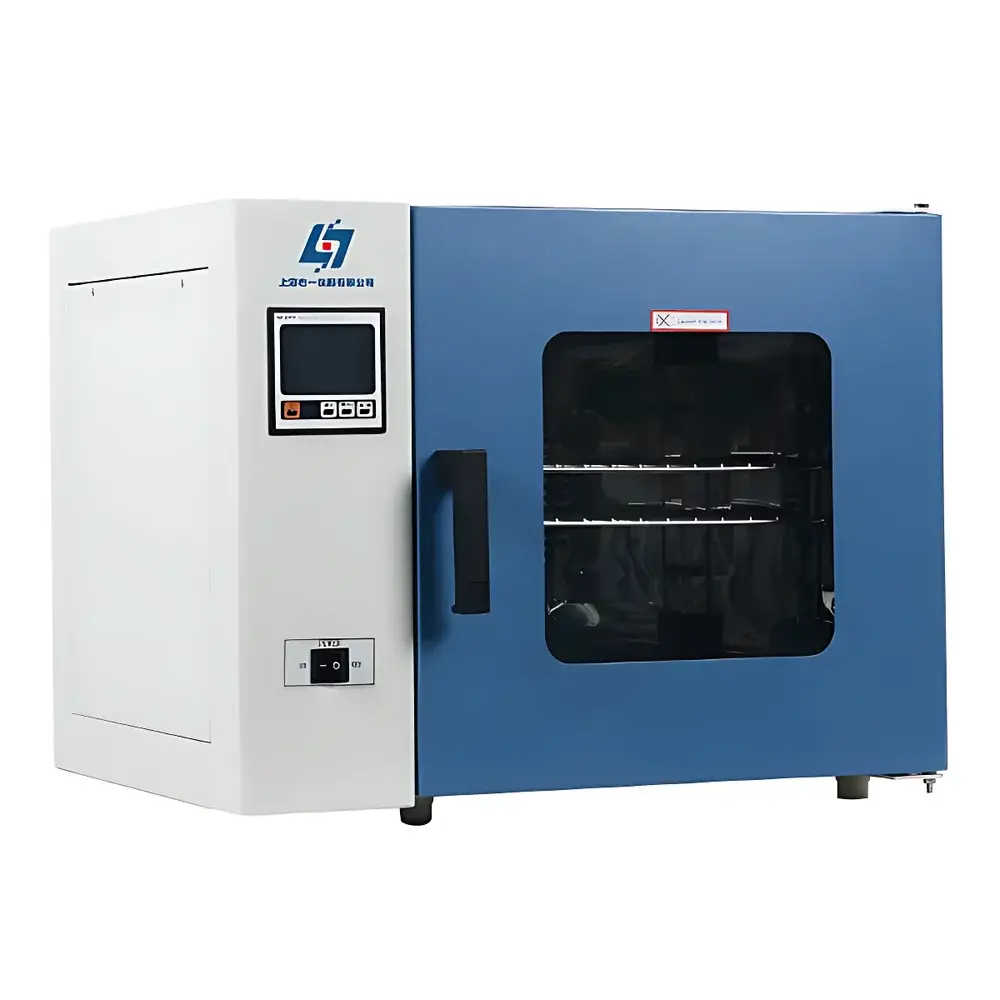
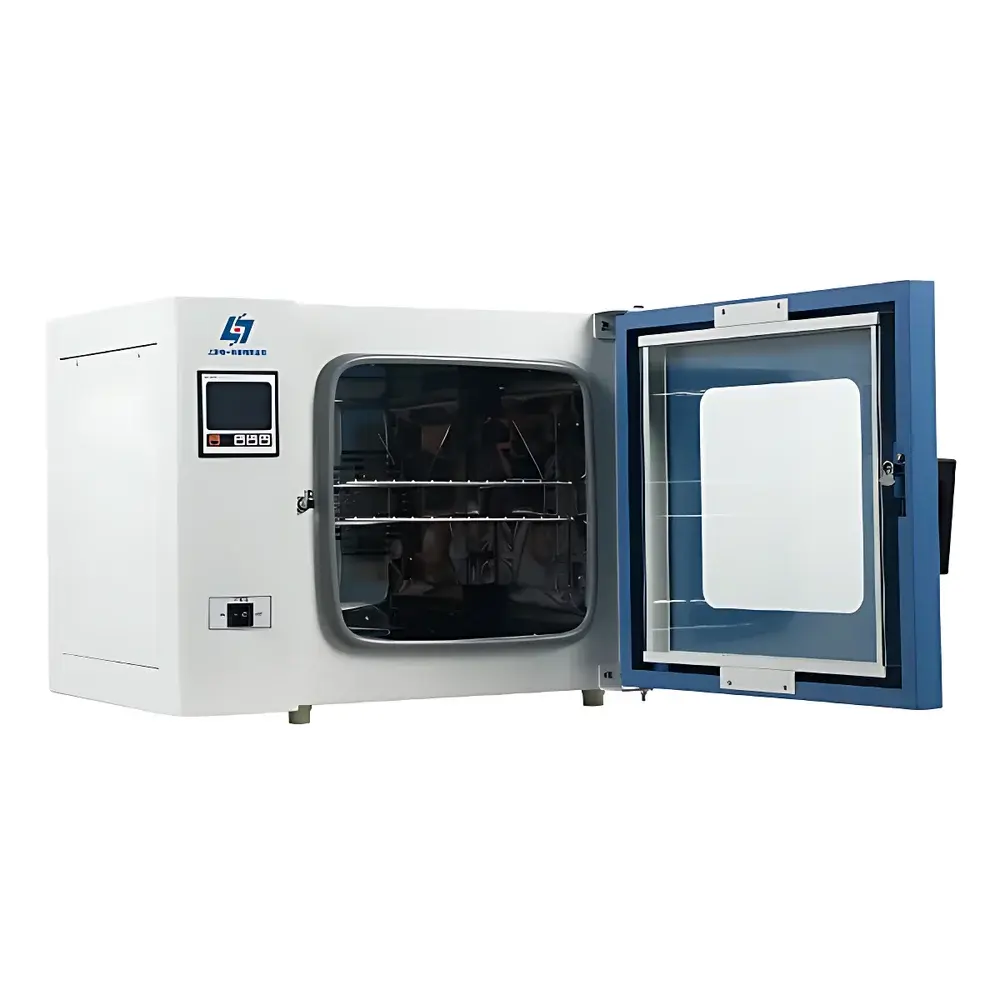
Yoyilab DHG-9245A Forced-Air Constant-Temperature Drying Oven with LCD Interface
| Brand | Yoyilab |
|---|---|
| Model | DHG-9245A |
| Type | General-Purpose Forced-Convection Drying Oven |
| Temperature Range | RT+10°C to 300°C |
| Temperature Uniformity | ±2.5% (at 100°C) |
| Temperature Fluctuation | ±1°C |
| Temperature Resolution | 0.1°C |
| Internal Chamber Dimensions | 600 × 595 × 650 mm (W×D×H) |
| Internal Volume | 220 L |
| External Dimensions | 880 × 800 × 830 mm (W×D×H) |
| Interior Material | Mirror-Finish Stainless Steel (SUS304) |
| Exterior Material | Cold-Rolled Steel with Electrostatic Powder Coating |
| Power Supply | AC 220 V, 50 Hz |
| Rated Power | 2500 W |
| Working Environment | 5–40°C ambient, ≤80% RH |
| Compliance | GB/T 30435–2013 |
Overview
The Yoyilab DHG-9245A is a microprocessor-controlled forced-air drying oven engineered for precision thermal processing in research laboratories, quality control environments, and industrial R&D settings. It operates on the principle of convection-based heat transfer, utilizing a rear-mounted centrifugal blower and optimized air duct architecture to ensure uniform airflow distribution across the entire working chamber. This design enables consistent thermal exposure of samples—critical for applications such as moisture loss determination, polymer curing, pharmaceutical stability testing, pre-weighing desiccation, and sterilization of glassware and instruments. The unit complies with GB/T 30435–2013, the Chinese national standard governing performance requirements and test methods for electric heating drying ovens and forced-convection variants. Its operational envelope spans from ambient +10°C to 300°C, supporting both low-temperature drying and high-temperature thermal treatment protocols under controlled atmospheric conditions.
Key Features
- Intelligent microcomputer temperature controller with real-time monitoring, programmable timing (1–9999 minutes), and over-temperature alarm with automatic cut-off circuitry
- High-resolution LCD interface displaying setpoint temperature, actual chamber temperature, elapsed time, and remaining hold time simultaneously
- Double-layer tempered glass observation window with large viewing area, enabling non-intrusive visual inspection without thermal disruption
- Optimized air circulation system featuring rear-mounted adjustable-speed fan, multi-directional air ducts, and automatic intake/exhaust ports for continuous vapor removal
- Mirror-finish SUS304 stainless steel interior chamber with smooth, non-porous surface for easy cleaning and corrosion resistance
- Robust cold-rolled steel exterior with electrostatic powder coating for mechanical durability and chemical resistance
- High-temperature silicone door gasket ensuring long-term sealing integrity and thermal efficiency up to 300°C
- Configurable safety architecture including parameter memory retention during power interruption and auto-recovery upon restoration
Sample Compatibility & Compliance
The DHG-9245A accommodates a broad range of sample types—including petri dishes, weighing boats, crucibles, glass vials, metal trays, and polymer substrates—within its 220 L stainless steel chamber. Adjustable stainless steel shelving (standard configuration: two shelves, fully removable and repositionable) supports flexible load arrangement. The oven is suitable for use in GLP-compliant laboratories when paired with optional data logging accessories. While not inherently 21 CFR Part 11 compliant, the RS485 interface (optional) enables integration with validated LIMS or SCADA systems for audit-trail-capable temperature recording. All electrical components meet IEC 61010-1 safety standards for laboratory equipment. The unit is CE-marked for export to EEA markets and conforms to GB/T 30435–2013 for thermal performance validation under no-load conditions at 20°C ambient and 50% RH.
Software & Data Management
As a standalone instrument, the DHG-9245A operates via embedded firmware with no proprietary software dependency. Optional RS485 serial interface allows connection to external PCs running third-party data acquisition platforms (e.g., LabVIEW, MATLAB, or custom Python scripts) for time-stamped temperature logging. An optional embedded thermal printer provides hard-copy output of temperature profiles and event timestamps—useful for batch documentation in ISO/IEC 17025-accredited testing labs. For advanced process control, the optional multi-segment programmable temperature controller supports up to 30 ramp-hold cycles, facilitating complex thermal profiles required in materials aging studies or accelerated stability testing per ICH Q1 guidelines.
Applications
- Drying biological samples, soil specimens, and botanical materials prior to gravimetric analysis
- Baking and curing of coatings, adhesives, and composite laminates in materials science labs
- Thermal conditioning of electronic components and PCB assemblies before functional testing
- Pre-sterilization of glassware and stainless-steel tools in microbiology and cell culture facilities
- Moisture content determination in food, feed, and pharmaceutical raw materials per AOAC or USP <1251>
- Heat treatment of calibration standards and reference materials in metrology laboratories
- Accelerated aging of polymers and elastomers under controlled isothermal conditions
FAQ
What is the maximum operating temperature and how is thermal stability maintained?
Maximum operating temperature is 300°C. Thermal stability is ensured by a PID-controlled heating system with dual-sensor feedback (working thermistor + independent safety limiter), achieving ±1°C fluctuation under steady-state conditions.
Can inert gas purging be implemented for oxygen-sensitive processes?
Yes—via the optional inert gas inlet port equipped with a calibrated rotameter, enabling precise flow regulation (0–10 L/min) of nitrogen or argon to maintain reducing or inert atmospheres inside the chamber.
Is the oven suitable for GMP-regulated environments?
When configured with RS485 + validated software and electronic audit trail functionality, it can support GMP-aligned workflows; however, full qualification (IQ/OQ/PQ) must be performed by the end user per internal SOPs.
How is temperature uniformity verified across the chamber?
Uniformity is validated per GB/T 30435–2013 using nine calibrated PT100 probes placed at standardized locations (center + eight corners). At 100°C, measured deviation remains within ±2.5% of setpoint.
Are replacement parts such as door gaskets or shelves available separately?
Yes—Yoyilab supplies OEM-grade silicone door seals, SUS304 shelving kits, and fan assemblies through authorized distributors. Lead time for spare parts is typically 2–4 weeks ex-warehouse Shanghai.
Related Products



