
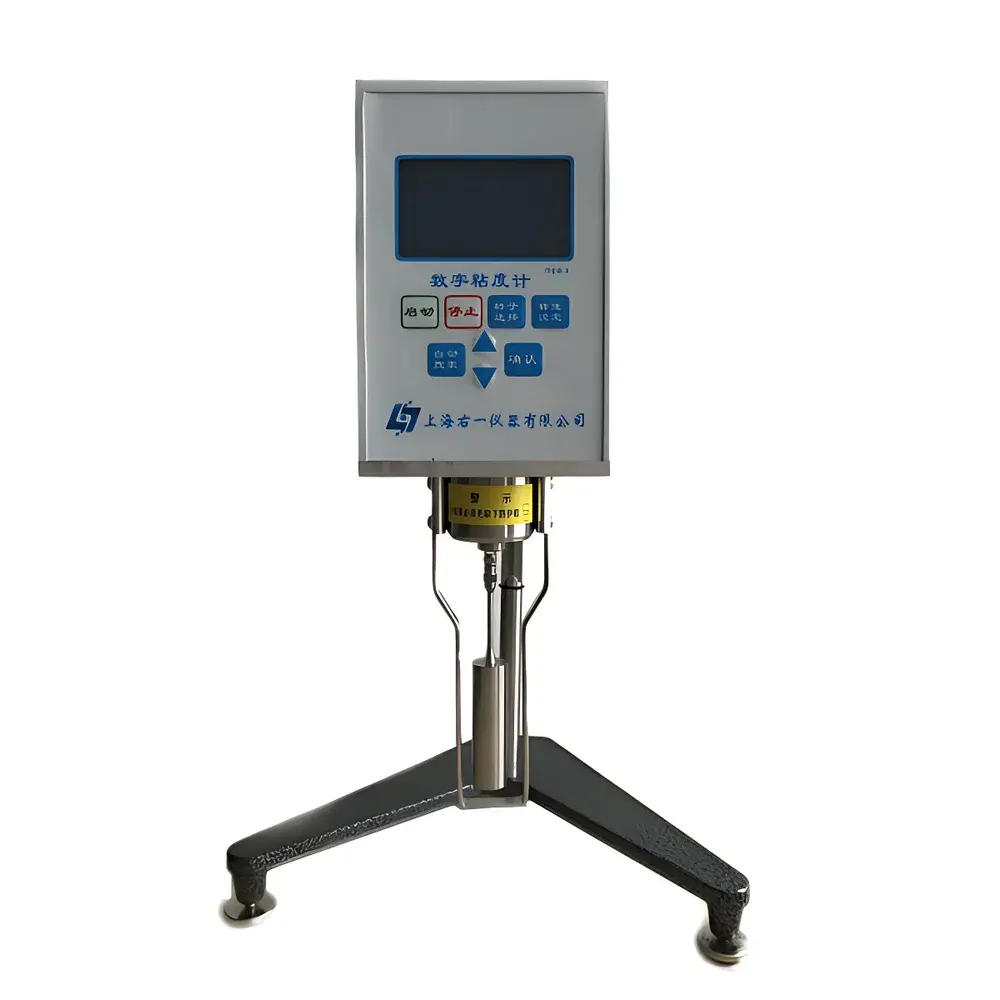
Yoyilab NDJ-9S Digital Rotational Viscometer with 1–6,000,000 mPa·s Viscosity Range
| Brand | Yoyilab |
|---|---|
| Origin | Shanghai, China |
| Manufacturer | Yoyilab Instruments Co., Ltd. |
| Model | NDJ-9S |
| Instrument Type | Benchtop Rotational Viscometer |
| Viscosity Range | 1–6,000,000 mPa·s (with optional #0 spindle) |
| Spindle Options | Standard #1–#4 spindles |
| Speed Settings | 0.1, 0.3, 0.6, 1.5, 3, 6, 12, 30, 60 rpm (9 speeds) |
| Accuracy | ±3% of full scale (Newtonian fluids) |
| Repeatability | ±0.5% of full scale |
| Resolution | 1 mPa·s (0.1 mPa·s with #0 spindle) |
| Power Supply | 110–220 V AC, ±10%, 50–60 Hz |
| Operating Temperature | 5–35 °C, ≤80% RH |
| Dimensions (W×D×H) | 95 × 130 × 155 mm |
| Net Weight | 2 kg (excluding base) |
Overview
The Yoyilab NDJ-9S Digital Rotational Viscometer is a microprocessor-controlled benchtop instrument engineered for precise and reproducible measurement of dynamic viscosity in both Newtonian and non-Newtonian liquids. Based on the principle of rotational viscometry—where torque required to rotate a spindle at a defined angular velocity within a fluid is directly proportional to its shear viscosity—the NDJ-9S employs a stepper motor-driven spindle system coupled with a high-sensitivity torsion sensor. This architecture ensures stable rotational speed control across nine discrete settings (0.1–60 rpm), enabling reliable characterization of low-shear-rate behavior critical for quality control in formulation development and production monitoring. Designed for routine laboratory use under ambient conditions, the instrument complies with fundamental metrological requirements for viscosity measurement as outlined in ISO 2555 and ASTM D2196, supporting traceable calibration using standard silicone oils.
Key Features
- 16-bit microcontroller architecture with embedded real-time data acquisition and processing
- Auto-search function for optimal spindle/speed combination based on preliminary viscosity estimation
- Nine programmable rotational speeds (0.1, 0.3, 0.6, 1.5, 3, 6, 12, 30, 60 rpm) ensuring flexibility across wide shear rate ranges
- Standard set of four spindles (#1–#4) covering 10–6,000,000 mPa·s; optional #0 spindle extends lower detection limit to 1 mPa·s with 0.1 mPa·s resolution
- Wide-input power compatibility (110–220 V AC, 50–60 Hz), eliminating need for external voltage regulators in global lab environments
- Integrated digital display with Chinese/English bilingual interface (hardware-selectable), showing real-time viscosity, speed, spindle ID, and temperature (when paired with optional probe)
- Robust mechanical design: compact footprint (95 × 130 × 155 mm), aluminum alloy housing, and precision-machined stainless-steel spindles for long-term dimensional stability
Sample Compatibility & Compliance
The NDJ-9S is validated for use with homogeneous, non-aerated liquid samples exhibiting minimal particle sedimentation during measurement. It is routinely applied to solvent-based adhesives, latex dispersions, polymer solutions, coatings, cosmetic emulsions, food-grade starch slurries, ink formulations, and pulp suspensions. While not intended for yield-stress or thixotropic quantification without protocol adaptation, its fixed-speed operation supports comparative QC testing per internal SOPs aligned with ISO 2884-1 (paints and varnishes) and USP (viscosity of semisolid dosage forms). The instrument meets CE electromagnetic compatibility (EMC) directives and conforms to IEC 61010-1 safety standards for laboratory electrical equipment. Calibration verification follows manufacturer-recommended intervals using NIST-traceable viscosity standards.
Software & Data Management
The NDJ-9S operates as a standalone instrument with no proprietary PC software dependency. All measurements are displayed and retained locally on the unit’s LCD screen. For documentation compliance in regulated environments (e.g., GLP or GMP facilities), users may manually record values alongside test parameters (spindle ID, speed, temperature, sample ID) in bound logbooks or LIMS-integrated spreadsheets. Optional RS-232 output (available via accessory cable) enables ASCII-formatted data export to external terminals or legacy lab systems. Though lacking FDA 21 CFR Part 11-compliant audit trail functionality, the device supports ALCOA+ principles through consistent operator training, defined calibration schedules, and controlled environmental monitoring (temperature/humidity logs).
Applications
- Quality assurance of industrial coatings: verifying batch-to-batch consistency in acrylic and epoxy resin systems prior to application
- Rheological screening of personal care gels: assessing pseudoplastic response across shear rates relevant to pump dispensing and skin spreadability
- Process validation in food manufacturing: monitoring cornstarch slurry viscosity during thermal gelatinization to ensure texture uniformity
- Adhesive formulation development: evaluating solvent evaporation effects on open time and bond strength precursors
- Educational laboratories: demonstrating Newtonian vs. non-Newtonian flow behavior using glycerol/water mixtures and xanthan gum solutions
- Pharmaceutical excipient testing: confirming viscosity compliance of carbomer-based topical bases per pharmacopeial monographs
FAQ
What spindle configuration is required to measure viscosity below 10 mPa·s?
The optional #0 spindle must be installed, and measurements should be performed at 60 rpm using the lowest torque range setting.
Is temperature control integrated into the NDJ-9S?
No. External water baths or Peltier-equipped sample holders are required for temperature-dependent studies; an optional PT100 probe can be connected for ambient temperature logging.
Can the NDJ-9S comply with ISO 2555 calibration requirements?
Yes—when calibrated against certified reference oils (e.g., Cannon NIST-traceable standards) using the specified spindles and speeds, and documented per ISO/IEC 17025 procedures.
How often should the instrument be recalibrated?
Annually under normal use; more frequently if subjected to mechanical shock, spindle damage, or operation outside specified environmental limits.
Does the NDJ-9S support continuous data logging?
Not natively. Real-time streaming requires third-party DAQ hardware interfaced via RS-232; manual snapshot recording remains the primary method for regulatory traceability.
Related Products



