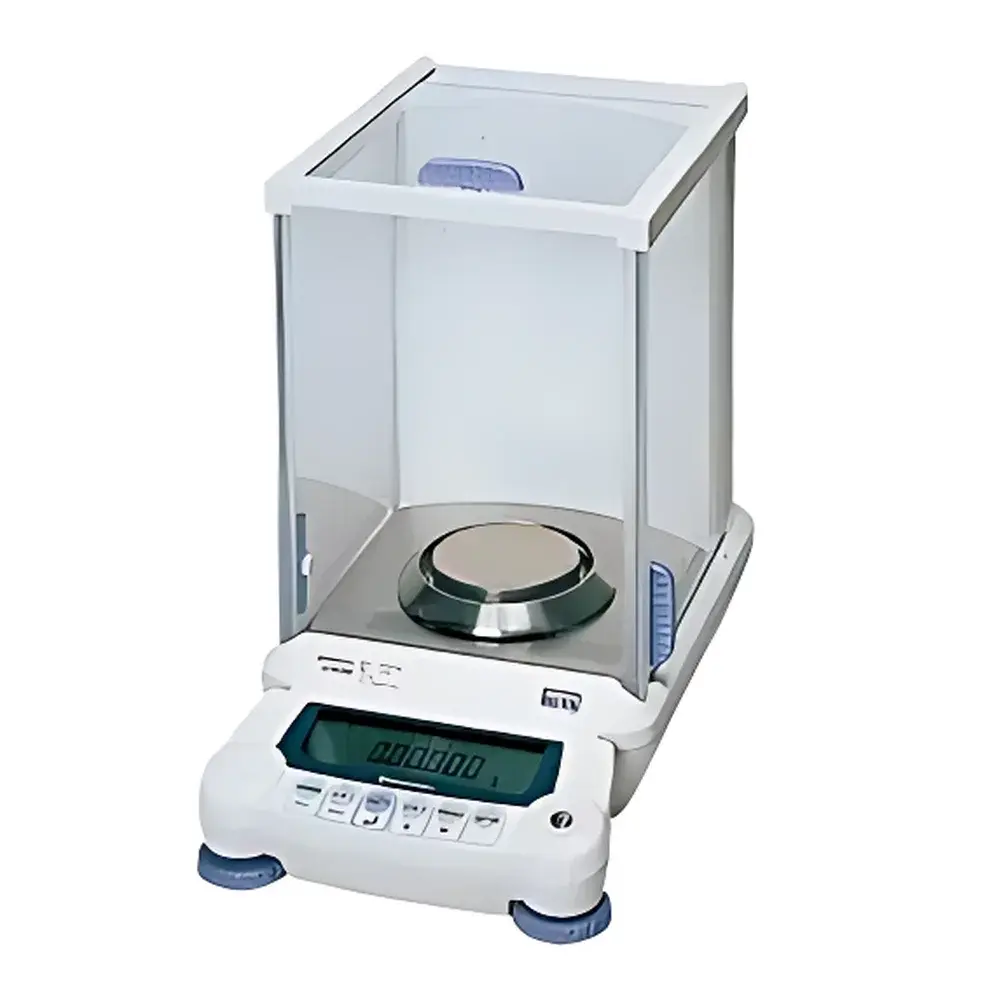
Shimadzu Analytical Balance Series (AP, AUW, AUX, ATX, AUY, UW, UX, TW, TX, TXB, MOC Models)
| Brand | Shimadzu |
|---|---|
| Origin | Japan |
| Instrument Type | Analytical Balance |
| Capacity Range | 20 g to 8,200 g |
| Readability | 0.01 mg to 0.1 g |
| Calibration | Internal & External (Manual and Automatic) |
| Repeatability | ≤ ±0.02 mg (typical for 0.01 mg models) |
| Compliance | ISO/IEC 17025, ASTM E899, USP <41>, GLP/GMP-ready architecture |
Overview
The Shimadzu Analytical Balance Series represents a comprehensive portfolio of high-precision mass measurement instruments engineered for reproducible, traceable, and regulatory-compliant weighing in pharmaceutical QC laboratories, academic research facilities, and industrial R&D environments. These balances operate on electromagnetic force compensation (EMFC) principle — where the gravitational force acting on a sample is precisely counterbalanced by an electromagnetic field generated within a precision coil assembly. The resulting current required to maintain equilibrium is linearly proportional to mass and digitally converted into weight output with exceptional linearity and temperature stability. Designed and manufactured in Kyoto, Japan, each unit undergoes rigorous factory calibration against NIST-traceable standards and incorporates advanced thermal drift compensation algorithms to ensure long-term accuracy under variable ambient conditions.
Key Features
- Electromagnetic force compensation (EMFC) sensor technology delivering high resolution, low noise, and minimal hysteresis across full capacity range
- Dual-range models (e.g., AP225WD-AD: 220 g / 102 g with 0.1 mg / 0.01 mg readability) optimized for both gross and fine weighing tasks without manual range switching
- Internal motorized calibration with automatic temperature-triggered recalibration (AutoCal™), supporting scheduled or event-driven verification per ISO 17025 Clause 6.5.2
- Advanced draft shield systems including modular anti-static glass enclosures (e.g., RDB-202 display + STABLO-AP ionizer) reducing electrostatic interference and air turbulence effects
- Integrated environmental monitoring: real-time temperature, humidity, and barometric pressure logging synchronized with weight data for uncertainty budgeting (per GUM Supplement 1)
- Modular hardware architecture enabling field-upgradable firmware, interchangeable displays (RDB-201/RDB-202), and plug-and-play accessories including density kits (SMK series), animal weighing cages, and sinker sets
Sample Compatibility & Compliance
Shimadzu analytical balances accommodate diverse sample types — from hygroscopic powders and volatile solvents to irregular solids and biological specimens — via configurable pan geometry, optional weighing boats, and anti-static treatment of internal surfaces. All models comply with international metrological requirements outlined in OIML R76-1 (2013) and support metrological traceability through documented calibration certificates issued per ISO/IEC 17025. For regulated environments, balances are compatible with 21 CFR Part 11-compliant software (LabSolutions BalanceCS), providing electronic signature capability, audit trail generation, and role-based access control. Routine performance qualification (PQ) is facilitated using certified test weights (Class E2 or better) and standardized protocols aligned with USP , EP 2.1.6, and ASTM E899-22.
Software & Data Management
LabSolutions BalanceDB (standalone) and BalanceCS (networked) provide secure, scalable data handling for multi-user laboratory networks. BalanceCS supports centralized instrument management, automated backup to SQL Server databases, and export to LIMS via CSV, XML, or direct API integration. Audit trails record all user actions — including zeroing, taring, calibration events, and data exports — with immutable timestamps and operator identification. Data integrity safeguards include write-protected storage, checksum validation, and encrypted communication (TLS 1.2+). Optional modules enable statistical process control (SPC) charting, tolerance band alerts, and GxP-aligned report templates compliant with ALCOA+ principles (Attributable, Legible, Contemporaneous, Original, Accurate, Complete, Consistent, Enduring, Available).
Applications
- Pharmaceutical formulation: active pharmaceutical ingredient (API) dispensing, excipient blending, and content uniformity testing per USP
- Materials science: density determination of polymers and ceramics using SMK-series buoyancy kits with ASTM D792/D891 compliance
- Environmental analysis: gravimetric quantification of particulate matter (PM2.5/PM10) filters per EPA Method 201A
- Academic research: stoichiometric reagent preparation, catalyst loading, and micro-scale synthesis workflows requiring sub-0.02 mg repeatability
- Food safety testing: moisture loss tracking with MOC-series halogen moisture analyzers interfaced via RS-232/USB
- Reference material certification: primary standard preparation in national metrology institutes requiring ≤ 0.005% relative standard deviation (RSD)
FAQ
What is the difference between internal and external calibration on Shimadzu balances?
Internal calibration uses built-in reference masses actuated by motorized mechanisms; external calibration requires user-provided certified weights and is mandatory for ISO/IEC 17025 accreditation.
Are Shimadzu analytical balances compatible with LIMS integration?
Yes — via LabSolutions BalanceCS with configurable ASCII/CSV output, ODBC connectivity, and RESTful API support for seamless bidirectional data exchange.
How does the AutoCal™ function maintain accuracy over time?
AutoCal™ initiates calibration automatically when internal temperature sensors detect ≥ 2°C deviation from last calibration point, ensuring continuous traceability without manual intervention.
Can these balances be used in Class A/B cleanrooms?
Yes — models with IP54-rated enclosures (e.g., AP, AUW, ATX series) meet ISO 14644-1 requirements; optional HEPA-filtered draft shields further reduce particle ingress.
Is GLP/GMP audit trail functionality available out-of-the-box?
Yes — LabSolutions BalanceCS provides full 21 CFR Part 11 compliance including electronic signatures, audit trail review tools, and password-protected configuration locks.