
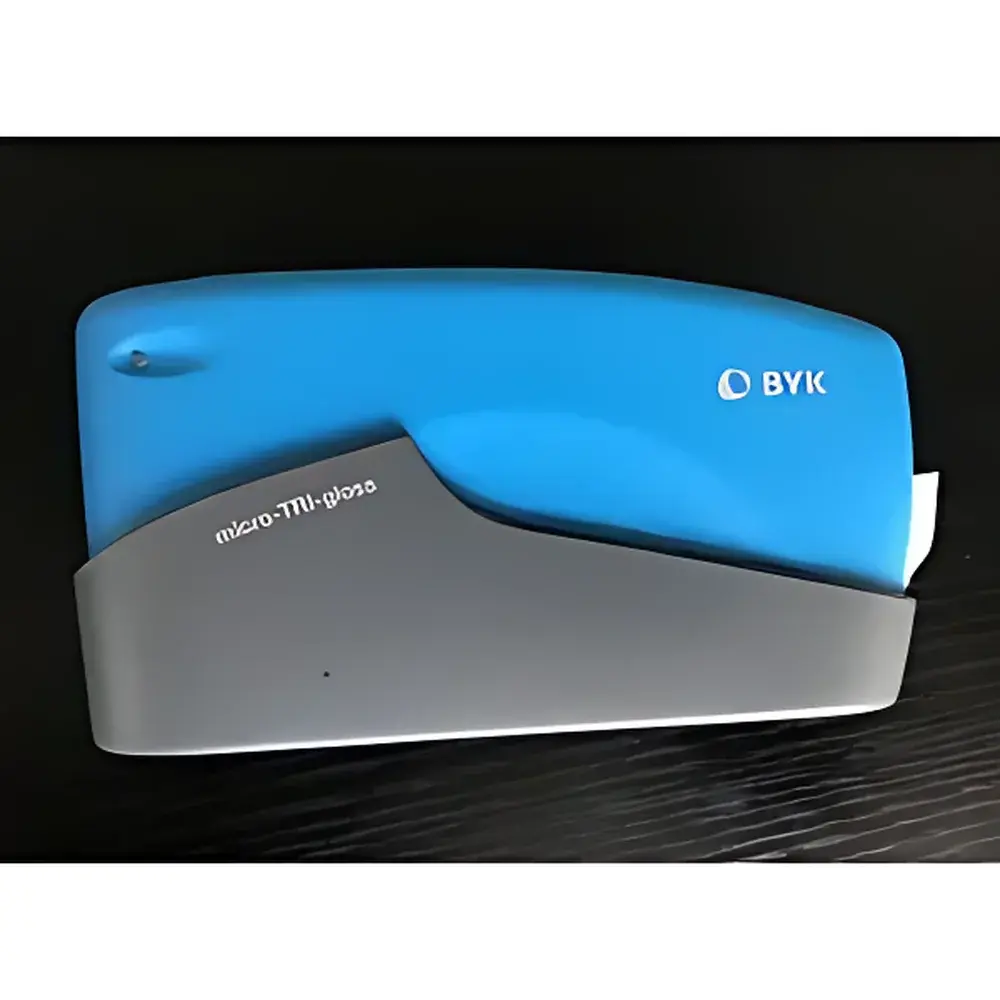
BYK-GARDNER micro-TRI-gloss 4563 Portable Tri-Angle Gloss Meter for Automotive Paint & Trim Quality Control
| Brand | BYK-GARDNER |
|---|---|
| Origin | Germany |
| Model | BYK 4563 |
| Measurement Angles | 20°, 60°, 85° |
| Optical Aperture | 9×15 mm (60°), 10×10 mm (20°), 5×38 mm (85°) |
| Gloss Range | 0–2000 GU |
| Repeatability | ±0.2 GU (0–100 GU), ±0.2% (100–2000 GU) |
| Transmittance Range | 0–100% |
| Transmittance Repeatability | ±0.2% |
| Compliance | ISO 2813, ASTM D523, DIN 67530, JIS Z8741, TAPPI T 480, BS 3900-E7 |
| Software Interface | smart-chart™ and smart-lab™ |
| Probe Type | Dual-mode (magnetic/non-magnetic) for coating thickness + gloss on metal substrates |
| Operating Temperature | 10–40 °C |
| Storage Temperature | –20–60 °C |
| Battery Life | >10,000 measurements per charge |
Overview
The BYK-GARDNER micro-TRI-gloss 4563 is a handheld, tri-angle gloss meter engineered for precision surface quality control in automotive OEM and Tier-1 manufacturing environments. Based on the principle of specular reflectance measurement at defined incident angles—20° for high-gloss surfaces (e.g., clearcoats, chrome trims), 60° for medium-gloss applications (e.g., painted body panels, instrument clusters), and 85° for low-gloss materials (e.g., leather interiors, matte plastics)—this instrument delivers traceable, repeatable gloss values in Gloss Units (GU) across the full 0–2000 GU range. Its optical architecture conforms to CIE standard geometry and integrates a stabilized LED light source with a silicon photodiode detector, ensuring long-term photometric stability under factory-floor conditions. Designed and manufactured in Germany, the 4563 meets stringent requirements for process validation in IATF 16949-certified production lines and supports objective pass/fail decisions aligned with internal OEM specifications (e.g., Ford WSS-M2P195-A, GMW14872, VW TL 226).
Key Features
- Tri-angle measurement in a single compact unit: simultaneous 20°, 60°, and 85° readings without manual recalibration or angle switching—reducing operator-induced variability.
- Ergonomic, one-hand operation with tactile roller navigation, high-contrast color LCD display, and intuitive menu structure optimized for glove-compatible use in paint shops and assembly lines.
- Integrated automatic diagnostic system: real-time verification of calibration status, standard tile cleanliness, and sensor alignment—providing audible/visual alerts when recalibration is required per ISO 2813 Annex A.
- Dual-function capability: optional magnetic/non-magnetic probe attachment enables concurrent gloss and dry-film thickness (DFT) measurement at the same spot, supporting ISO 2360 and ASTM D7091 compliance for coating process optimization.
- Extended low-gloss sensitivity: enhanced signal-to-noise ratio in the 0–20 GU range (60° mode), validated per BYK’s certified low-gloss calibration protocol, critical for evaluating soft-touch dashboards and brushed-metal finishes.
- Ruggedized IP54-rated housing with chemical-resistant anodized aluminum body, tested to MIL-STD-810G for shock, vibration, and humidity resistance in industrial settings.
Sample Compatibility & Compliance
The micro-TRI-gloss 4563 accommodates diverse automotive substrates—including solvent-borne and waterborne basecoats/clearcoats, thermoplastic polyolefins (TPO), PU-leather, anodized aluminum, electroplated ABS, and laminated composites—without requiring sample preparation or masking. Its variable aperture sizes (9×15 mm at 60°, 10×10 mm at 20°, 5×38 mm at 85°) ensure representative sampling across textured surfaces (e.g., grain patterns, shot-peened metals) while minimizing edge effects. The instrument complies with international standards governing gloss metrology: ISO 2813 (paints and varnishes), ASTM D523 (specular gloss), DIN 67530 (German adaptation), JIS Z8741 (Japanese standard), and TAPPI T 480 (paper and board). For regulated quality systems, raw measurement data—including timestamp, GPS coordinates (via Bluetooth-enabled tablet integration), operator ID, and environmental metadata (temperature/humidity)—are captured with full audit trail functionality compatible with FDA 21 CFR Part 11 and GLP/GMP documentation workflows.
Software & Data Management
Data acquisition and reporting are supported by two dedicated software platforms: smart-chart™ for real-time statistical process control (SPC) on the shop floor, and smart-lab™ for laboratory-grade analysis and long-term trend monitoring. smart-chart™ enables immediate calculation of mean, standard deviation, min/max, and Cp/Cpk indices per measurement set; exports PDF reports with embedded pass/fail flags based on user-defined specification limits. smart-lab™ provides advanced features including multi-instrument fleet management, custom report templates (Excel/PDF), batch comparison across shifts or suppliers, and integration with LIMS via ODBC or CSV. All software modules support electronic signature capture, version-controlled method files, and encrypted local database storage—ensuring data integrity during internal audits or customer technical reviews.
Applications
- Automotive exterior paint validation: detecting orange peel, mottling, or curing inconsistencies via 20°/60° gloss differentials across panel zones (e.g., hood vs. fender).
- Interior trim consistency: quantifying gloss uniformity across stitched leather, soft-touch TPE, and brushed aluminum components to meet OEM aesthetic tolerances (±0.5 GU).
- Coating process development: correlating gloss shifts with film build, cure temperature, or solvent blend adjustments during R&D trials.
- Supplier quality assurance: incoming inspection of plastic grilles, chrome moldings, or composite spoilers against contractual gloss specifications.
- Refinish repair verification: post-sanding/polishing assessment of localized repairs to confirm optical continuity with adjacent surfaces.
- Material substitution studies: objective comparison of bio-based coatings or recycled-content plastics against baseline gloss performance metrics.
FAQ
What calibration standards are supplied with the BYK 4563?
A traceable ceramic reference standard (certified per ISO/IEC 17025) is included for 60° calibration; optional 20° and 85° standards are available separately (Order No. 4563-CAL-20 / 4563-CAL-85).
Can the instrument measure curved or contoured surfaces?
Yes—the compact form factor and short working distance (1.5 mm) enable reliable measurements on radii ≥25 mm; for tighter curves (<15 mm), the optional micro-spot 60° XS probe (Model 4569) is recommended.
Is firmware upgradable in the field?
Yes—firmware updates are delivered via USB or Bluetooth using smart-lab™; all versions are archived and backward-compatible with historical measurement databases.
How does the auto-diagnostic function verify standard tile cleanliness?
The system performs a spectral reflectance scan of the stored calibration tile prior to each measurement sequence; deviations exceeding ±0.1 GU trigger a “Clean Tile” warning with visual guidance.
Does the device support wireless data transfer to MES or SAP QM modules?
Via smart-lab™’s API interface, raw gloss data (including metadata and SPC parameters) can be exported in XML or JSON format for direct ingestion into enterprise quality management systems.






