
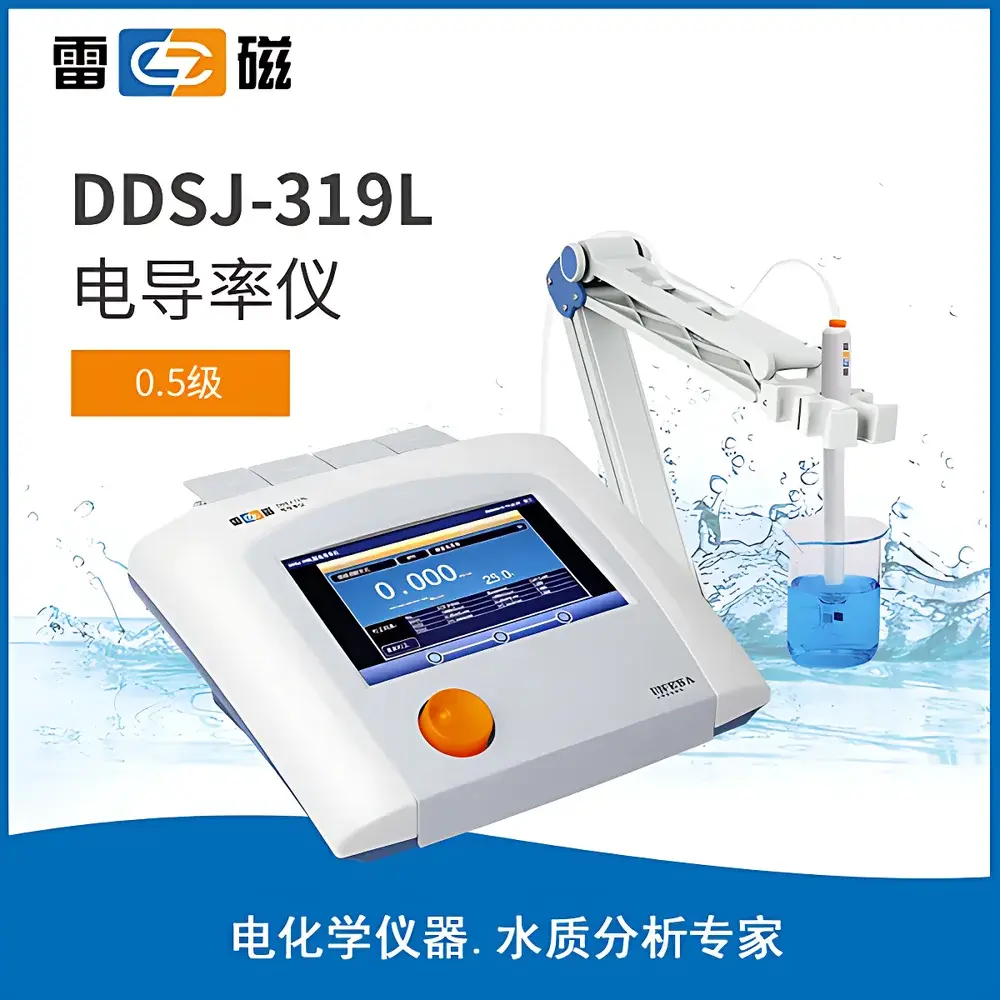
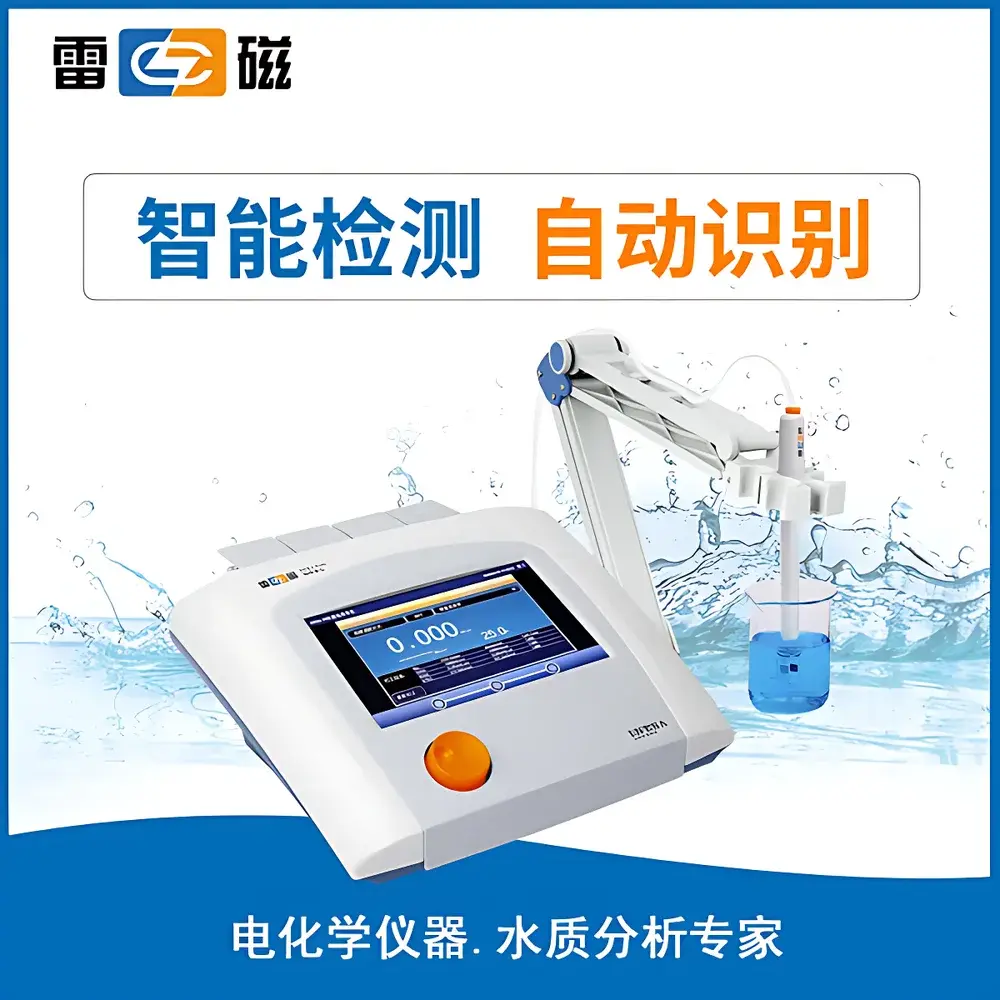
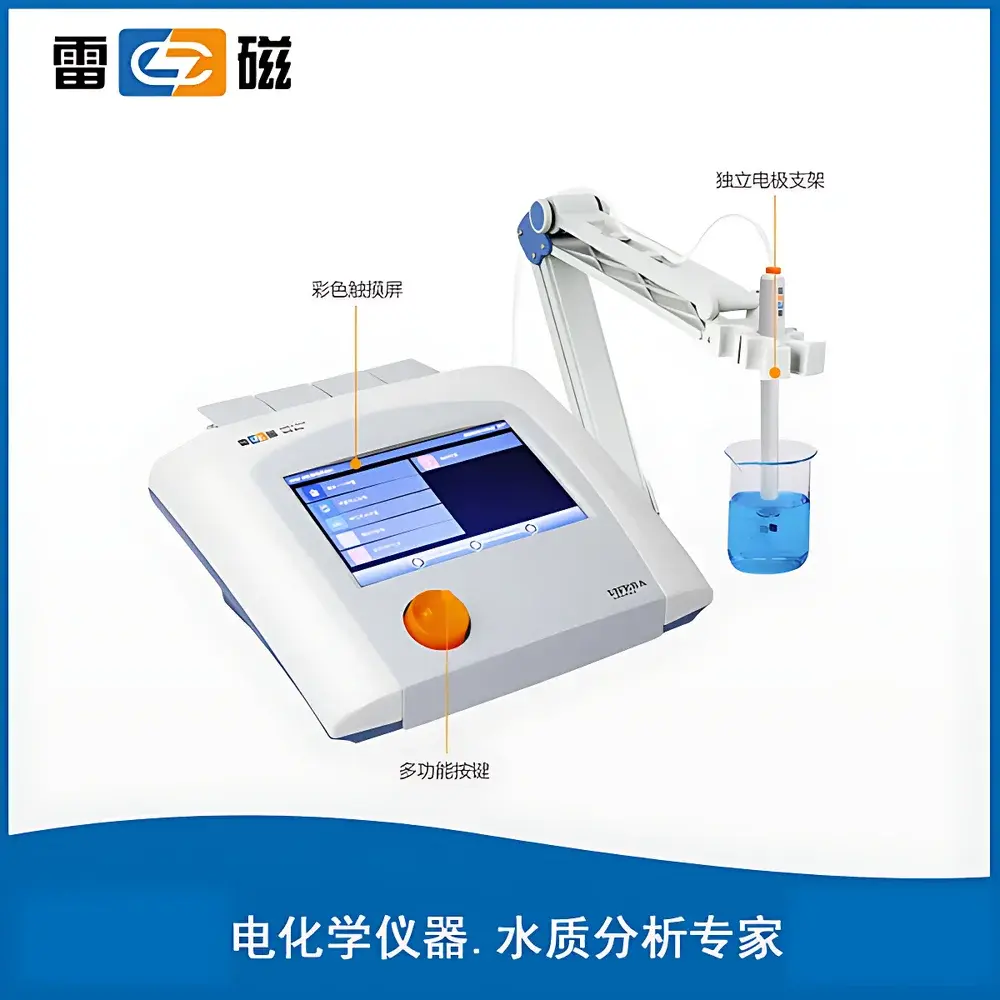
Leici DDSJ-319L Benchtop Conductivity Meter
| Brand | Leici |
|---|---|
| Origin | Shanghai, China |
| Model | DDSJ-319L |
| Instrument Class | 0.5 |
| Conductivity Range | 0.000 µS/cm to 3000 mS/cm |
| TDS Range | 0.000 mg/L to 1000 g/L |
| Resistivity Range | 5.00 Ω·cm to 100.0 MΩ·cm |
| Salinity Range | 0.00–8.00 % |
| Temperature Range | −5.0 to 130.0 °C |
| Accuracy | ±0.5 % FS (conductivity/resistivity/TDS), ±0.1 % FS (salinity), ±0.1 °C (temperature) |
| Minimum Resolution | 0.001 µS/cm (conductivity), 0.01 Ω·cm (resistivity), 0.001 mg/L (TDS), 0.01 % (salinity), 0.1 °C (temperature) |
| Power Supply | 24 VDC, 3 A (adapter input: 100–240 VAC, 1.35 A) |
| Dimensions | 280 × 280 × 130 mm |
| Weight | 2.5 kg |
Overview
The Leici DDSJ-319L is a high-precision benchtop conductivity meter engineered for rigorous laboratory environments where multi-parameter electrochemical analysis—conductivity, resistivity, total dissolved solids (TDS), salinity, and temperature—is required with traceable accuracy and regulatory compliance. Based on four-electrode AC conductivity measurement principles, the instrument eliminates polarization errors and electrode fouling effects common in DC-based systems, enabling stable, reproducible readings across an exceptionally wide dynamic range—from ultrapure water (5.00 Ω·cm) to highly concentrated electrolytes (3000 mS/cm). Its 0.5-class accuracy per GB/T 6682 and ISO 7888 ensures metrological reliability for quality control, environmental monitoring, pharmaceutical water system validation, and academic research applications. The DDSJ-319L operates under a modular firmware architecture that supports method-driven workflows, real-time sensor diagnostics, and automated endpoint detection—critical for GLP-compliant laboratories performing routine water purity testing or process stream characterization.
Key Features
- Intelligent endpoint recognition with configurable reading modes: auto-hold, timed reading, interval sampling, and manual capture
- Automatic temperature compensation (ATC) using integrated Pt1000 thermistor; user-selectable compensation algorithms including linear, non-linear (NaCl curve), and pure-water-specific models
- Auto-identification of standard solutions: preloaded with four GB-standard KCl calibration solutions (e.g., 0.01 mol/L, 0.1 mol/L); supports up to five-point conductivity calibration with editable standard values
- Smart frequency switching: single electrode covers full 0–200 mS/cm range without manual range switching or electrode replacement
- Dual compensation support: configurable conductivity compensation for natural waters (e.g., seawater salinity correction per PSS-78), deionized water (low-conductivity cell constant adjustment), and industrial brines
- Integrated electrode health monitoring: real-time impedance diagnostics and calibration alert system based on electrode resistance drift thresholds
- Modular connectivity: RS-232 and USB ports for PC communication; USB host interface for direct data export to flash drives
Sample Compatibility & Compliance
The DDSJ-319L accommodates standard 2-cell and 4-cell conductivity cells (e.g., DJS-1C, DJS-10C) with interchangeable cell constants (0.01–10 cm⁻¹), supporting aqueous matrices ranging from Type I ultrapure water (≥18.2 MΩ·cm) to saturated salt solutions and aggressive industrial effluents. It complies with national and international standards including GB/T 11018–2021 (conductivity meters), ISO 7888:2019 (water quality — determination of electrical conductivity), ASTM D1125–20 (standard test methods for electrical conductivity of water), and USP (Water Conductivity). All data operations—including calibration logs, measurement records, and user actions—are timestamped and attributed, satisfying GLP data integrity requirements and facilitating FDA 21 CFR Part 11 readiness when paired with validated software environments.
Software & Data Management
- Onboard storage for up to 1000 complete measurement sets, each containing conductivity, TDS, resistivity, salinity, temperature, date/time stamp, operator ID, and electrode serial number
- Comprehensive data review: sorting by parameter, date range, or method ID; statistical functions (mean, SD, RSD, min/max) with histogram visualization
- Method management: save and recall up to 20 user-defined test protocols, including preferred units, compensation models, auto-read settings, and report templates
- Electrode lifecycle tracking: automatic logging of calibration history, usage hours, and performance degradation trends
- Export formats: CSV and TXT files compatible with LIMS integration, Excel analysis, and audit-ready PDF reports (via optional PC software)
- User access control: three-tier permission structure (Operator, Supervisor, Administrator) with password protection and audit trail generation
Applications
The DDSJ-319L serves as a core analytical platform in diverse regulated and research-intensive settings: validation of purified water (PW) and water-for-injection (WFI) systems per pharmacopeial monographs; monitoring of boiler feedwater and condensate in power generation; characterization of wastewater treatment influent/effluent streams; quality assurance of food-grade brines and beverage concentrates; electroplating bath conductivity control; and teaching laboratories conducting fundamental electrochemistry experiments. Its broad dynamic range and intelligent compensation models make it particularly suitable for comparative studies involving mixed-salt solutions, geothermal fluids, and membrane filtration permeates where conventional two-range meters require frequent recalibration or sensor swaps.
FAQ
Does the DDSJ-319L support FDA 21 CFR Part 11 compliance?
The instrument provides foundational audit-trail capabilities (user login, timestamped events, immutable records) but requires validated third-party software and procedural controls to achieve full Part 11 compliance in regulated GxP environments.
Can the DDSJ-319L be used for seawater analysis?
Yes—it includes PSS-78 seawater salinity compensation and supports conductivity-to-salinity conversion per UNESCO algorithms, with accuracy validated for salinities up to 8.00 %.
What types of conductivity cells are compatible?
Standard DIN/ISO-compliant 2-electrode and 4-electrode cells with BNC or mini-DIN connectors and cell constants from 0.01 cm⁻¹ to 10 cm⁻¹ (e.g., Leici DJS-1C, DJS-10C, or equivalent OEM cells).
Is automatic calibration possible with external hardware?
Yes—the instrument supports RS-232 communication with Leici-compatible automatic samplers and calibration stations for unattended multi-point calibration and batch sample analysis.
How is temperature measurement performed?
Using a built-in Pt1000 RTD sensor with ±0.1 °C accuracy; optional external temperature probes (e.g., Pt100 immersion sensors) can be connected for process-coupled measurements.





