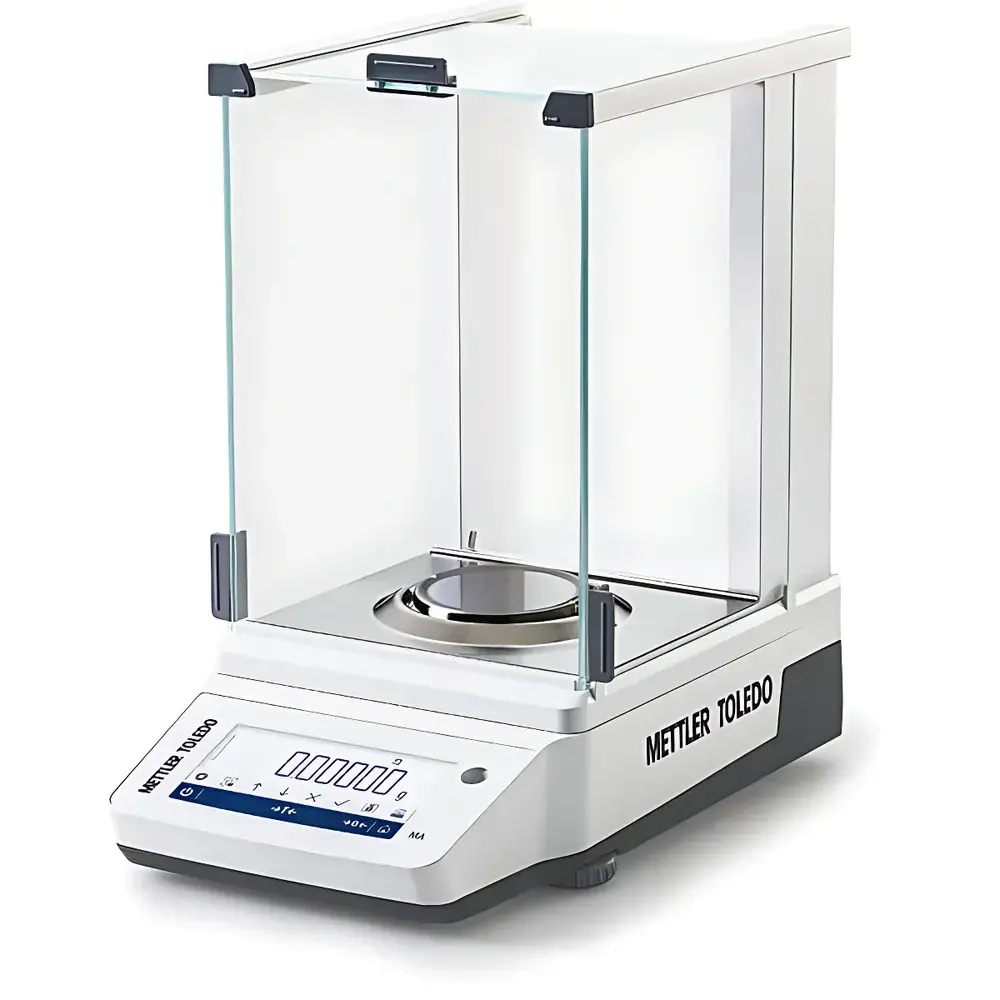
METTLER TOLEDO MA104/A Analytical Balance with Internal Calibration, 120 g Capacity, 0.1 mg Readability
| Brand | METTLER TOLEDO |
|---|---|
| Origin | Shanghai, China |
| Model | MA104/A |
| Instrument Type | Analytical Balance |
| Maximum Capacity | 120 g |
| Readability | 0.1 mg |
| Calibration Method | Internal |
| Repeatability (typ.) | 0.08 mg |
| Minimum Weight (U=1%, k=2, typ.) | 16 mg |
| Stabilization Time | 2 s |
| Weighing Pan Diameter | 90 mm |
| Dimensions (H×W×D) | 354 mm × 209 mm × 354 mm |
| Interface | RS232, USB-A, Bluetooth (optional) |
| Display | LCD hybrid touchscreen |
| Compliance | USP Chapter 41/1251, OIML R76, NIST Handbook 44, GLP/GMP-ready |
Overview
The METTLER TOLEDO MA104/A is a high-precision analytical balance engineered for routine laboratory weighing tasks requiring traceable accuracy and operational reliability. Designed according to the fundamental principles of electromagnetic force compensation (EMFC), it delivers stable, drift-resistant measurements by dynamically balancing the gravitational force on the sample against a precisely controlled electromagnetic counterforce. With a maximum capacity of 120 g and readability of 0.1 mg (100 µg), the MA104/A meets the performance criteria for Class I analytical balances per OIML R76 and satisfies the minimum weight requirements defined in USP and when operated under validated environmental conditions. Its robust mechanical architecture—featuring a die-cast aluminum base, stainless-steel weighing pan, and chemically resistant housing—ensures long-term stability in QC labs, pharmaceutical production environments, and academic research settings where exposure to solvents, acids, or bases is common.
Key Features
- Internal calibration system with motor-driven internal test weights, eliminating manual intervention and reducing calibration-induced uncertainty
- Hybrid LCD touchscreen interface with intuitive icon-based navigation and guided application workflows (e.g., formulation, percentage, density, statistics)
- Dual communication interfaces: RS232 for legacy lab equipment integration and USB-A for direct data export to PCs or flash drives without driver installation
- GLP/GMP-compliant functionality including user-level password protection, audit trail logging (when connected to METTLER TOLEDO LabX software), and configurable electronic signatures
- Automatic leveling assistance via integrated bubble level and adjustable feet; optimized mechanical damping for rapid stabilization (≤2 s typical)
- Compliance-ready design: certified to OIML R76-1 (2017), NIST Handbook 44 (2023), and EU Measuring Instruments Directive (MID) Annex MI-001 for trade-related applications
Sample Compatibility & Compliance
The MA104/A accommodates standard laboratory vessels—including weighing boats, crucibles, and volumetric flasks—within its 90 mm diameter stainless-steel pan. Its low-profile pan geometry minimizes air-current interference during micro-weighing, while the sealed electronics compartment prevents ingress of particulates or vapors. The balance is qualified for use in regulated environments: it supports 21 CFR Part 11 compliance when paired with LabX software (requiring role-based access control, electronic signature enforcement, and immutable audit trails). All factory calibrations are traceable to national standards (NIM, China) and include documented uncertainty budgets per ISO/IEC 17025 requirements. Minimum weight verification (16 mg at U = 1%, k = 2) is pre-validated and documented in the instrument’s Certificate of Conformance.
Software & Data Management
While the MA104/A operates autonomously via its embedded firmware, full data integrity and regulatory compliance are achieved through optional integration with METTLER TOLEDO LabX™ software. LabX enables centralized method management, automated report generation (PDF/CSV), real-time statistical process monitoring (SPC), and secure cloud synchronization. Raw weighing data—including timestamps, operator IDs, environmental metadata (if external sensors are connected), and calibration history—is stored with cryptographic hashing to prevent tampering. USB-A port supports plug-and-play export of unprocessed measurement logs directly to spreadsheet applications, satisfying internal QA documentation needs without software dependency.
Applications
- Pharmaceutical quality control: active pharmaceutical ingredient (API) assay, reference standard preparation, and dissolution testing sample quantification
- Chemical synthesis: stoichiometric reagent dispensing, catalyst loading, and reaction yield calculation
- Materials science: powder density determination, coating thickness validation via mass-thickness correlation
- Food & beverage testing: moisture content analysis (per AOAC 950.46), ash residue quantification, and nutritional labeling compliance
- Environmental labs: filter weighing for PM2.5/PM10 gravimetric analysis (EPA Method IO-4.2 compliant setup)
- Educational laboratories: teaching fundamental metrology concepts including uncertainty propagation, repeatability assessment, and calibration hierarchy
FAQ
Is the MA104/A suitable for USP compliance verification?
Yes—the balance achieves a typical minimum weight of 16 mg at U = 1% (k = 2), well below the 160 mg threshold specified for 0.1% tolerance under USP . Full verification requires documented environmental monitoring and periodic performance checks.
Does internal calibration satisfy ISO/IEC 17025 accreditation requirements?
Internal calibration alone does not replace accredited external calibration. However, it serves as an effective intermediate verification tool between formal calibrations performed by ISO/IEC 17025-accredited providers.
Can the MA104/A be connected to LIMS systems?
Yes—via RS232 or USB virtual COM port, enabling seamless ASCII-based data streaming into LIMS platforms supporting ASTM E1382 or custom delimiter protocols.
What is the recommended recalibration frequency?
Per ISO 17025 and manufacturer guidance, recalibration should occur at least daily before first use, after relocation, following significant temperature fluctuations (>5 °C), or after any event affecting mechanical integrity.
Is Bluetooth connectivity standard or optional?
Bluetooth is an optional module (order code: MA104/A-BT); it enables wireless connection to METTLER TOLEDO’s SmartView app for remote status monitoring and basic data review—not for full method execution or audit-trail capture.