
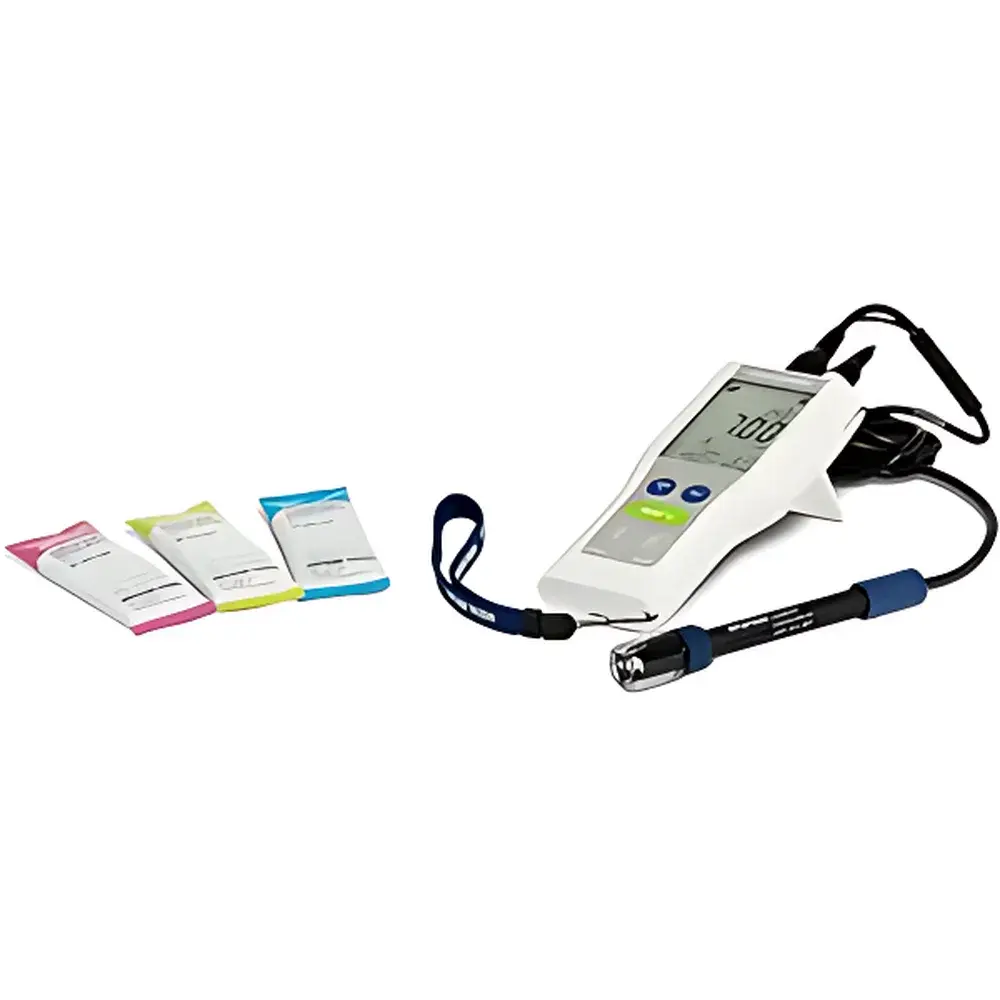
METTLER TOLEDO FiveGo F2-Standard Portable pH/mV Meter
| Brand | METTLER TOLEDO |
|---|---|
| Origin | Shanghai, China |
| Model | F2-Standard |
| Instrument Type | Portable |
| Parameters Measured | pH and mV (single-channel) |
| pH Range | 0–14 |
| pH Resolution | 0.01 |
| pH Accuracy | ±0.01 |
| mV Range | −1999.000 to +1999.000 |
| mV Resolution | 1 |
| mV Accuracy | ±1 |
| Temperature Range | 0–100 °C |
| Temperature Resolution | 0.1 °C |
| Temperature Accuracy | ±0.5 °C |
| Display | 3.1-inch segmented monochrome LCD |
| Dimensions | 188 × 77 × 33 mm |
| Weight | 260 g |
| Protection Rating | IP67 |
| Sensor Interface | BNC and Cinch/RCA |
| ISM Compatibility | No |
| Data Storage | 200 measurements |
| Included Sensor | LE438 pH electrode |
Overview
The METTLER TOLEDO FiveGo F2-Standard is a rigorously engineered portable pH/mV meter designed for field-based and routine laboratory applications where reliability, ease of use, and environmental resilience are critical. Built upon electrochemical potentiometric measurement principles, the instrument determines hydrogen ion activity via a glass pH electrode (e.g., LE438) coupled with a reference system, delivering stable, reproducible readings across the full aqueous pH scale (0–14). Its single-channel architecture supports simultaneous pH and redox potential (mV) measurements without cross-interference, enabling both direct acidity assessment and oxidation-reduction status evaluation in water, soil extracts, food matrices, and industrial process streams. The F2-Standard complies with core metrological requirements outlined in ISO 7888 (water quality — determination of pH), ASTM D1293 (standard test method for pH of water), and supports GLP-aligned documentation through its integrated data logging capability.
Key Features
- IP67-rated enclosure ensures full protection against dust ingress and immersion in water up to 1 m for 30 minutes — validated for operation in humid laboratories, outdoor sampling sites, and industrial washdown environments.
- Ergonomic, one-handed operation enabled by tactile button layout, low-profile housing (188 × 77 × 33 mm), and foldable stand for stable benchtop positioning and optimal viewing angle.
- High-contrast 3.1-inch segmented monochrome LCD display with large numerals and intuitive iconography minimizes reading errors under variable lighting conditions.
- Calibration flexibility: supports 1-, 2-, or 3-point pH calibration using standard buffers (e.g., pH 4.01, 7.00, 10.01) with automatic buffer recognition and slope/offset diagnostics.
- Temperature compensation via integrated Pt1000 sensor or manual entry; automatic ATC ensures accurate pH values across 0–100 °C sample temperature range.
- Non-volatile memory stores up to 200 timestamped measurements, including pH, mV, temperature, date/time, and calibration history — exportable via optional PC interface (not included).
Sample Compatibility & Compliance
The F2-Standard is optimized for aqueous and mildly aggressive liquid samples, including drinking water, wastewater effluents, agricultural runoff, beverage formulations, and pharmaceutical rinse solutions. It accommodates standard BNC and Cinch/RCA connectors, ensuring compatibility with METTLER TOLEDO’s LE438 universal pH electrode — a robust gel-filled, double-junction sensor with low-maintenance design and rapid response time (<15 s to 95% stability). While not ISM-enabled, the device meets essential regulatory expectations for traceability: each measurement retains embedded metadata (calibration ID, operator tag if entered manually, ambient temperature), supporting audit readiness under ISO/IEC 17025 and FDA 21 CFR Part 11 (when paired with compliant data transfer software and access controls). It is CE-marked and conforms to IEC 61010-1 safety standards for electrical equipment used in measurement, control, and laboratory applications.
Software & Data Management
Data retrieval from the F2-Standard is performed via USB-to-serial adapter (sold separately) and METTLER TOLEDO’s free LabX Lite software or third-party terminal emulators supporting ASCII protocol. The instrument outputs comma-separated values (CSV) containing measurement ID, pH/mV value, temperature, calibration status, and timestamp. While it lacks real-time wireless transmission or cloud synchronization, its local storage architecture ensures data integrity during offline field deployments. All stored entries are immutable until cleared manually — preventing accidental overwrites and preserving raw measurement provenance. For regulated environments, users may implement supplementary procedural controls (e.g., dual-operator verification, handwritten logbook cross-reference) to satisfy ALCOA+ data governance criteria (Attributable, Legible, Contemporaneous, Original, Accurate).
Applications
- Environmental monitoring: On-site pH screening of surface water, groundwater, and leachate per EPA Method 150.1 and EU Directive 2000/60/EC.
- Food & beverage QC: Batch verification of brine solutions, dairy products, fruit juices, and fermentation broths prior to release.
- Education & training: Undergraduate chemistry labs requiring rugged, intuitive instrumentation for teaching acid-base theory and electrode fundamentals.
- Industrial maintenance: Routine checks of cooling tower water, boiler feedwater, and cleaning-in-place (CIP) rinse efficacy.
- Agricultural extension: Soil extract analysis (1:1 or 1:5 suspension) for lime requirement estimation and nutrient availability assessment.
FAQ
Does the F2-Standard support automatic temperature compensation (ATC)?
Yes — it accepts input from an integrated Pt1000 sensor or external temperature probe (via Cinch connector) and applies Nernstian correction in real time.
Can I use non-METTLER TOLEDO electrodes with this meter?
Yes, provided they feature standard BNC or Cinch/RCA output and operate within the instrument’s input impedance and voltage range (±2000 mV).
Is GLP-compliant calibration reporting available?
Calibration parameters (slope, offset, buffer IDs, date/time) are stored with each measurement batch. Full GLP compliance requires external documentation practices and controlled software for report generation.
What is the battery life under typical usage?
With alkaline AA batteries, continuous operation lasts approximately 2,000 hours; auto-off after 15 minutes of inactivity extends service life significantly.
How often should the LE438 electrode be recalibrated?
Recalibration is recommended before each measurement session, after electrode cleaning, or when drift exceeds ±0.02 pH between known standards — frequency depends on sample matrix and required uncertainty budget.




