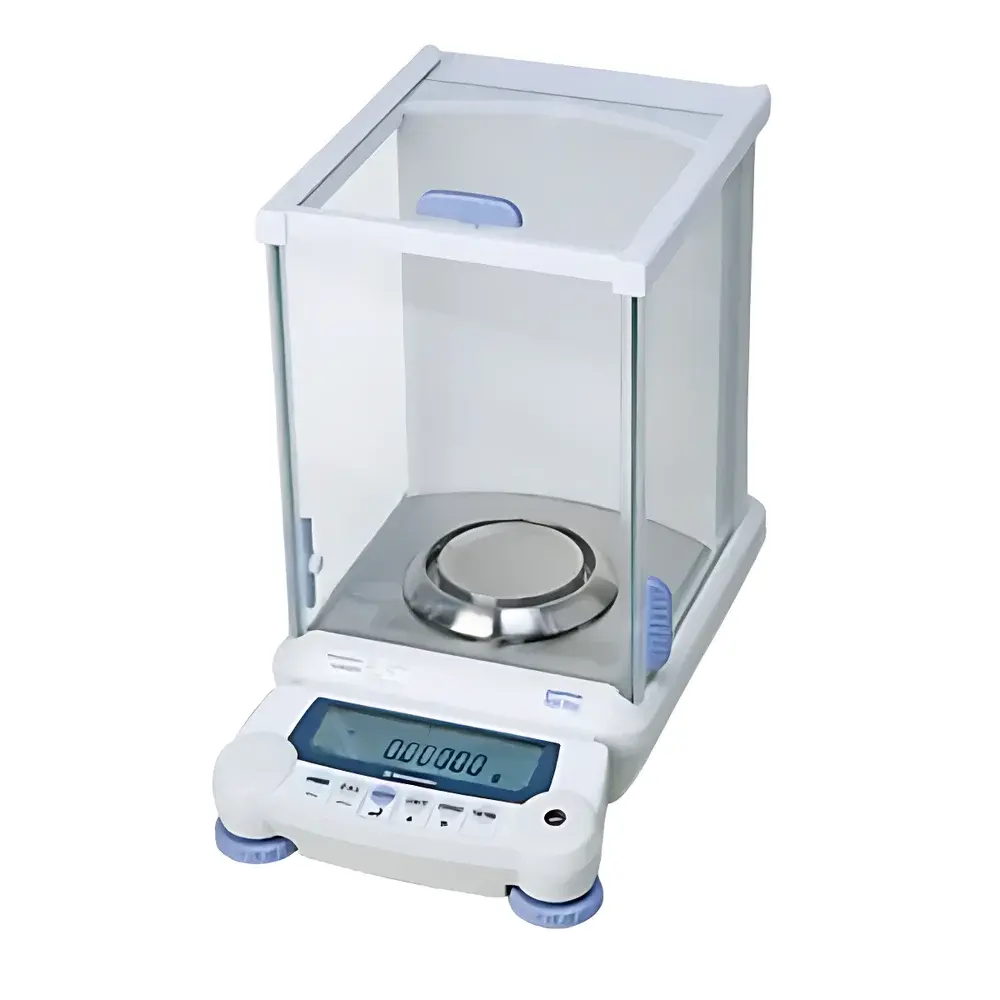
Shimadzu AUY220 Analytical Balance (220 g / 0.1 mg)
| Brand | Shimadzu |
|---|---|
| Origin | Japan |
| Model | AUY220 |
| Maximum Capacity | 220 g |
| Readability | 0.1 mg |
| Repeatability | 0.1 mg |
| Linearity | ±0.2 mg |
| Average Response Time | ≤0.2 s |
| Pan Size | 380 mm × 380 mm |
| Calibration | Internal motorized calibration (PSC) |
| Compliance | GLP/GMP/ISO-compliant calibration logging |
| Interface | RS-232, USB, Windows Direct Data Transfer |
Overview
The Shimadzu AUY220 Analytical Balance is a high-precision, single-range laboratory balance engineered for demanding quantitative analysis in regulated and research-intensive environments. Utilizing Shimadzu’s proprietary Unibloc monolithic electromagnetic force restoration sensor architecture, the AUY220 delivers exceptional stability, rapid stabilization (<0.2 seconds), and long-term measurement integrity under variable thermal and mechanical conditions. Designed to meet the metrological requirements of ISO 9001, ISO/IEC 17025, and pharmacopeial standards (USP , EP 2.1.6), this 0.1 mg readability balance operates at a nominal capacity of 220 g with linearity error limited to ±0.2 mg across its full range. Its robust aluminum alloy housing, draft shield-compatible design (optional), and anti-static STABLO-EX integrated static eliminator ensure consistent performance in low-humidity laboratories—critical for accurate weighing of hygroscopic, electrostatic-prone, or micro-dosed samples.
Key Features
- Unibloc single-piece electromagnetic sensor: Eliminates mechanical hysteresis and drift; enables sub-millisecond response and superior long-term repeatability (≤0.1 mg standard deviation over 10 consecutive weighings).
- Programmable internal calibration (PSC): Automatic temperature-triggered recalibration maintains traceable accuracy without manual intervention; eliminates drift-induced bias during extended operation.
- GLP/GMP-compliant data logging: Timestamped calibration records—including date, time, operator ID (via optional keypad or PC integration), and calibration weight value—are stored onboard and exportable via RS-232 or USB.
- Windows Direct Data Transfer: Native ASCII output protocol allows real-time transmission of weight values directly into Excel, LIMS, or ELN platforms—no proprietary driver or middleware required.
- Integrated STABLO-EX electrostatic neutralizer: Actively dissipates surface charge on samples and containers, reducing weighing errors caused by electrostatic attraction—particularly critical for powders, polymers, and pharmaceutical APIs.
- Large 380 mm × 380 mm stainless-steel weighing pan: Optimized for volumetric glassware, crucibles, and multi-sample trays; compatible with optional draft shields meeting ISO 17025 environmental control guidelines.
Sample Compatibility & Compliance
The AUY220 supports diverse sample forms—including solids, granules, lyophilized powders, filter papers, and small-volume liquid containers—across industries subject to stringent regulatory oversight. Its design conforms to ISO 17025 clause 6.4.1 (equipment suitability), USP (balance performance verification), and ASTM E898–22 (laboratory balance specification). All calibration events comply with FDA 21 CFR Part 11 requirements when paired with validated data acquisition software (e.g., Shimadzu LabSolutions or third-party LIMS with audit trail functionality). The unit undergoes factory certification per JIS B 7721 and includes an individual calibration certificate traceable to NMIJ (National Metrology Institute of Japan).
Software & Data Management
Data output is standardized to ASCII format via RS-232 (DB9) and USB virtual COM port interfaces. The balance supports configurable delimiters (TAB, CR/LF), auto-print triggers (on stable reading), and prefix/suffix identifiers for batch or sample tagging. When connected to Windows OS, it functions as a HID-compliant device enabling seamless copy-paste into spreadsheets or databases. For enterprise integration, Shimadzu provides SDK documentation for custom API development and supports OPC UA connectivity through optional gateway modules. Audit trails—including calibration history, zero tracking, and overload events—are retained for ≥10,000 entries and exportable as CSV or PDF.
Applications
- Pharmaceutical QC/QA: Active ingredient quantification, reference standard preparation, and dissolution tablet mass verification per ICH Q5C and USP .
- Environmental testing labs: Filter weighing for TSS, PM2.5/PM10 gravimetric analysis (EPA Method 160.1, ISO 12141).
- Materials science R&D: Catalyst loading precision, polymer additive dosing, and nanomaterial dispersion mass control.
- Food & cosmetics: Nutrient fortification verification, preservative concentration checks, and fragrance oil blending accuracy.
- Academic research: Stoichiometric reagent preparation, crystallization yield determination, and isotope-labeled compound handling.
FAQ
What is the difference between PSC and Clock-CAL calibration modes?
PSC (Predictive Self-Calibration) activates automatically upon detection of ambient temperature change ≥1°C, ensuring continuous metrological validity. Clock-CAL (available only on AUW series) executes scheduled calibrations at user-defined times—suitable for unattended overnight operation.
Does the AUY220 support external calibration weights?
Yes—manual external calibration is supported using Class E2 or better certified weights; however, internal PSC is recommended for routine use to minimize operator error and contamination risk.
Can the balance be integrated into a 21 CFR Part 11-compliant workflow?
Yes—when used with validated software that enforces electronic signatures, audit trails, and role-based access control, the AUY220’s timestamped calibration logs and raw data output satisfy Part 11 record retention and integrity requirements.
Is the STABLO-EX static eliminator optional or built-in?
STABLO-EX is fully integrated into the AUY220’s base unit and requires no external power source or accessories—it operates continuously during weighing cycles.
What environmental conditions are recommended for optimal performance?
Operate within 15–30°C ambient temperature, ≤60% RH (non-condensing), and on a vibration-isolated granite or Sorbothane platform. Avoid direct airflow from HVAC vents or windows to prevent draft-induced instability.