
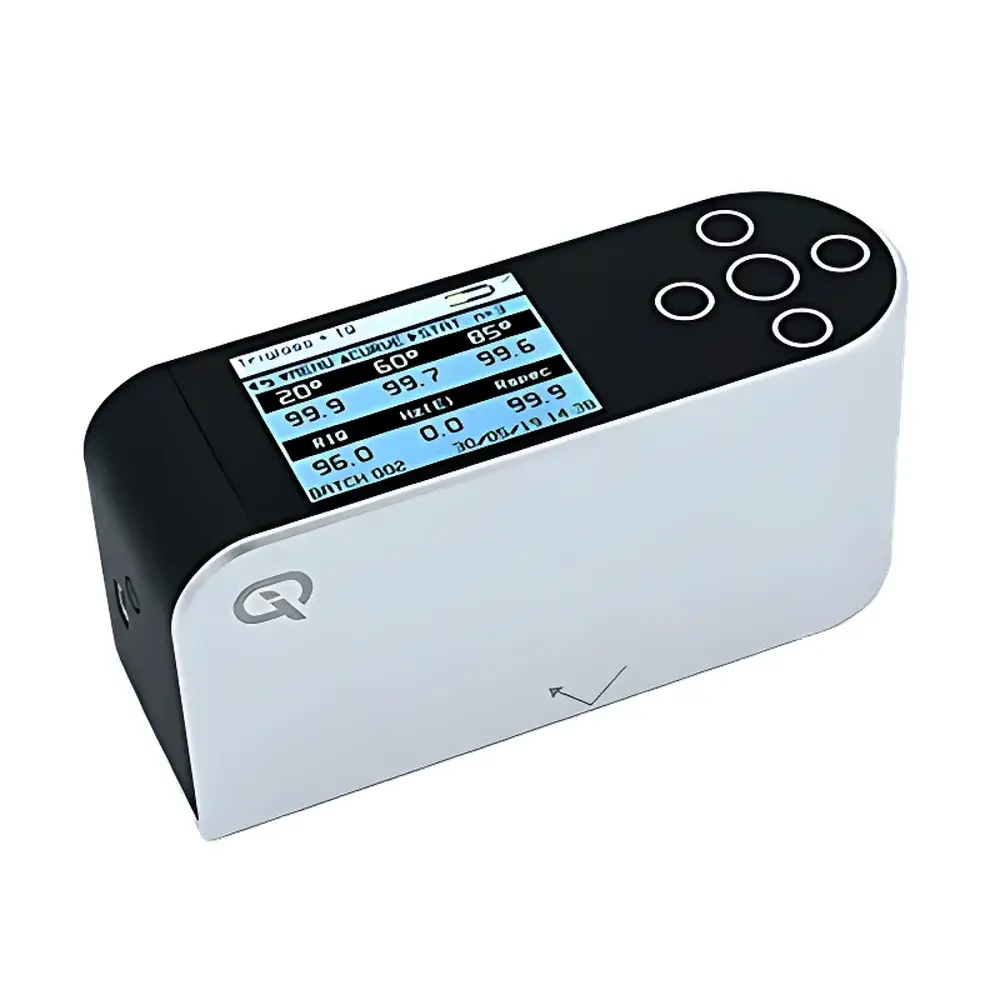
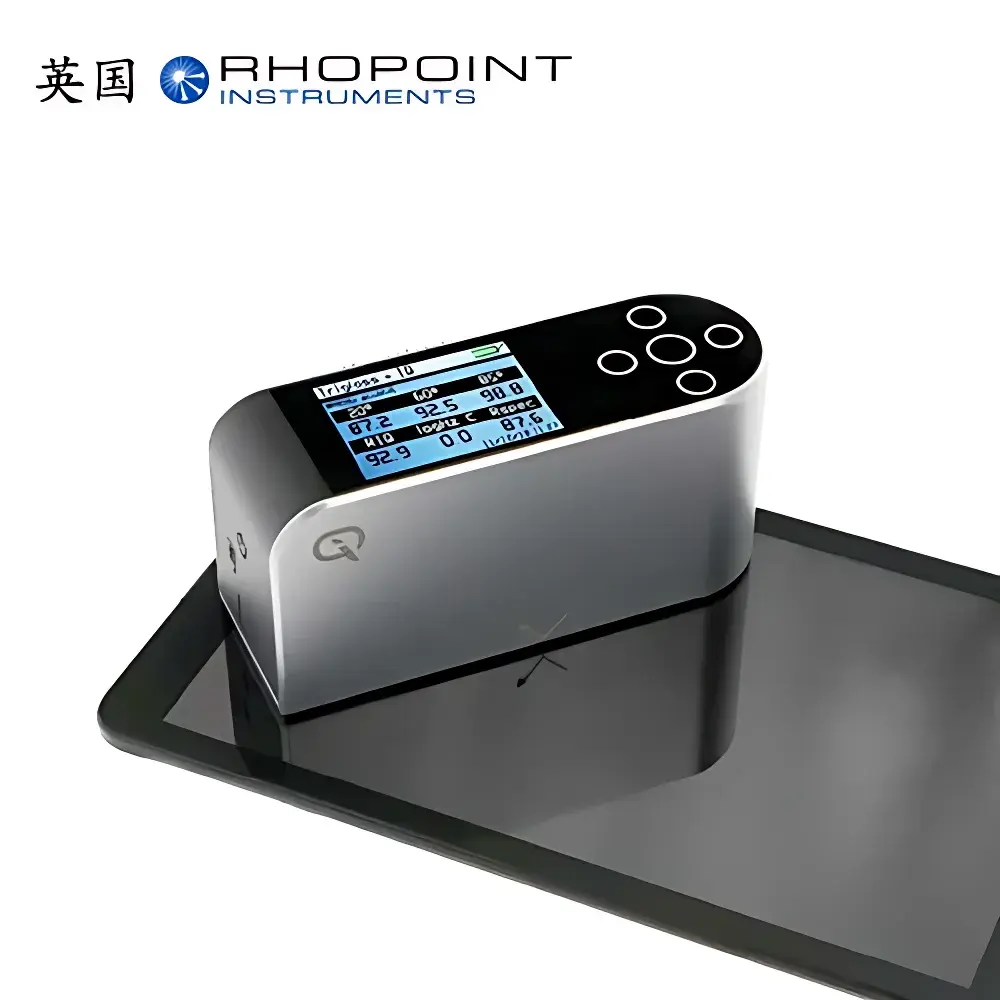
Rhopoint IQ20/60/85 Advanced Surface Quality Analyzer
| Brand | Rhopoint |
|---|---|
| Origin | United Kingdom |
| Model | IQ20/60/85 |
| Gloss Angles | 20°, 60°, 85° |
| Gloss Range | 0–100 GU and 100–2000 GU |
| Gloss Resolution | 0.1 GU |
| Gloss Repeatability | ±0.2 GU or ±0.2% |
| Gloss Reproducibility | ±0.5 GU or ±0.5% |
| Haze Range | 0–30 HU (LogHU optional) |
| Haze Resolution | 0.1 HU |
| Haze Repeatability | ±0.5 HU |
| Haze Reproducibility | ±1.5 HU |
| DOI (Distinctness of Image) Range | 0–100 |
| DOI Resolution | 0.1 |
| DOI Repeatability | ±0.2 |
| DOI Reproducibility | ±0.5 |
| Transmittance Range | 0–100% |
| Transmittance Repeatability | ±0.1% |
| Power | Rechargeable Li-ion battery (17+ hours runtime, 20,000+ measurements) |
| Data Storage | 8 MB internal memory (>999 readings with user-defined labels) |
| Interface | Full-color capacitive touchscreen, USB-C connectivity, no driver installation required |
| Compliance | ISO 2813, ASTM D523, ASTM D2457, DIN 67530, JIS Z8741 (gloss) |
Overview
The Rhopoint IQ20/60/85 Advanced Surface Quality Analyzer is a handheld, multi-angle optical metrology instrument engineered for comprehensive assessment of surface appearance in industrial R&D, QC, and production environments. Unlike conventional glossmeters that quantify only specular reflectance intensity at fixed angles, the IQ20/60/85 integrates simultaneous measurement of gloss (at 20°, 60°, and 85°), haze (measured in the near-specular zone: 18–19° and 21–22°), distinctness of image (DOI), peak reflectance, and transmittance — enabling quantitative correlation between microstructural surface features and macroscopic visual perception. Its optical architecture employs a stabilized tungsten-halogen source, precision-aperture collimation optics, and dual-channel photodetector arrays optimized for high signal-to-noise ratio across all measurement modes. The device operates on the principle of angular-resolved reflectance analysis, where deviations from ideal mirror-like reflection — caused by subsurface scattering, topographical roughness, or coating heterogeneity — are resolved into independent, traceable metrics aligned with international standards.
Key Features
- Triple-angle gloss measurement (20°, 60°, 85°) with automatic angle selection and seamless switching between high-gloss (20°), general-purpose (60°), and low-gloss/ultra-matte (85°) configurations
- Simultaneous haze quantification per ASTM E430 and ISO 13803 using controlled off-specular detection zones (±1.5° from nominal angle), with selectable units (HU or LogHU)
- DOI measurement per ASTM D5767, resolving surface imaging fidelity via edge contrast analysis of standardized test patterns
- Integrated transmittance mode for transparent and translucent substrates (e.g., films, lenses, coated glass), compliant with ISO 13468-1
- Full-color capacitive touchscreen with six adjustable brightness levels, intuitive icon-driven navigation, and real-time graphical display of gloss curves and statistical overlays
- Onboard statistical engine computing min/max/mean/standard deviation for all parameters across user-defined batches
- Automatic self-calibration using integrated reference standards; no external calibration tiles required for routine operation
- Rechargeable lithium-ion battery supporting >17 hours of continuous use and >20,000 measurements per charge cycle
- 8 MB non-volatile memory storing >999 readings with customizable sample IDs, timestamps, and operator tags
Sample Compatibility & Compliance
The IQ20/60/85 accommodates flat, curved, textured, and flexible substrates ranging from rigid metal panels and automotive body parts to thin polymer films, powder-coated extrusions, and printed packaging. Its compact footprint (65 × 140 × 50 mm) and ergonomic design enable stable single-hand operation on vertical, overhead, or contoured surfaces. All measurement algorithms adhere strictly to internationally recognized protocols: gloss per ISO 2813 and ASTM D523; haze per ASTM E430 and ISO 13803; DOI per ASTM D5767; and transmittance per ISO 13468-1. Each unit ships with a UKAS-accredited ISO/IEC 17025 calibration certificate, ensuring metrological traceability to NPL (National Physical Laboratory, UK). The instrument supports GLP-compliant data integrity through timestamped, tamper-evident readouts and audit-ready export logs.
Software & Data Management
Data acquisition and reporting are streamlined via native USB-C connectivity — no proprietary drivers or software installation required. Readings export directly as CSV or Excel-compatible files, preserving metadata (angle, date/time, operator ID, batch tag). Optional Novo-Gloss software (included on supplied USB drive) enables advanced trend analysis, SPC charting, multi-instrument comparison, and PDF report generation with embedded pass/fail thresholds. Bluetooth-enabled mobile app integration (iOS/Android) permits remote configuration and live dashboard viewing. All firmware updates are delivered via secure web portal, maintaining compliance with evolving regulatory expectations including FDA 21 CFR Part 11 for electronic records in regulated manufacturing.
Applications
The IQ20/60/85 serves as a critical quality gate in sectors where surface aesthetics directly impact brand perception and functional performance. Paint and coil coating manufacturers deploy it to validate batch-to-batch consistency of metallic effect pigments and clearcoat flow behavior. Automotive OEMs and Tier-1 suppliers apply it during paint shop audits to correlate DOI values with perceived “depth” and “sharpness” of finish. Plastics processors use haze and transmittance data to qualify optical films for displays and lighting applications. Ink formulators rely on 85° gloss and haze synergy to optimize matte varnish formulations for packaging. Additional users include yacht builders assessing gelcoat uniformity, furniture manufacturers evaluating wood stain clarity, and additive manufacturers qualifying anti-fog agents for medical devices.
FAQ
What standards does the IQ20/60/85 comply with for gloss measurement?
It conforms to ISO 2813, ASTM D523, ASTM D2457, DIN 67530, and JIS Z8741 across all three angles.
Can the instrument measure both opaque and transparent materials?
Yes — gloss and DOI on opaque surfaces; haze, transmittance, and gloss on transparent/translucent substrates such as PET film or acrylic sheets.
Is the calibration certificate traceable to national standards?
Yes — each unit includes a UKAS-accredited ISO/IEC 17025 calibration certificate, traceable to the National Physical Laboratory (NPL), UK.
How is data security maintained during transfer and storage?
All stored readings include immutable timestamps and user-assigned identifiers; exported files retain full metadata and support cryptographic hashing for audit verification.
Does the device support statistical process control (SPC) workflows?
Yes — onboard statistics (mean, SD, min/max) and Novo-Gloss software enable real-time SPC charting, control limit definition, and automated out-of-spec alerts.



