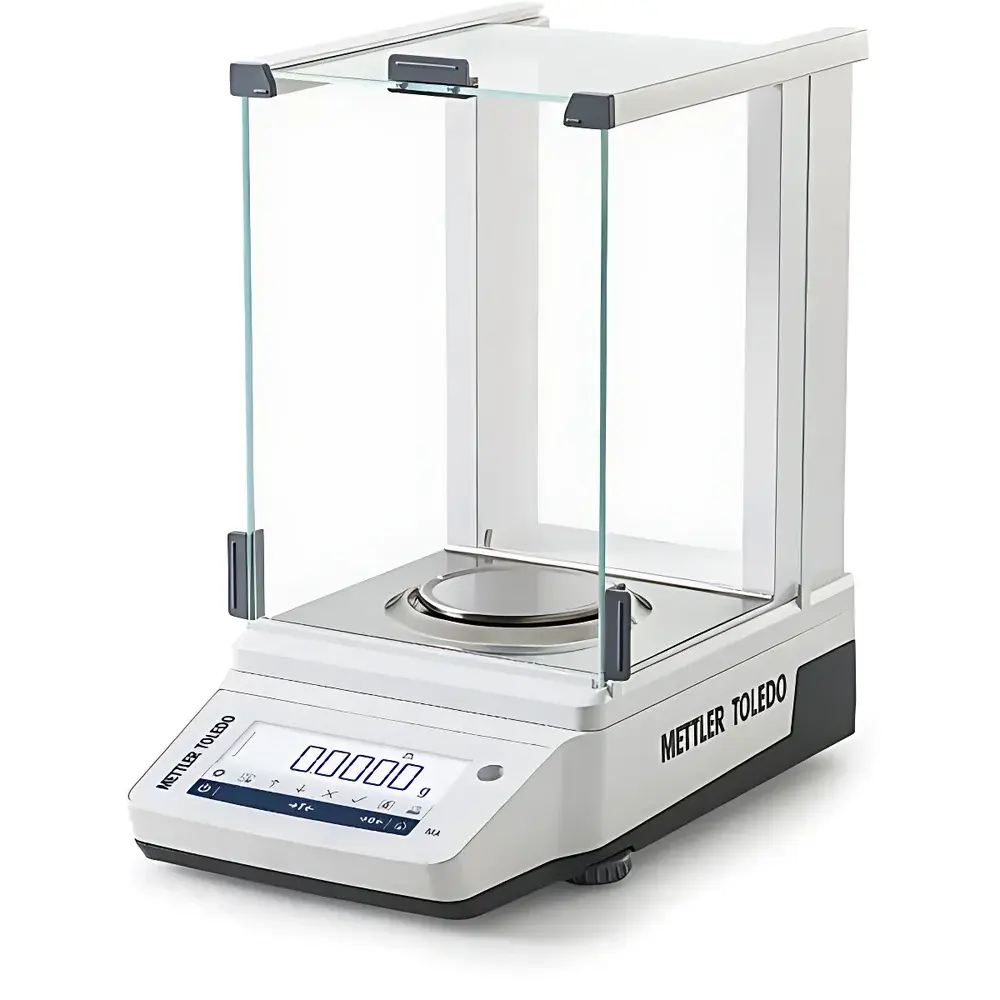
METTLER TOLEDO MA104E/A Analytical Balance
| Brand | METTLER TOLEDO |
|---|---|
| Origin | Shanghai, China |
| Model | MA104E/A |
| Instrument Type | Analytical Balance |
| Maximum Capacity | 120 g |
| Readability | 0.1 mg |
| Repeatability (typical) | 0.08 mg |
| Minimum Weight (U=1%, k=2, typical) | 16 mg |
| Stabilization Time | 2 s |
| Calibration | External |
| Interface | RS232, USB-A, Bluetooth (optional) |
| Display | LCD hybrid touch screen |
| Pan Diameter | 90 mm |
| Dimensions (H×W×D) | 354 mm × 209 mm × 354 mm |
| Certified Readability | 1 mg |
| Compliance | USP Chapter 41/1251, OIML R76, NIST Handbook 44, trade settlement approved |
Overview
The METTLER TOLEDO MA104E/A Analytical Balance is a high-precision, entry-level analytical balance engineered for routine laboratory weighing tasks requiring accuracy at the 0.1 mg readability level. Built upon METTLER TOLEDO’s proven electromagnetic force compensation (EMFC) transduction principle, it delivers stable, drift-resistant measurements under standard environmental conditions (20–25 °C, ≤60% RH, minimal air currents). Designed for laboratories performing QC checks, sample preparation, reagent dispensing, and formulation work, the MA104E/A integrates robust mechanical architecture with intuitive human-machine interaction—ensuring consistent performance across shifts and operators. Its certified 1 mg readability for trade settlement applications confirms compliance with national metrological regulations, while its 120 g maximum capacity and 16 mg minimum weight (per USP at k=2, U=1%) support reliable quantification of small-mass samples in pharmaceutical, chemical, and academic settings.
Key Features
- Electromagnetic force compensation (EMFC) sensor technology ensuring long-term stability and low drift over time
- Hybrid LCD touch screen with responsive interface and context-sensitive soft keys for rapid navigation
- Integrated leveling assistance system with visual tilt indicator and adjustable feet for fast, repeatable setup
- Chemically resistant stainless-steel weighing pan (Ø90 mm) and reinforced polymer housing rated for exposure to common solvents and mild acids
- Dual communication interfaces: RS232 for legacy printer or PC integration and USB-A for direct connection to Windows-based systems and data export
- User access control with configurable password protection supporting multi-user environments and audit-ready operation
- Overload protection up to 150% of maximum capacity (180 g), safeguarding sensor integrity during accidental misuse
- Fast stabilization time of ≤2 seconds enables high-throughput workflows without compromising measurement fidelity
Sample Compatibility & Compliance
The MA104E/A accommodates a broad range of solid and granular samples—including powders, tablets, filter papers, crucibles, and volumetric flasks—within its 90 mm pan diameter and 120 g load limit. Its design conforms to international regulatory frameworks governing analytical instrumentation: USP and for minimum weight validation and repeatability assessment; OIML R76-1 for legal-for-trade certification; and NIST Handbook 44 Appendix D for commercial weighing applications. While not equipped with internal calibration (requiring external mass standards traceable to national metrology institutes), its external calibration protocol supports GLP-compliant documentation when paired with calibrated weights and recorded calibration logs. The balance meets IP32 ingress protection requirements for resistance to dripping water and particulate ingress during normal lab use.
Software & Data Management
Data output is natively supported via ASCII-formatted serial transmission over RS232 or USB virtual COM port, enabling seamless integration with LIMS, ELN, or custom spreadsheet automation. Optional Bluetooth connectivity (via accessory module) allows wireless transfer to mobile devices or local servers running METTLER TOLEDO LabX Lite or third-party data aggregation tools. All weighing events—including tare, net weight, date/time stamps, operator ID (if enabled), and calibration status—are timestamped and exportable as CSV or TXT files. Password-protected method storage permits preconfiguration of common tasks (e.g., percentage weighing, density determination, parts counting) to reduce procedural variability and enhance operator compliance with SOPs.
Applications
- Pharmaceutical quality control: active pharmaceutical ingredient (API) assay, excipient blending verification, and reference standard weighing per ICH Q5C guidelines
- Academic research labs: gravimetric analysis, stoichiometric reagent preparation, and catalyst loading in synthetic chemistry
- Food and beverage testing: moisture content determination (in conjunction with halogen moisture analyzers), nutritional labeling compliance, and portion control validation
- Environmental labs: filter weighing for total suspended solids (TSS), particulate matter (PM10/PM2.5) analysis, and ash content determination
- Industrial R&D: formulation development, batch consistency checks, and raw material identity confirmation via mass-based specifications
FAQ
What is the minimum weight that can be reliably measured on the MA104E/A according to USP ?
The typical minimum weight is 160 mg when applying USP criteria (0.1% tolerance, k=2), derived from the balance’s repeatability of 0.08 mg.
Does the MA104E/A support internal calibration?
No—it requires external calibration using certified weights traceable to SI units; internal motorized calibration is not implemented in this model.
Is the balance compliant with FDA 21 CFR Part 11 for electronic records?
Out-of-the-box, it does not provide full Part 11 compliance (e.g., electronic signatures, audit trails); however, when integrated with LabX software or validated third-party data capture systems, it can support compliant workflows.
Can the MA104E/A be used for trade settlement purposes?
Yes—its certified 1 mg readability and OIML R76-1 approval enable legal-for-trade use in commercial transactions where mass-based pricing applies.
What environmental conditions are recommended for optimal performance?
Ambient temperature between 20–25 °C, relative humidity ≤60%, and placement on a vibration-damped, level surface away from drafts, HVAC vents, or electromagnetic sources.