
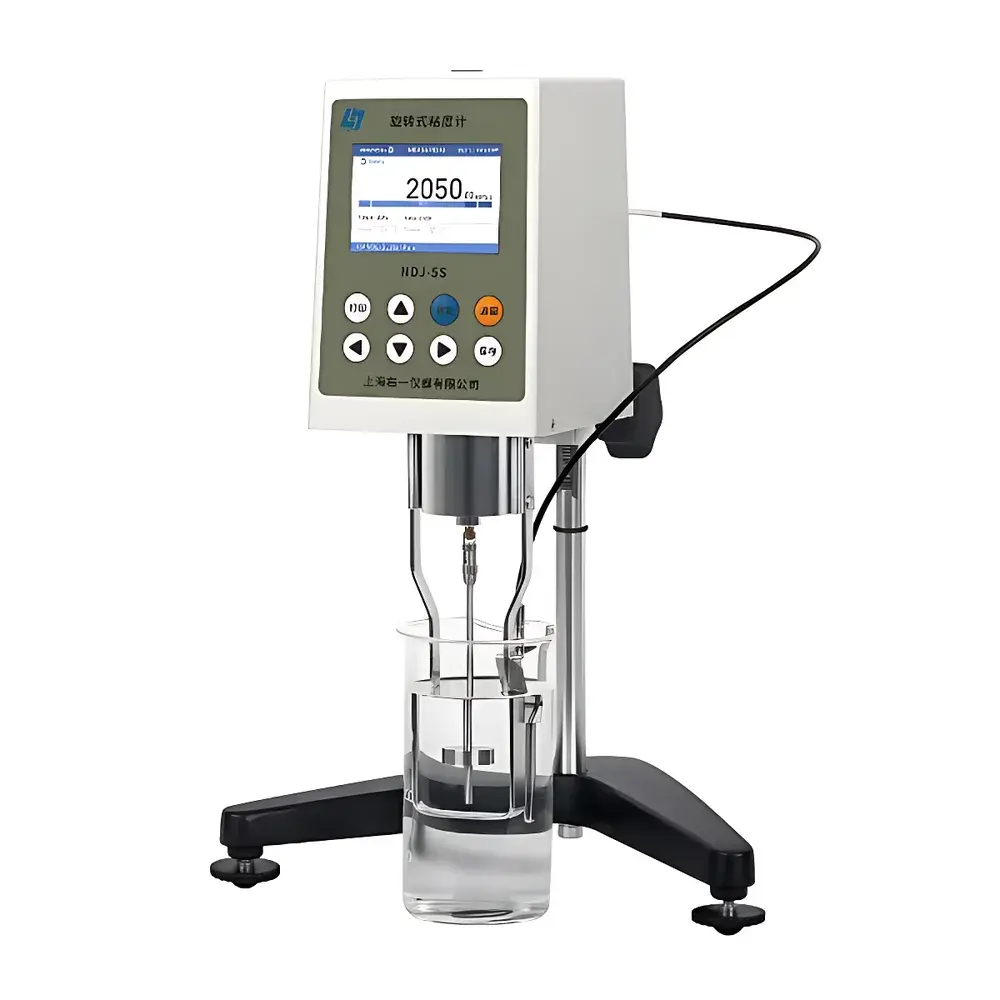
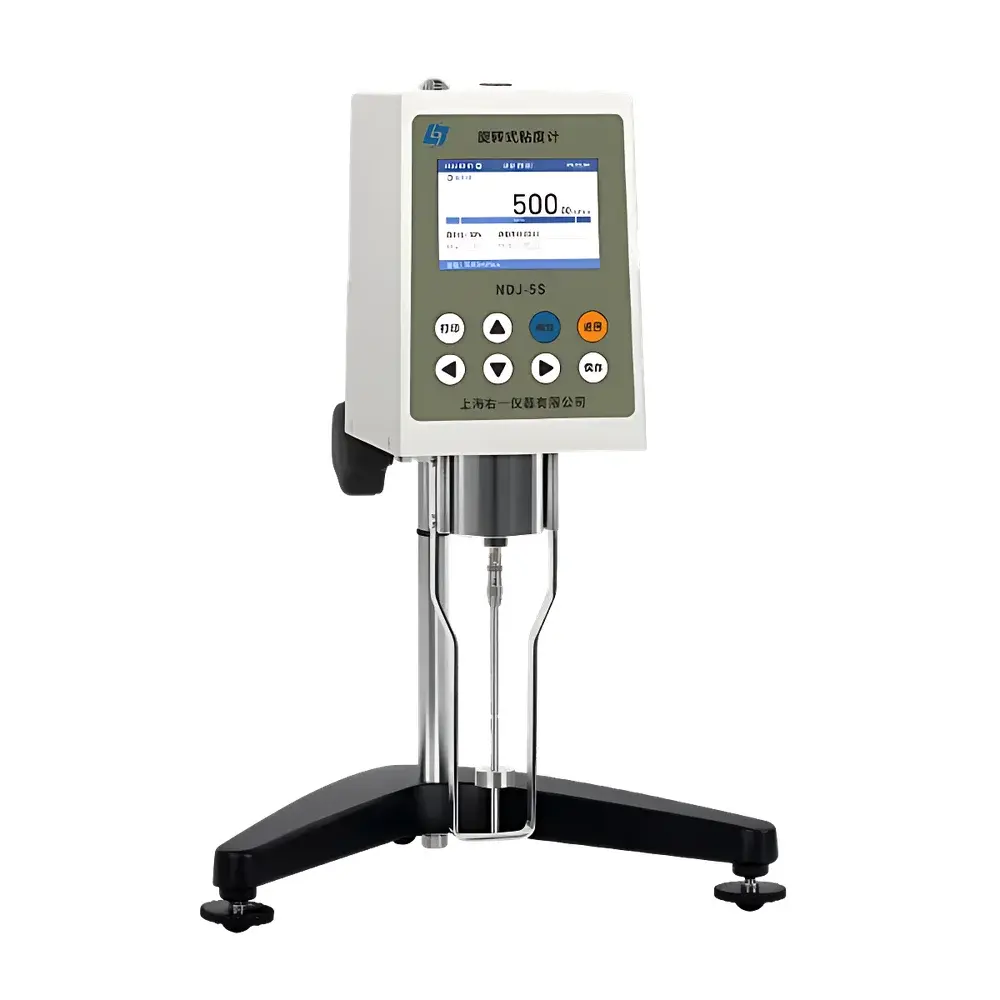
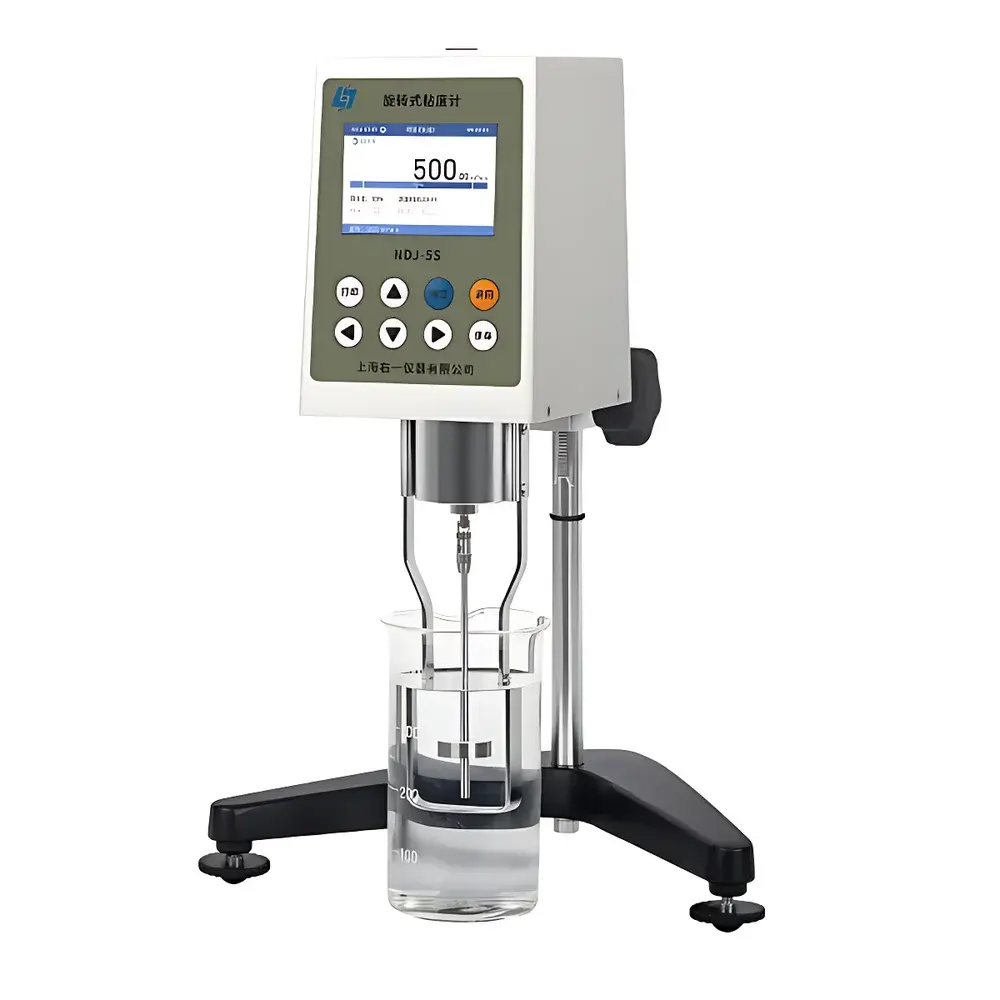
Yoyi NDJ-5S Digital Rotational Viscometer
| Brand | Yoyi |
|---|---|
| Origin | Shanghai, China |
| Manufacturer Type | Direct Manufacturer |
| Model | NDJ-5S |
| Measurement Range | 10–1×10⁵ mPa·s |
| Speed Settings | 6, 12, 30, 60 rpm |
| Standard Spindles | #1–#4 |
| Display | 3.5-inch IPS color LCD (resolution: 0.01 mPa·s) |
| Accuracy | ±2% (Newtonian fluids) |
| Repeatability | ±1% (Newtonian fluids) |
| Temperature Range | 0–150 °C (with optional temperature probe) |
| Data Storage | 50 measurement records |
| Measurement Modes | Quick (auto-hold), Timed (up to 99 min), Auto-scan (spindle/speed recommendation) |
| Connectivity | USB, RS-232, temperature probe input |
| Power Supply | 100–240 VAC, 50 Hz ±10% |
| Dimensions | 280 × 260 × 290 mm |
| Net Weight | 6.8 kg |
Overview
The Yoyi NDJ-5S Digital Rotational Viscometer is a precision-engineered instrument designed for routine and quality control viscosity measurements of Newtonian and mildly non-Newtonian fluids in laboratory and production environments. It operates on the principle of rotational viscometry—measuring the torque required to rotate a defined spindle (e.g., LV #1–#4) at a controlled angular velocity within a sample. The resulting torque is directly proportional to the fluid’s dynamic viscosity under steady-state shear conditions, following the fundamental Couette flow model. This method conforms to standardized test protocols including ASTM D2196, ISO 2555, and GB/T 2794—making the NDJ-5S suitable for regulatory-compliant testing in industries subject to GLP or internal QC documentation requirements.
Key Features
- High-resolution 3.5-inch IPS color LCD display with intuitive menu navigation—simultaneously shows viscosity (mPa·s), spindle number, rotational speed (rpm), torque (%), sample temperature (°C), and maximum measurable viscosity for the selected spindle/speed combination.
- Microprocessor-based control system ensures stable speed regulation and precise torque acquisition, delivering ±2% accuracy and ±1% repeatability for Newtonian reference fluids.
- Four fixed-speed settings (6, 12, 30, 60 rpm) paired with four standard spindles (#1–#4) yield 16 distinct measurement configurations—covering a dynamic viscosity range from 10 to 1×10⁵ mPa·s.
- Three operational modes: Quick Mode (automatically holds result upon stability detection), Timed Mode (user-defined duration up to 99 minutes), and Auto-scan Mode (recommends optimal spindle and speed based on preliminary torque feedback).
- Integrated leveling system with adjustable feet and bubble level ensures consistent immersion depth and axial alignment—critical for minimizing eccentricity-induced measurement drift.
- Dual communication interfaces (USB and RS-232) support direct data export to PCs or printers, logging timestamp, spindle ID, speed, viscosity, temperature, torque %, and measurement duration for traceable recordkeeping.
Sample Compatibility & Compliance
The NDJ-5S is optimized for homogeneous, low-to-medium viscosity liquids—including aqueous polymer solutions, solvent-based adhesives, food emulsions, pharmaceutical suspensions, coatings, and industrial lubricants. Optional temperature probe integration enables real-time thermal monitoring across 0–150 °C, supporting ASTM D1092 and ISO 7305 viscosity-temperature profiling. While not certified for FDA 21 CFR Part 11 compliance out-of-the-box, its audit-ready data output format (CSV-compatible), timestamped records, and non-volatile memory storage align with foundational GMP/GLP documentation expectations. All mechanical components comply with IEC 61010-1 safety standards for laboratory electrical equipment.
Software & Data Management
No proprietary software installation is required: raw measurement data exports as plain-text or CSV via USB mass-storage emulation or serial ASCII stream over RS-232. Each saved record includes date/time stamp, spindle identifier, rotational speed, measured viscosity, temperature (if probe connected), torque percentage, and stability status. Fifty measurements are retained in non-volatile memory with overwrite protection. Users may manually convert dynamic viscosity (mPa·s) to kinematic viscosity (mm²/s) using known sample density—a function accessible via on-device menu. Exported logs are compatible with LIMS platforms, Excel-based trending analysis, and internal QA reporting templates.
Applications
- Quality assurance of batch-consistency in adhesive formulations (e.g., PVA, acrylic emulsions) and ink rheology screening prior to gravure or flexographic printing.
- Routine QC of oral liquid pharmaceuticals (syrups, suspensions) per USP guidance on viscosity as a critical quality attribute.
- Process validation of food products—such as salad dressings, sauces, and dairy beverages—where viscosity correlates with mouthfeel, pumpability, and shelf-life stability.
- Research-level characterization of water-based nanofluids and polymer nanocomposites during formulation development.
- Educational use in university physical chemistry and materials science labs for teaching fundamental rheological concepts and Newtonian behavior verification.
FAQ
Is the NDJ-5S compatible with non-Newtonian fluid characterization?
It provides single-point viscosity values under defined shear rates; for full flow curve analysis (e.g., shear-thinning index, yield stress), a programmable rheometer with variable shear rate control is recommended.
Can the NDJ-5S be calibrated in-house?
Yes—users may perform two-point calibration using traceable standard oils (e.g., Cannon N-series) following the built-in calibration routine; certificate of calibration is not supplied but can be generated internally.
What is the minimum sample volume required for accurate measurement?
With standard spindles and a 600-mL sample container, full immersion depth (typically ≥3 cm above spindle base) requires ≥20 mL for #1 spindle and ≥40 mL for #4 spindle.
Does the instrument support automatic temperature compensation?
No—it displays real-time temperature when an optional PT100 probe is connected, but viscosity correction must be applied externally using published temperature-viscosity coefficients for the material.
Is firmware upgrade capability available?
Firmware updates are distributed by Yoyi upon request via USB drive; no over-the-air or network-based update functionality is implemented.



