
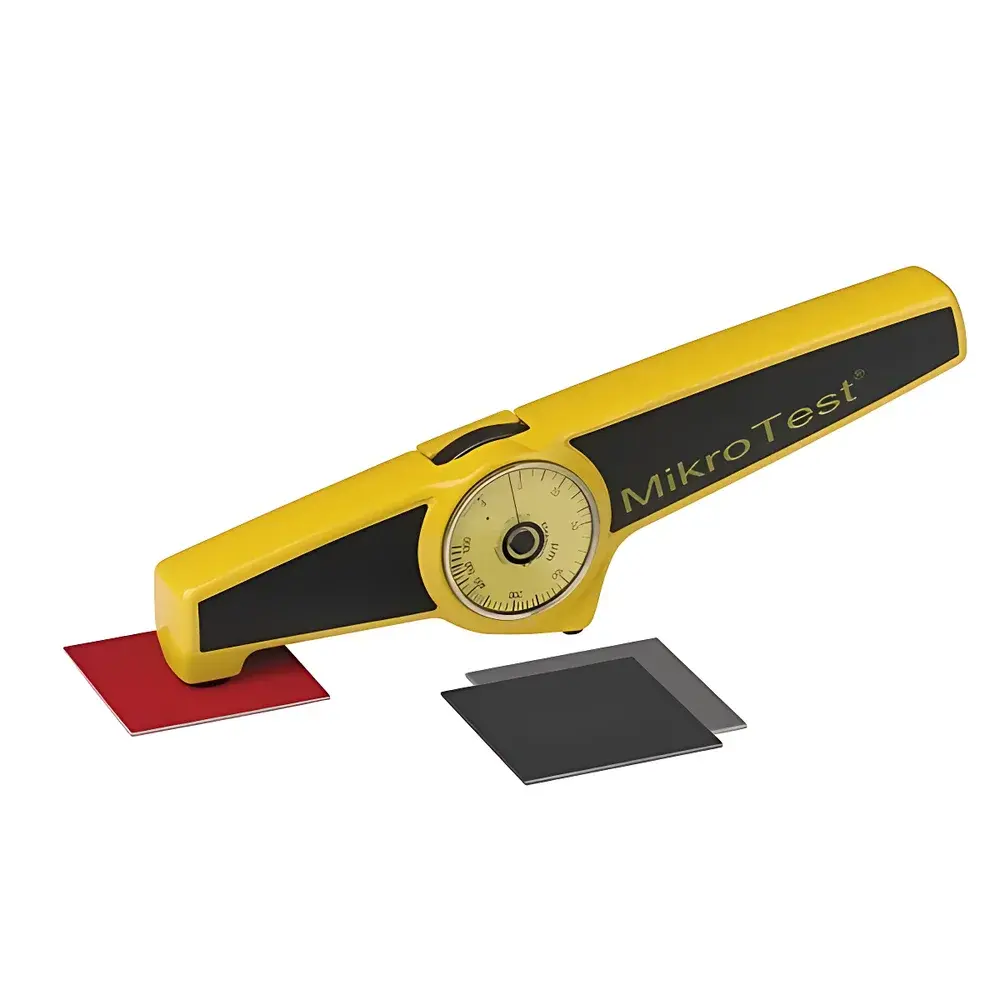
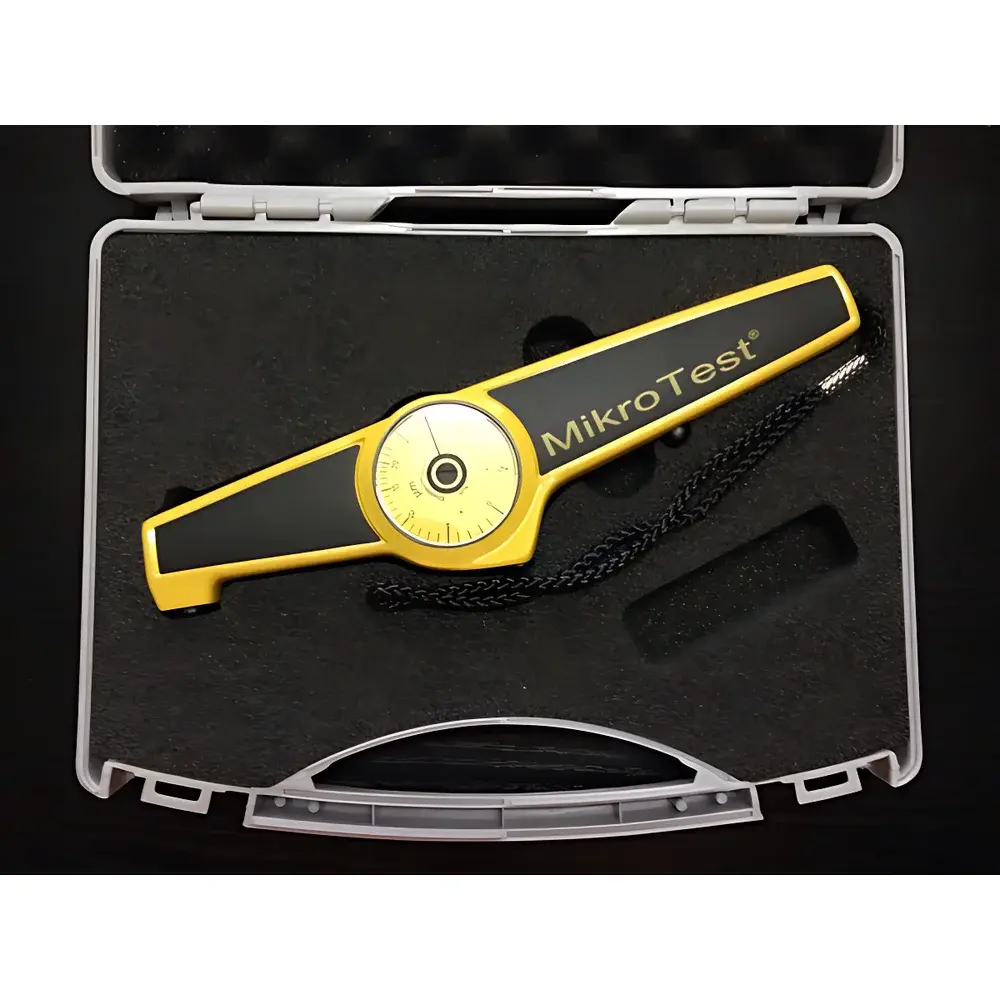
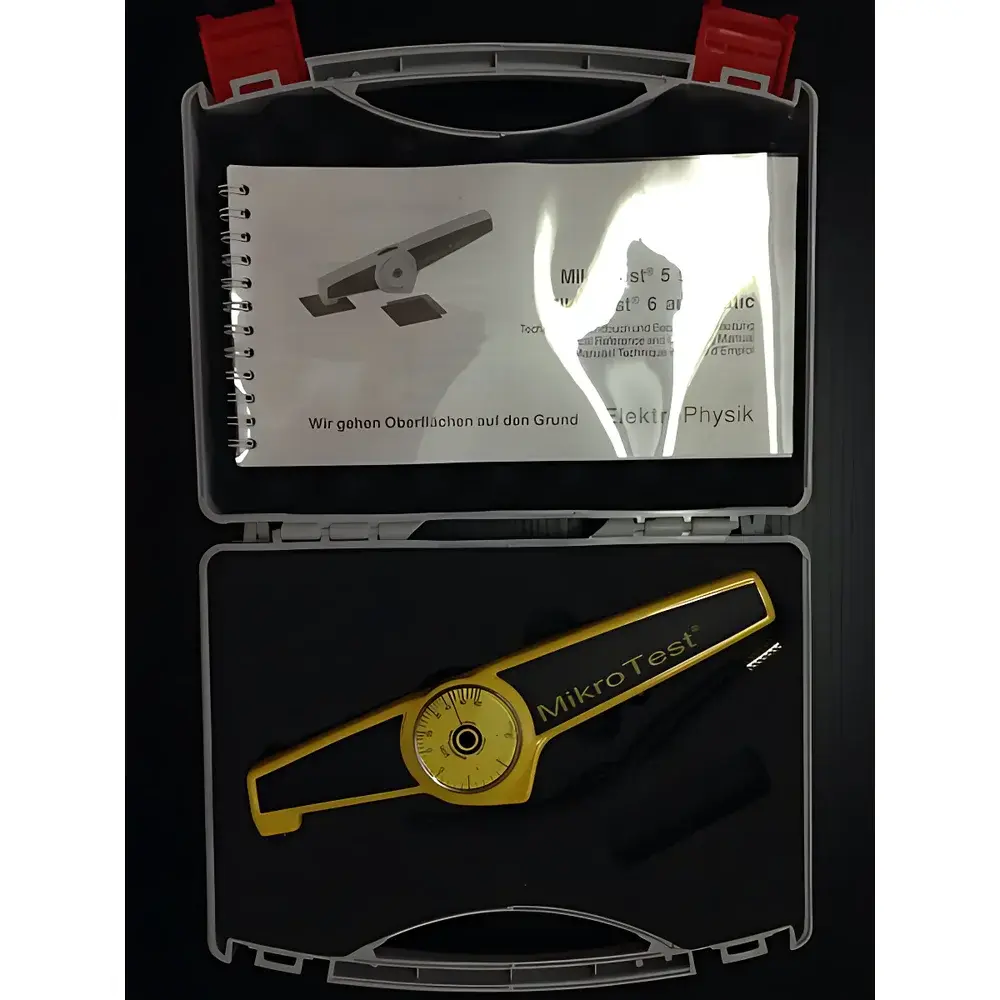
EPK MIKROTEST G6 Electromagnetic Coating Thickness Gauge for Ferrous Substrates (0–100 µm)
| Brand | EPK |
|---|---|
| Country of Origin | Germany |
| Model | G6 |
| Measurement Range | 0–100 µm |
| Accuracy | ±1 µm or ±5% of reading |
| Minimum Measuring Area Diameter | 20 mm |
| Minimum Curvature Radius (Convex/Concave) | 5 mm |
| Minimum Substrate Thickness | 0.5 mm |
| Probe Type | Permanent Magnet-Based Magnetic Induction |
| Power Source | None (Mechanical Spring-Actuated) |
| Compliance | DIN 50981, ISO 2178, ASTM B499 |
| Application | Non-destructive measurement of non-magnetic coatings on ferrous metals |
Overview
The EPK MIKROTEST G6 is a precision-engineered, purely mechanical electromagnetic coating thickness gauge designed specifically for rapid, repeatable, and non-destructive measurement of non-magnetic coatings on ferrous substrates—including steel and iron. Unlike electronic gauges requiring batteries, firmware, or calibration routines, the G6 operates on a proven magnetic induction principle: a permanent magnet probe interacts with the magnetic permeability gradient at the interface between the ferrous base material and the non-magnetic coating layer. The resulting deflection—mechanically amplified via a calibrated spring-lever system—is directly translated into a linear analog thickness reading on a high-contrast, parallax-free scale. This passive architecture ensures long-term stability, zero drift over time, and immunity to electromagnetic interference, temperature fluctuations, or battery degradation. With over three decades of field validation across automotive OEMs, metal finishing facilities, and quality control laboratories, the MIKROTEST series remains a benchmark for reliability in environments where operational simplicity and regulatory traceability are paramount.
Key Features
- Fully mechanical operation—no batteries, electronics, or software required
- Instantaneous, single-point measurement with visual analog readout (0–100 µm range)
- High-resolution scale with ±1 µm absolute accuracy or ±5% relative accuracy, whichever is greater
- Rugged stainless-steel housing with IP54-rated ingress protection for shop-floor durability
- Integrated gravity-compensated balance mechanism enabling accurate measurements at any orientation—including vertical surfaces, overhead positions, and interior pipe walls
- Probe tip engineered for consistent contact pressure and minimal substrate deformation—even on soft coatings such as rubber or plastic
- Minimal substrate requirements: only 0.5 mm base metal thickness needed for valid readings
- Validated curvature tolerance: functional on convex or concave surfaces with radius ≥5 mm
Sample Compatibility & Compliance
The G6 is optimized for non-magnetic layers on ferromagnetic substrates. Compatible coating types include electrogalvanized zinc, electrodeposited nickel, enamel, powder coatings, paint, lacquer, plastic films, rubber linings, and tin plating. It is not suitable for non-ferrous substrates (e.g., aluminum, copper, stainless steel 304/316) or magnetic coatings (e.g., magnetic paints). All MIKROTEST instruments comply with internationally recognized standards for magnetic coating thickness measurement: DIN 50981 (German standard for magnetic induction methods), ISO 2178 (non-magnetic coatings on magnetic substrates), and ASTM B499 (standard test method for measurement of coating thicknesses by magnetic method). These standards govern instrument design, verification procedures, and reporting requirements—ensuring data integrity for internal audits and third-party certification under ISO 9001, IATF 16949, or AS9100 frameworks.
Software & Data Management
The MIKROTEST G6 does not incorporate digital components and therefore has no embedded software, firmware, or data storage capability. Its analog nature eliminates concerns related to cybersecurity, software validation, or electronic record retention. For regulated environments operating under FDA 21 CFR Part 11 or EU Annex 11, this absence of electronic systems simplifies compliance: no audit trail, electronic signature, or system validation is required. Users maintain full control over documentation—measurements are recorded manually or transcribed into LIMS or Excel-based QC logs. Optional traceable calibration standards (e.g., certified foil sets per ISO 19840) can be used to verify instrument performance prior to critical batches, supporting GLP/GMP-aligned measurement uncertainty assessments.
Applications
The G6 is routinely deployed in electroplating lines for real-time monitoring of zinc and nickel deposit uniformity; in coil coating plants for verifying primer and topcoat thickness on cold-rolled steel; in automotive body shops for assessing e-coat integrity before baking; and in infrastructure maintenance for evaluating protective polymer coatings on structural steel bridges and pipelines. Its portability and lack of power dependency make it ideal for field inspections—especially where explosion-proof or intrinsically safe equipment is mandated. Because it requires no warm-up time or user training beyond basic handling, it supports high-throughput sampling in incoming inspection, in-process checks, and final release testing without introducing measurement variability from operator technique or device configuration.
FAQ
Does the G6 require periodic recalibration?
No. The G6 contains no adjustable electronics or firmware. Its calibration is factory-set and mechanically fixed. Users should verify performance using certified reference standards before critical measurement campaigns.
Can the G6 measure coatings on stainless steel?
No. Standard austenitic stainless steels (e.g., 304, 316) are non-magnetic and incompatible with magnetic induction principles. Use eddy current instruments (e.g., EPK MIKROTEST F6) for non-ferrous substrates.
What is the smallest coated area the G6 can measure?
The minimum measurable area diameter is 20 mm. Smaller areas risk edge effects and inaccurate readings due to magnetic field dispersion.
Is the G6 suitable for curved surfaces like pipes or cylinders?
Yes—provided the surface curvature radius is ≥5 mm (convex or concave). The integrated balance mechanism compensates for gravitational torque variations.
How is measurement uncertainty determined for the G6?
Per ISO 2178, uncertainty arises from probe alignment, surface roughness, substrate homogeneity, and operator parallax. Certified reference standards enable uncertainty quantification per GUM (Guide to the Expression of Uncertainty in Measurement).



