
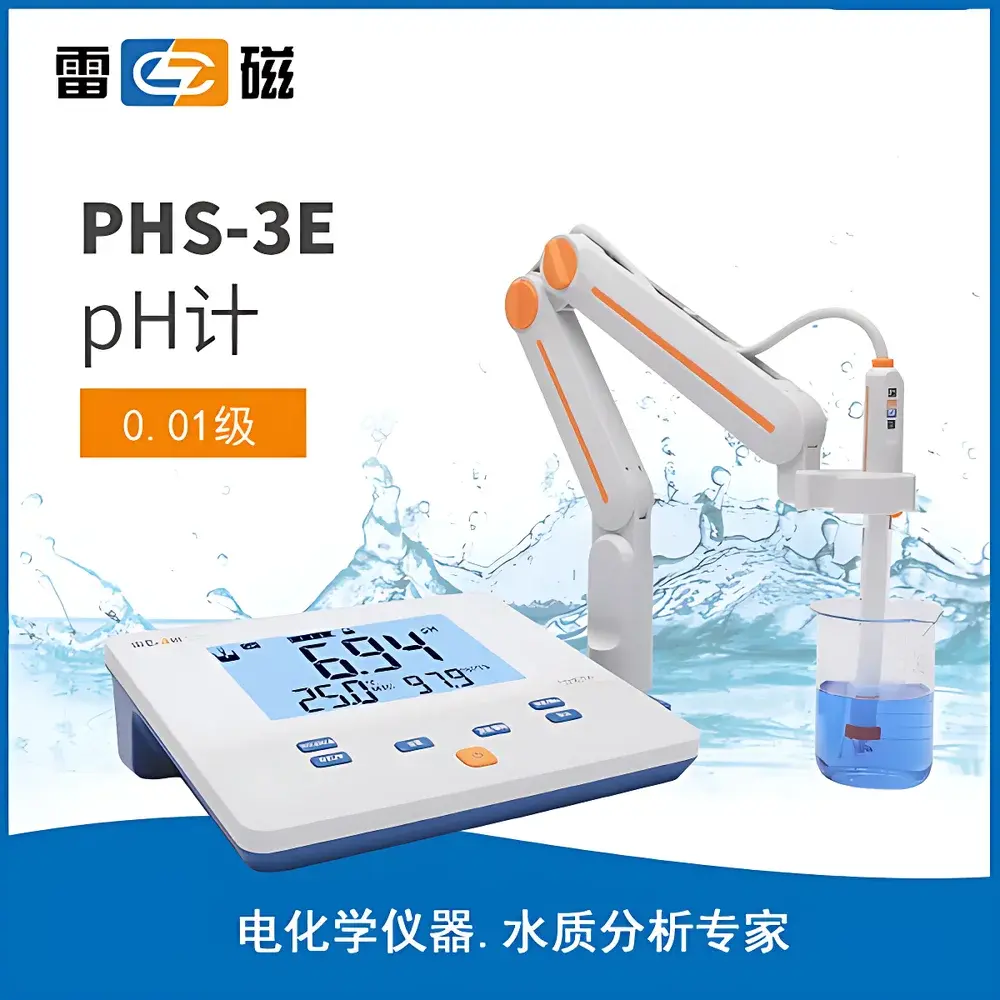
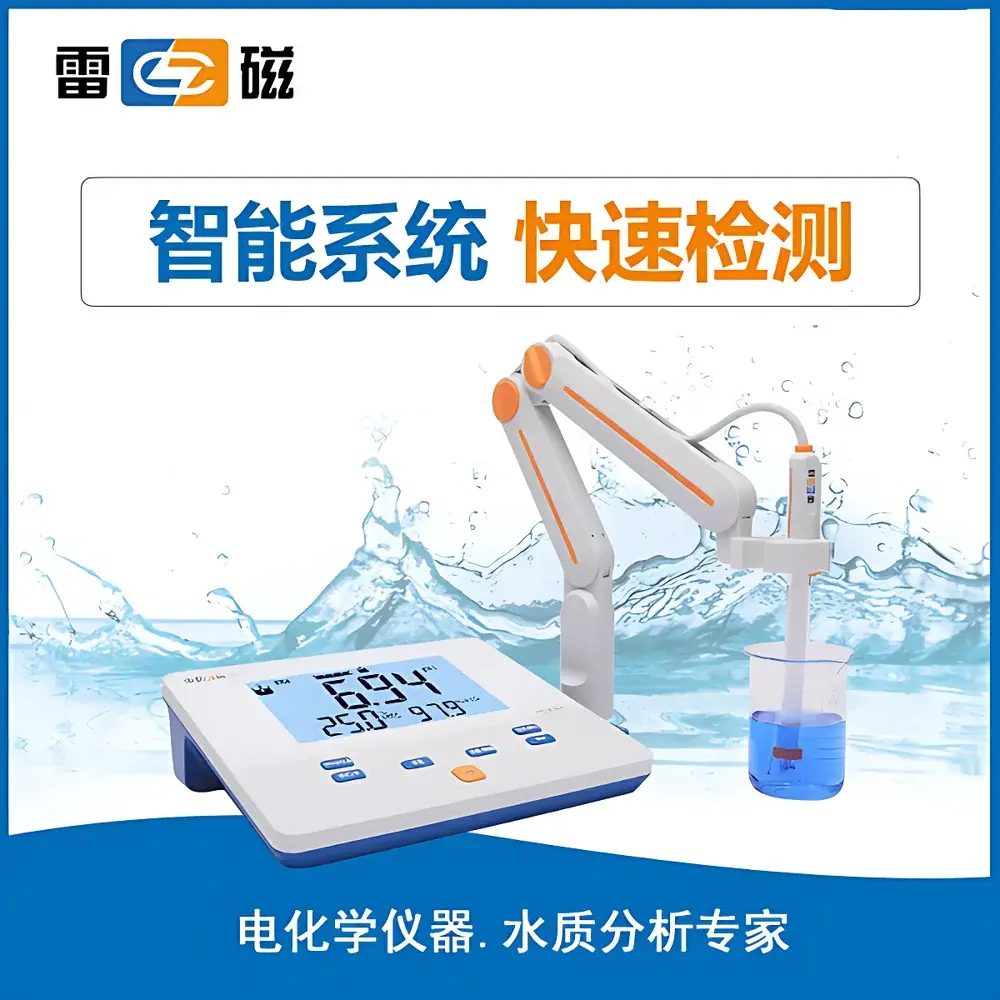
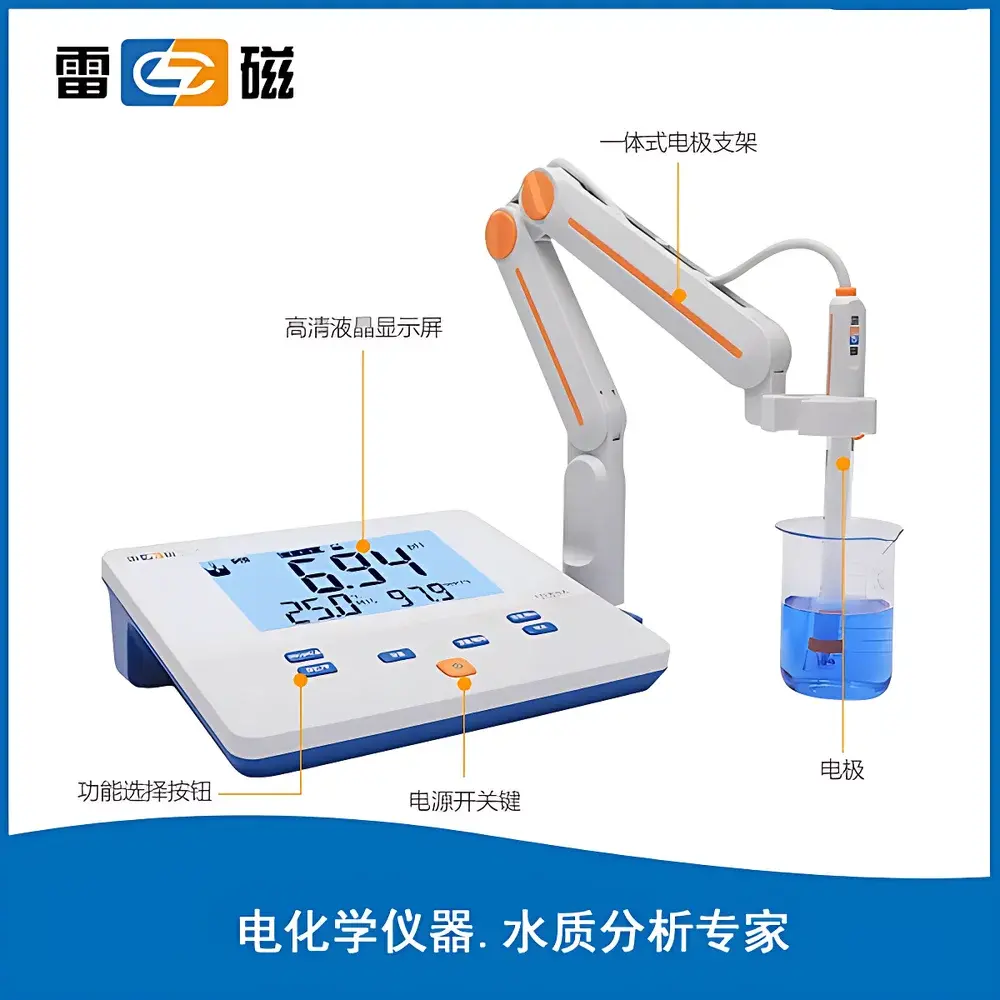
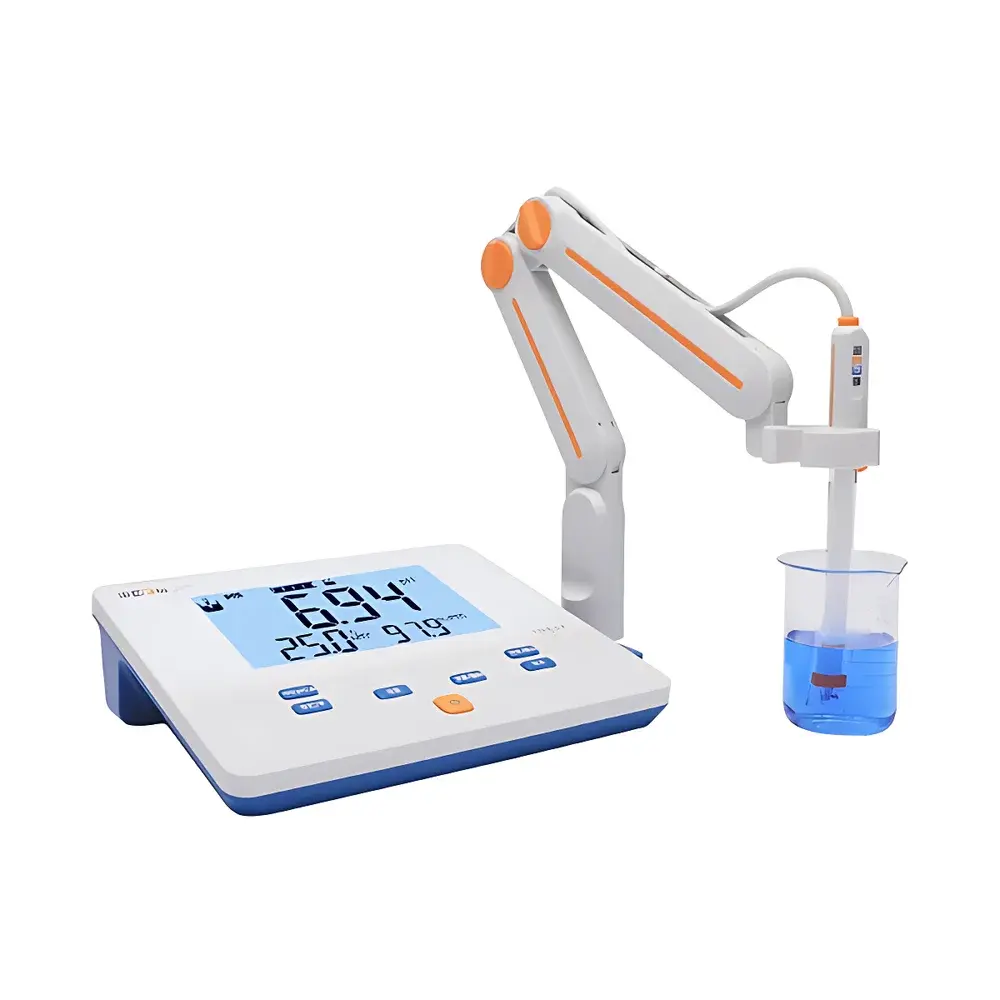
Leici PHS-3E Benchtop pH/mV/Temperature Meter
| Brand | Leici |
|---|---|
| Origin | Shanghai, China |
| Model | PHS-3E |
| Instrument Type | Benchtop |
| Measurement Parameters | pH, mV (ORP), Temperature |
| pH Accuracy | ±0.01 pH ± 1 digit |
| pH Range | 0.00–14.00 pH |
| pH Resolution | 0.01 pH |
| mV Range | −1999–+1999 mV |
| mV Resolution | 1 mV |
| Temperature Range | 0.0–99.9 °C |
| Temperature Resolution | 0.1 °C |
| Temperature Accuracy | ±0.3 °C |
| Stability | ≤ 0.01 pH ± 1 digit / 3 h |
| Calibration Buffers | pH 4.00, 6.86, and 9.18 |
| Calibration Method | Two-point automatic buffer recognition |
| Temperature Compensation | Automatic or manual (0.0–99.9 °C) |
| Display | Backlit LCD with dual-parameter simultaneous readout |
| Power Supply | AC 220 V ± 10 %, 50 Hz ± 1 Hz |
| Dimensions (W×D×H) | 290 × 210 × 95 mm |
| Weight | 1.5 kg |
Overview
The Leici PHS-3E is a benchtop electrochemical meter engineered for precision measurement of pH, oxidation-reduction potential (mV/ORP), and temperature in aqueous solutions. Designed in accordance with IEC 60746-1 (Electrochemical analyzers — Part 1: General requirements) and aligned with common laboratory quality frameworks—including ISO/IEC 17025 traceability practices—the instrument employs high-impedance input circuitry (≥1×10¹² Ω) to minimize electrode loading effects and ensure stable, reproducible readings across diverse sample matrices. Its core measurement principle relies on the Nernst equation, where the potential difference between a glass pH electrode and a reference electrode is converted into a calibrated pH value using standardized buffer solutions. The PHS-3E operates at 0.01-class accuracy—meeting the performance criteria defined in GB/T 11165–2005 (Chinese national standard for laboratory pH meters) and comparable to ASTM E70-22 specifications for pH measurement in general-purpose aqueous systems.
Key Features
- Benchtop form factor with compact footprint (290 × 210 × 95 mm) and lightweight design (1.5 kg), optimized for shared lab environments and limited bench space;
- Backlit monochrome LCD display supporting simultaneous real-time readouts of pH, mV, and temperature—enabling rapid cross-parameter verification during calibration or sample analysis;
- Automatic recognition of three standard IUPAC-traceable calibration buffers (pH 4.00, 6.86, and 9.18 at 25 °C), reducing operator error during two-point calibration;
- Dual-mode temperature compensation: selectable automatic (via integrated Pt1000 sensor) or manual entry (0.0–99.9 °C), ensuring accurate pH correction across non-ambient conditions without requiring external thermometers;
- Stable DC amplifier architecture with drift ≤ 0.01 pH ± 1 digit over 3 hours—validated under continuous operation per GB/T 11165 stability protocols;
- Compliance-ready functionality: supports GLP-style calibration logging (date/time-stamped buffer IDs and slope/mV offset values), facilitating internal audit trails and method documentation.
Sample Compatibility & Compliance
The PHS-3E is validated for use with standard combination glass electrodes (e.g., Leici E-201-C or equivalent BNC-compatible sensors) and exhibits robust performance in low-ionic-strength samples (e.g., deionized water), buffered solutions, and mildly contaminated industrial effluents. It is not intended for non-aqueous, high-viscosity, or strongly oxidizing media (e.g., concentrated HNO3 or organic solvents), where specialized electrodes and extended calibration protocols are required. While the instrument itself does not carry CE, UKCA, or FDA 510(k) certification, its electrical safety conforms to GB 4793.1–2019 (equivalent to IEC 61010-1:2010). For regulated environments—such as QC labs operating under GMP or ISO 17025—the device supports calibration traceability to national metrology institutes via documented buffer certificates and routine verification using certified reference materials (e.g., NIST SRM 186, pH 4.005 at 25 °C).
Software & Data Management
The PHS-3E operates as a standalone instrument with no embedded data storage or USB/Bluetooth connectivity. All calibration and measurement records must be manually transcribed or captured via external lab notebooks or LIMS interfaces. However, its consistent output format—displaying slope (%), asymmetry potential (mV), and temperature-corrected pH—enables seamless integration into paper-based or electronic batch record systems compliant with 21 CFR Part 11 when paired with controlled documentation workflows. Users performing method validation per USP or EP 2.2.3 should verify electrode response time (<30 s for 95% stabilization) and repeatability (RSD ≤ 0.3% for triplicate pH 7.00 measurements) prior to routine use.
Applications
- Academic teaching laboratories: Demonstrating acid-base equilibria, titration endpoints, and buffer capacity principles;
- Environmental testing: Monitoring pH in surface water, wastewater influent/effluent, and soil leachates per EPA Method 150.1;
- Pharmaceutical QC: Verifying pH of aqueous drug formulations, cleaning validation rinse waters, and dissolution media (USP );
- Food & beverage R&D: Controlling fermentation pH in dairy, brewing, and juice processing;
- Industrial process support: Routine checks of boiler feedwater, cooling tower make-up, and plating bath chemistry.
FAQ
What calibration buffers are supported by the PHS-3E?
The instrument automatically identifies and applies calibration coefficients for pH 4.00, 6.86, and 9.18 standard buffers at 25 °C. Custom buffer values cannot be programmed.
Does the PHS-3E meet ISO/IEC 17025 requirements for accredited testing?
While the meter itself is not accredited, it can be used within an ISO/IEC 17025-compliant system when operated with documented procedures, traceable calibration buffers, and periodic verification against reference standards.
Can the PHS-3E measure ORP in non-aqueous solvents?
No. The instrument is designed exclusively for aqueous-phase measurements. ORP readings in ethanol, acetone, or glycerol-based systems require solvent-specific electrodes and alternative instrumentation.
Is temperature compensation mandatory during pH measurement?
Temperature compensation is optional but strongly recommended; uncorrected measurements deviate by approximately 0.03 pH units per °C from 25 °C for typical buffer systems.
What is the expected service life of the built-in temperature sensor?
The Pt1000 RTD sensor is rated for ≥5 years of continuous use under standard laboratory conditions (20–25 °C, 40–60% RH), with recalibration recommended annually or after physical impact.




